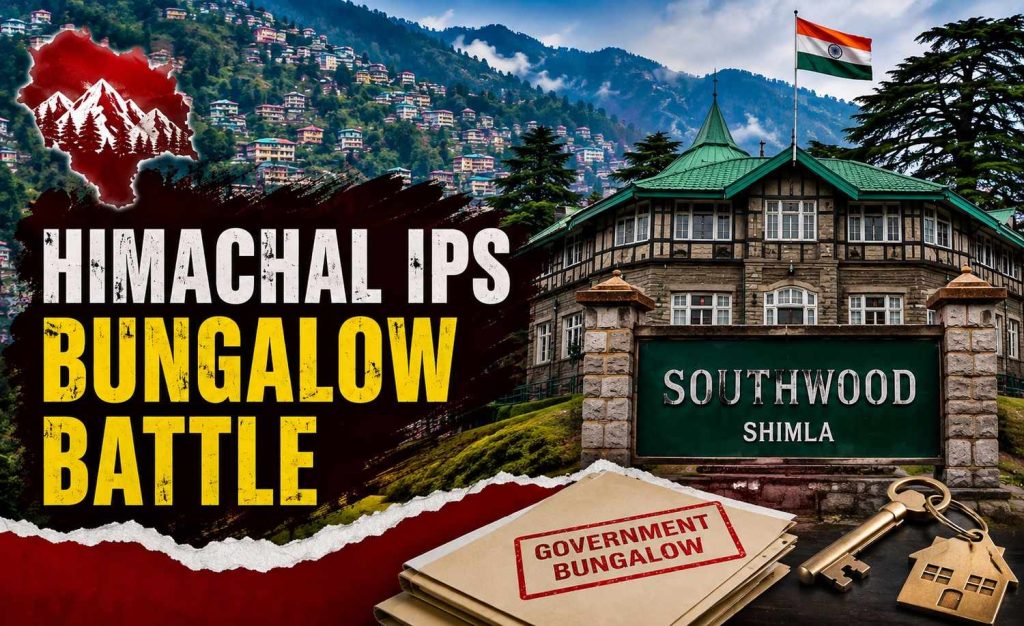
Shimla: The Himachal Pradesh bureaucracy is once again in the spotlight, this time over a government bungalow in Shimla. A dispute involving senior Indian Police Service (IPS) officers has brought questions about administrative discipline, official accommodation and the growing friction within the state’s police establishment.
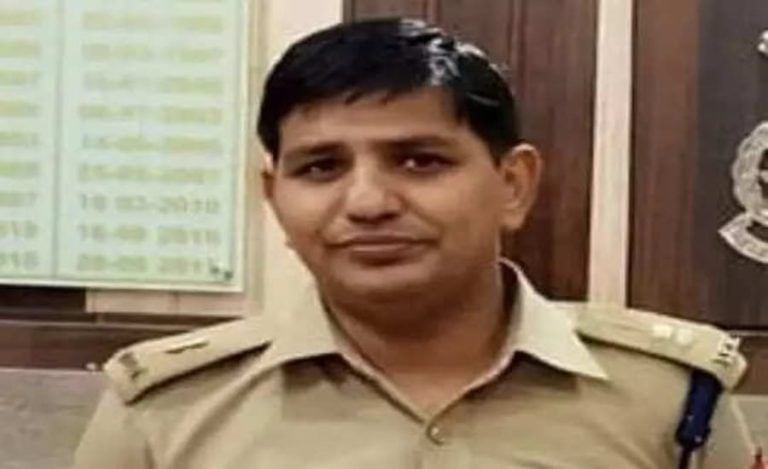
At the centre of the latest controversy is Southwood, the sprawling official residence designated for the Shimla Superintendent of Police. The bungalow, situated in one of Shimla’s prominent areas that also houses the Governor and several political figures, has become the focal point of an increasingly contentious episode involving acting DGP Ashok Tewari (IPS: 1993: HP) and DIG Sanjeev Gandhi (IPS: 2012: HP).
The issue arose after Gandhi, who previously served as Shimla SP, continued to occupy the residence even after his transfer from the post. His successor, Gaurav Singh (IPS: 2013: HP), took charge as Shimla SP in January but has reportedly been staying at Police Headquarters instead of the designated official residence.
Southwood Bungalow at the Centre of the Dispute
Mr Gandhi was transferred out of the Shimla SP’s post around six months ago. However, according to reports, he continued to occupy Southwood despite directions from the Police Headquarters to vacate the premises.
Gandhi reportedly explained that the government accommodation allotted to him elsewhere was already occupied by the superintendent of a medical college. Subsequently, another government house was allotted to him, but he reportedly declined it, citing its poor and allegedly “dilapidated” condition.
The continued occupation of Southwood created an unusual situation: the serving Shimla SP was reportedly unable to use the official residence meant for the post.
The matter subsequently escalated within the police hierarchy, with acting DGP Tewari taking steps to have the bungalow vacated.
Special Audit Adds Another Dimension
The accommodation dispute took a more serious turn when DGP Tewari constituted a committee to conduct a special audit of expenditure incurred on repairs and maintenance at Southwood during the period when Gandhi served as Shimla SP.
The decision has added an administrative and financial dimension to what initially appeared to be a dispute over government accommodation.
The move has reportedly intensified differences between the two senior IPS officers. What began as a question of vacating an official residence has consequently developed into a wider controversy involving the use and maintenance of government property.
However, the allegations and claims surrounding the dispute need to be viewed in the context of the ongoing administrative process, and the reported audit itself does not establish any wrongdoing.
Why Gaurav Singh Is Staying at Police Headquarters
The immediate impact of the dispute has been on the officer currently responsible for policing Shimla.
Gaurav Singh took charge as Shimla SP in January. Since the official residence continued to be occupied by his predecessor, he has reportedly been staying at the Police Headquarters.
The unusual arrangement has drawn attention because the Southwood bungalow is officially associated with the Shimla SP’s post.
The episode has therefore raised broader questions about how quickly government accommodation should be handed over following transfers and whether disputes involving official residences should be allowed to affect the functioning of serving officers.
Not the First Public Dispute Involving Sanjeev Gandhi
The latest controversy is not the first time Sanjeev Gandhi has reportedly figured in a public dispute involving senior police leadership in Himachal Pradesh.
Last year, Gandhi was reported to have been involved in a public disagreement with then-DGP Atul Verma (IPS: 1991: HP) concerning a probe involving him. The episode reportedly escalated to the point where both officers were sent on leave.
The latest disagreement with the present police leadership has therefore revived attention around earlier episodes involving senior IPS officers in the state.
Former DGP S.R. Mardi Also Raised Questions
The friction within the state’s police establishment has also involved former DGP S.R. Mardi (IPS: 1986: HP).
In March 2020, Mardi reportedly questioned delays in the handling of the investigation into alleged fake degrees linked to Manav Bharti University. At the time, Ashok Tewari was serving as Additional Director General of Police (CID).
The episode added another layer to the series of disagreements that have periodically emerged among senior police officials in Himachal Pradesh.
Wider Bureaucratic Friction in Himachal
The Southwood controversy comes against the backdrop of other disputes involving the state’s senior bureaucracy.
Earlier this year, the Himachal Pradesh administrative establishment was also caught up in allegations and counter-allegations involving former Chief Secretary Sanjay Gupta (IAS: 1988: HP) and two former colleagues.
Taken together, these episodes have contributed to a perception of increasing friction within sections of the state’s administrative machinery.
While differences between senior officials are not unusual in a large government system, repeated public disputes can raise concerns about institutional coordination, administrative discipline and the ability of the bureaucracy to function cohesively.
Political-Bureaucratic Relations Also Under Strain
The tensions within the bureaucracy have also coincided with increasingly sharp exchanges between the Himachal Pradesh Congress government and sections of the state administration.
Recent remarks by state minister Vikramaditya Singh targeting non-domicile IAS and IPS officers have reignited debate over the relationship between elected representatives and the permanent executive.
Singh has publicly questioned the role and priorities of officers from outside Himachal Pradesh and urged Chief Minister Sukhvinder Singh Sukhu to take firm action. Deputy Chief Minister Mukesh Agnihotri has also spoken about alleged conspiracies within the bureaucracy against the government.
Such statements have added political weight to an already sensitive discussion about administrative accountability and the relationship between ministers and senior civil servants.
Accountability or Institutional Mistrust?
Elected representatives have the legitimate responsibility to question administrative performance and demand accountability from government officials. At the same time, public criticism of senior officers can have consequences for institutional trust if disagreements increasingly become personalised or confrontational.
For the bureaucracy, clear accountability mechanisms are essential. But so are transparent procedures for transfers, postings, official accommodation and disciplinary matters.
The Southwood episode illustrates how what appears to be a relatively routine administrative matter can quickly become a larger institutional controversy when it involves senior officials.
The Larger Question for Himachal Bureaucracy
The latest bungalow dispute is therefore about more than a government residence.
It has brought renewed attention to the relationship between senior police officers, the functioning of the state’s administrative machinery and the increasingly visible friction between the political executive and bureaucracy.
For ordinary citizens, the concern is ultimately straightforward: if senior officials are publicly locked in disputes over accommodation, investigations and administrative decisions, will it affect the delivery of policing and governance on the ground?
The challenge before the Himachal administration will be to ensure that such disputes are resolved through established institutional mechanisms, allowing officers to focus on their primary responsibility – effective governance and public service.