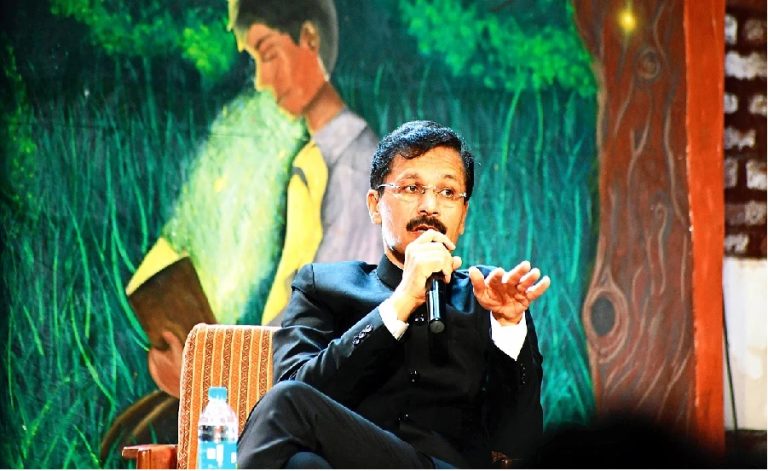
Some police careers can be understood through postings. Deepam Seth’s cannot.
The 1995-batch IPS officer who now heads Uttarakhand Police has moved through remarkably different theatres of policing, from the streets of undivided Uttar Pradesh to the mountains of Uttarakhand, from a United Nations peacekeeping mission in Kosovo to the high-altitude frontier of Ladakh.
Now, as Director General of Police of Uttarakhand, he finds himself responsible for a state where policing rarely means just policing. Pilgrimage crowds, fragile mountain roads, disasters, cybercrime, drugs, border security and massive public gatherings all converge here.
And Seth has spent much of his career preparing for precisely such complexity.
Also read: How IPS Akshay Sachdeva Is Building a Smarter and Stronger Sikkim Police
An Engineer Who Chose The Police
Born in Uttar Pradesh in 1968, Seth studied at Sherwood College, Nainital, before earning a B.E. in Electrical and Electronics Engineering from BITS Pilani. But engineering was not where his professional journey ended.
He joined the Indian Police Service in 1995 and began his career in undivided Uttar Pradesh, serving as Additional Superintendent of Police in Ghaziabad and Gautam Buddha Nagar and later as City Superintendent of Police in Agra.
With the creation of Uttarakhand in 2000, his professional journey became increasingly tied to the state that would eventually place him at its police headquarters.
He served as SSP Nainital and later held senior responsibilities involving the Provincial Armed Constabulary, Crime and Law & Order and the Special Task Force. The mountain state was gradually becoming familiar territory.
From Uttarakhand to Kosovo
Then came a chapter far removed from the Himalayas. Seth served with the United Nations peacekeeping mission in Kosovo as a Project Manager and received a UN Medal for his service.
The assignment exposed him to policing in a post-conflict international environment — a very different test from district policing in India, but one that demanded coordination, organisation and an ability to operate amid competing security concerns.
It would not be his last encounter with complicated security environments.
Into the high-altitude frontier
In 2019, Seth went on central deputation to the Indo-Tibetan Border Police. His career took him deep into the security architecture of the Himalayas, eventually placing him as IG of ITBP’s North-West Frontier at Leh during the tense India-China standoff in eastern Ladakh.
This was not a ceremonial posting.
Under Operation Snow Leopard, ITBP personnel operated in some of the world’s most difficult terrain. Seth was also associated with the high-level military dialogue during the standoff, participating in rounds of commander-level talks connected with the disengagement process.
His service during this period brought several recognitions, including the President’s Police Medal for Distinguished Service and the Union Home Minister’s Special Operation Medal.
By then, his career had acquired a rare range: domestic policing, international peacekeeping and high-altitude border security.
The policeman who went back to the classroom
Perhaps the most revealing part of Seth’s career came not on a frontier, but in an academic institution. He pursued a Master’s in Police Management from Osmania University and later earned a PhD in Management from IIT Roorkee in 2022.
His research focused on strategic planning, communication and team effectiveness in the policing of mega-events. It is an extraordinary coincidence, or perhaps a perfect preparation for the job he now holds.
Because Uttarakhand’s policing calendar is filled with mega-events. Char Dham Yatra. Kanwar Yatra. Kumbh preparations. Massive tourist flows. Disaster response. Traffic management.
The subject he studied has become the reality he must manage.
The DGP who inherited a complicated state
Seth took charge as Uttarakhand’s DGP in November 2024. His priorities have been clear: crime control, drugs, cybercrime, women’s and children’s safety, traffic management, disaster preparedness and stronger emergency response.
But his tenure has also brought a sharper focus on accountability within the police force.
In 2026, following serious crimes in Dehradun and Haridwar, Seth ordered disciplinary action against police personnel accused of negligence and called for detailed inquiries. After the killing of a retired Army brigadier in Dehradun, he launched Operation Prahaar, directing greater police visibility, hotspot monitoring, verification drives and focused action against criminal networks.
The message was straightforward: law and order must be visible on the ground, not merely discussed in conference rooms.
The biggest test may still be ahead
Uttarakhand is preparing for another enormous policing challenge: the 2027 Kumbh.
For Seth, it brings together almost every strand of his career: crowd management, inter-agency coordination, technology, emergency response, strategic planning and communication.
He has also pushed the use of technology and AI in policing while strengthening disaster-response systems — priorities particularly suited to a state where geography itself can become a security challenge.
From Kosovo’s post-conflict landscape to Ladakh’s icy frontier, Seth has spent three decades moving through situations where a police chief has little room for error.
Now the terrain is different. The responsibility is larger.
And the ultimate test of Deepam Seth’s career may be whether the lessons he spent years learning — about people, planning, communication and command — can make Uttarakhand’s police force faster, sharper and more prepared when the next crisis arrives.
For a man who once studied how police teams should handle extraordinary events, the most extraordinary assignment may be the one he has today: policing an entire Himalayan state where every season brings a new challenge
Also read: G.S. Rao: The IPS Officer Who Helped Shape Future Cops And Now Leads Tripura Police