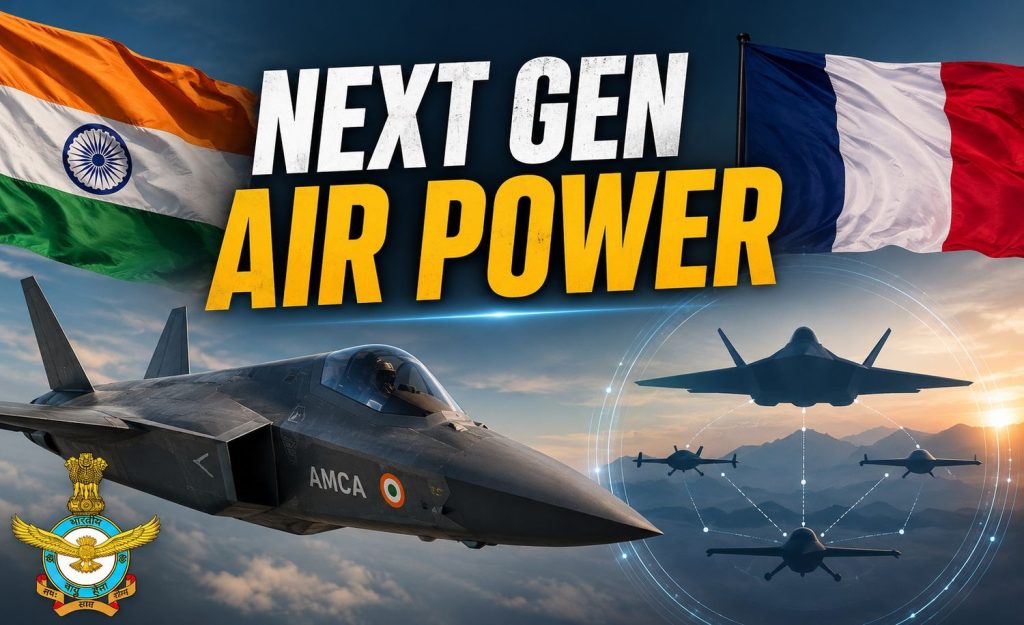
New Delhi: India has begun concrete efforts to participate in an international sixth-generation fighter jet programme, with the Ministry of Defence exploring participation in the French-led Future Combat Air System (FCAS) while also evaluating the Global Combat Air Programme (GCAP) being developed jointly by the UK, Italy and Japan.
The move signals India’s attempt to ensure that the Indian Air Force does not fall behind in the next generation of combat aviation technology. While India is developing its indigenous Advanced Medium Combat Aircraft (AMCA)as a fifth-generation stealth fighter, the government is simultaneously looking at international partnerships to build capabilities required for the sixth-generation era.
The development was disclosed to the Parliamentary Standing Committee on Defence, which has asked the Ministry of Defence to prepare a clear roadmap and timeline for the development and acquisition of sixth-generation aircraft.
The committee has emphasised that future air warfare will increasingly depend on advanced networked platforms, artificial intelligence, unmanned systems, stealth, electronic warfare and real-time data sharing.
India Explores Two Global Sixth-Generation Fighter Programmes
According to the information presented before the parliamentary committee, two major international groupings are currently pursuing sixth-generation combat aircraft programmes.
The first is FCAS, led by France and involving Germany and Spain. The second is GCAP, a joint programme involving the United Kingdom, Italy and Japan.
The Ministry of Defence has indicated that India will explore participation in one of these international programmes so that the Indian Air Force can acquire access to technologies and capabilities that may otherwise take considerably longer to develop domestically.
Read Also: How HAL’s Indigenous Satellite-Guided Landing System Will Transform Helicopter Operations in India
The committee has specifically advised the Ministry to formulate a comprehensive plan for the development and acquisition of sixth-generation aircraft.
The move is significant because it represents the first formal acknowledgement by the Government of India that it is exploring participation in a sixth-generation fighter development programme.
Why India Is Looking at Sixth-Generation Fighters
India’s decision comes against the backdrop of rapid advances in military aviation technology.
The Indian Air Force has a sanctioned strength of 42 fighter squadrons, but its operational strength is currently around 29 squadrons. At the same time, several older fighter aircraft are progressively approaching retirement.
China, meanwhile, is rapidly advancing its next-generation combat aviation programmes, increasing the pressure on India to prepare for the air-power requirements of the 2040s.
India has already fallen behind several major powers in the fifth-generation fighter race. The indigenous AMCA is intended to address that gap, but sixth-generation systems are expected to require a substantially more sophisticated technological ecosystem.
The Ministry therefore appears to be pursuing a two-track approach: develop AMCA domestically while simultaneously exploring international cooperation for sixth-generation capabilities.
What Is the FCAS Programme?
The Future Combat Air System (FCAS) is not simply a next-generation fighter aircraft project.
The programme was launched in 2017 as a major European effort involving France and Germany, with Spain joining later.
Its objective is to create an entire combat-air ecosystem consisting of a next-generation fighter, unmanned Remote Carrier systems and a sophisticated digital network known as the Combat Cloud.
The concept is built around connecting manned aircraft, drones, naval platforms, ground systems and other sensors so that information can be shared rapidly across the battlefield.
In practical terms, the fighter would operate as part of a wider network rather than as an isolated combat aircraft.
This architecture is expected to allow manned fighters to control or coordinate unmanned systems, process information from multiple sensors and make faster decisions in highly contested airspace.
FCAS Faced France-Germany Differences
The FCAS programme has faced significant disagreements between its principal industrial participants, particularly Dassault Aviation of France and Airbus of Germany.
The disagreements have reportedly involved issues including:
- Work-sharing between the participating countries and companies
- Leadership of the fighter aircraft component
- Intellectual property rights
- Control over critical technologies
- Different operational requirements of France and Germany
France has sought to preserve strategic autonomy and maintain control over key technologies, while Germany has pushed for greater participation and access to intellectual property and core technologies.
There have also been differences in the operational requirements of the two countries.
France has specific requirements linked to its aircraft-carrier operations and nuclear deterrence role, while Germany’s requirements are different.
These disagreements had raised serious doubts over the future structure and pace of the programme, with Germany at one stage signalling that it could pursue alternative options.
However, subsequent political discussions between French President Emmanuel Macron and German Chancellor Friedrich Merz resulted in efforts to mediate between the companies involved.
The future of the programme therefore remains closely linked to how France and Germany resolve their industrial and technological differences.
Why the FCAS Situation Could Open a Door for India
The uncertainty surrounding the programme has potentially created an opening for additional partners.
India already has a deep strategic and defence relationship with France, making Paris an attractive partner for New Delhi.
The two countries have extensive experience of defence cooperation, including the acquisition and operation of Rafale fighter aircraft, naval aviation cooperation and work towards advanced aircraft-engine technologies.
India is therefore examining whether participation in FCAS could allow it to secure a role beyond simply buying completed aircraft.
The country’s preference is reportedly for co-development and co-production, with significant local manufacturing and technology participation.
Such an arrangement could potentially give Indian companies access to advanced technologies and allow India to build greater expertise in next-generation combat aviation.
GCAP Also Being Evaluated
FCAS is not the only option under consideration.
India is also evaluating the Global Combat Air Programme (GCAP), a sixth-generation fighter initiative involving the UK, Italy and Japan.
GCAP is aimed at developing a next-generation combat aircraft and associated systems, with the programme targeting entry into service around the mid-2030s.
The three countries are pooling their industrial and technological capabilities to develop a highly advanced combat-air platform.
India’s evaluation of GCAP provides New Delhi with an alternative international pathway if participation in FCAS proves difficult.
However, the French option could have an advantage because of the existing depth of India-France defence cooperation.
A bilateral or more closely aligned partnership could potentially involve fewer coordination challenges than a programme involving several partner countries.
France Partnership Could Go Beyond Fighter Jets
India’s defence relationship with France already extends beyond the Rafale.
One of the most significant areas is aircraft-engine technology.
India and French aerospace company Safran are working towards greater cooperation in aircraft engines, including a proposed 120-kilonewton thrust engine for the AMCA Mark-2.
The cooperation is strategically important because high-thrust fighter engines remain one of the most challenging areas of aerospace technology.
India’s experience with Rafale aircraft and its growing domestic aerospace manufacturing ambitions could therefore provide a foundation for deeper cooperation in next-generation aircraft.
The planned local manufacturing of Rafale aircraft would also help expand India’s defence-industrial ecosystem and develop capabilities that could eventually support more advanced aircraft programmes.
What Could India Gain From Sixth-Generation Cooperation?
Participation in an international sixth-generation programme could potentially provide India with access to technologies that are difficult and time-consuming to develop independently.
These could include advanced:
- Stealth materials and low-observable technologies
- Active electronically scanned array and next-generation radar systems
- Artificial intelligence and autonomous decision-making
- Electronic warfare systems
- Sensor fusion
- Unmanned combat-aircraft control
- Manned-unmanned teaming technologies
- Combat-cloud and network-centric warfare architecture
The most important benefit, however, would be the opportunity to participate in the development ecosystem itself.
If negotiations succeed on India’s terms, New Delhi could seek to become a co-developer and co-producer rather than merely an end-user.
AMCA Will Continue Alongside the Foreign Partnership
India’s pursuit of FCAS or GCAP does not mean that the indigenous AMCA programme will be abandoned.
The Advanced Medium Combat Aircraft remains India’s principal indigenous fifth-generation fighter project.
AMCA is expected to incorporate technologies such as stealth, sensor fusion and electronic warfare, while its development is intended to strengthen India’s domestic capability to design and manufacture advanced fighter aircraft.
The prototype is expected to fly in the latter part of the 2020s, with induction targeted for the following decade.
However, sixth-generation aircraft are expected to go substantially beyond conventional fifth-generation stealth fighters.
Their defining features will include greater use of artificial intelligence, autonomous decision-making, unmanned teammates, distributed sensors and highly networked combat operations.
India is therefore looking at AMCA and sixth-generation cooperation as complementary rather than competing programmes.
‘Loyal Wingman’ and AI to Define Future Air Warfare
One of the biggest differences between fifth- and sixth-generation combat aircraft will be the increasing integration of manned and unmanned platforms.
Sixth-generation fighters are expected to operate alongside “loyal wingman” drones, which could perform tasks such as surveillance, electronic warfare, decoy operations and, depending on the system, strike missions.
Artificial intelligence would help pilots process enormous amounts of information and coordinate multiple platforms.
The aircraft would also function as part of a larger combat network, sharing data with satellites, drones, ships, ground stations and other aircraft.
This means that future air superiority may depend as much on information dominance and network connectivity as on the performance of the fighter itself.
India Wants Greater Domestic Manufacturing
For India, participation in a sixth-generation programme would also be an industrial opportunity.
New Delhi is likely to seek significant domestic production and technology participation rather than a conventional import arrangement.
Co-development and co-production could help Indian defence companies build capabilities in advanced aerospace materials, avionics, sensors, electronic warfare, artificial intelligence and unmanned systems.
A deeper industrial partnership could also create skilled employment, strengthen India’s aerospace supply chain and potentially open opportunities for future defence exports.
However, negotiations on technology transfer are expected to be challenging because advanced combat-aircraft technologies are closely guarded by their developers.
The Cost and Timeline Will Be Major Challenges
Sixth-generation fighter programmes are among the most expensive defence projects in the world.
Developing a complete combat-air ecosystem involving a manned fighter, unmanned systems, advanced sensors, artificial intelligence and a combat cloud requires investments running into billions of dollars.
India will therefore have to carefully evaluate the financial, technological and strategic implications before committing to a programme.
The timeline is another challenge.
Even if India joins an international programme relatively soon, a fully operational sixth-generation capability is unlikely to emerge quickly. The technology is expected to mature over the 2030s and into the 2040s.
This is why the parliamentary committee has asked the Defence Ministry to prepare a clear roadmap rather than treating the programme as a simple aircraft acquisition.
Parliamentary Committee Seeks Clear Roadmap
The Parliamentary Standing Committee on Defence has asked the Ministry of Defence to establish a clear plan for India’s sixth-generation fighter capability.
The committee’s intervention reflects concerns that India’s air power must keep pace with rapidly changing forms of warfare.
The committee has also sought updates on the progress of the AMCA programme so that India’s indigenous and international efforts can be monitored together.
The approach would allow India to develop its own fifth-generation platform while simultaneously preparing for the technological leap towards sixth-generation combat aviation.
India’s Two-Track Air Power Strategy
India’s emerging strategy can therefore be viewed as a combination of self-reliance and strategic partnership.
On one side is the indigenous AMCA, which is intended to build India’s own capability to design, develop and manufacture advanced fighter aircraft.
On the other is the exploration of international programmes such as FCAS and GCAP, which could provide access to technologies and expertise required for the next generation of air warfare.
France could emerge as a particularly important partner because of the long-standing defence relationship between the two countries.
If India succeeds in securing a meaningful role in FCAS—or another comparable sixth-generation programme—it could potentially move from being a customer of advanced fighter technology to becoming a co-developer and industrial partner.
For the Indian Air Force, the objective is clear: ensure that the country is technologically prepared for the air-power challenges of the 2040s and beyond, when stealth, artificial intelligence, autonomous systems and network-centric warfare are expected to dominate the battlefield.
Read also: Now India Can Detect the F-35: DRDO’s Arudhra Radar Simulation Sparks Global Defence Interest