For years, getting a monthly ration in Abujhmad was not a routine task. It was an expedition.
Women carrying sacks through forest routes, villagers crossing streams on foot, families walking for hours before halting overnight in Orchha… this was the reality behind the Public Distribution System in one of India’s most inaccessible regions.
In villages deep inside Narayanpur district’s Orchha block, ration existed on paper. Accessing it meant losing days of work, spending money on travel, and navigating dangerous terrain shaped by decades of Maoist violence and geographical isolation.
Then came a quiet but powerful administrative shift.
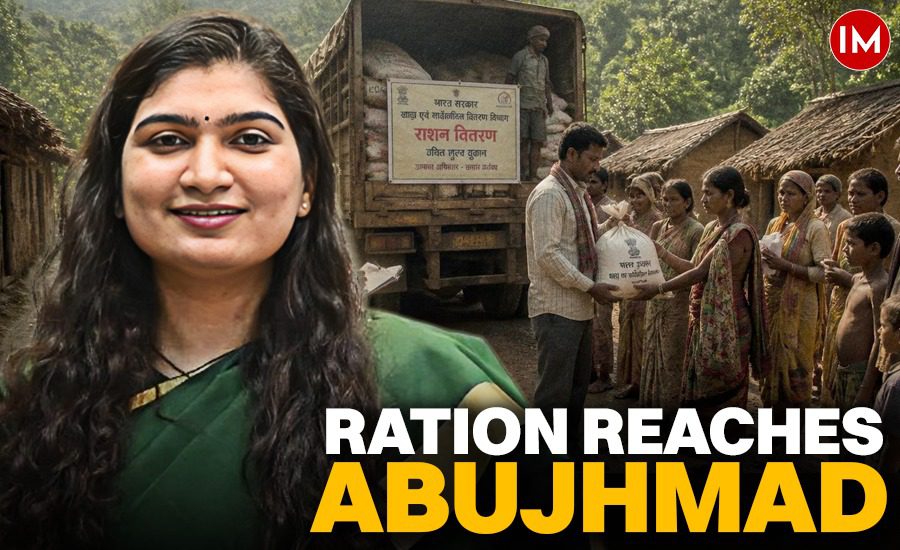
Under the leadership of the 2019 batch Chhattisgarh cadre IAS officer Namrata Jain, the Narayanpur district administration launched a decentralised Public Distribution System that now delivers food grains directly to remote gram panchayats across Abujhmad.
The initiative, introduced in January 2026, is changing how governance reaches one of the country’s most difficult terrains.
Also read: IAS Namrata Jain’s Sushasan Express Is Transforming Governance Delivery in Narayanpur’s Remote Villages
ENTERING A REGION ONCE BEYOND STATE REACH
Abujhmad, literally meaning “hills of the unknown” in Gondi, has long occupied a difficult place in India’s internal security landscape.
Spread across dense forests covering parts of Narayanpur, Bijapur and Dantewada districts, the region was considered the core area of Maoist influence in Bastar. Large stretches remained outside the routine reach of administration for decades.
Earlier this year, security forces and the state administration declared Abujhmad “Maoist-free” after sustained anti-insurgency operations. But restoring governance required more than security presence. It required services people could actually access.
That became the foundation of the district administration’s new PDS model.
“When we began mapping these villages, we saw the scale of hardship people faced just to collect their ration,” Jain shared with Indian Masterminds.
In several interior villages, collecting ration had meant a journey of nearly three days every month, involving forest routes, river crossings and overnight halts in Orchha or nearby settlements. During the monsoon, many habitations remained cut off for months as streams became impassable.
The administration realised that the burden of accessing welfare had effectively shifted onto the poorest residents themselves.
“The entitlement existed on paper, but physical access to it fell entirely on the poorest residents,” Jain explains.
THE TRACTOR THAT CHANGED PUBLIC DISTRIBUTION
The solution was deceptively simple: take the ration to the villages instead of forcing villages to come to the ration shop.
The district administration introduced a tractor-based decentralised Public Distribution System that now reaches 11,764 beneficiaries across 67 villages in Orchha block.
At present, the initiative covers 4,136 ration card holders spread across 14 gram panchayats:
- Murumwada
- Jatloor
- Thulthuli
- Aader
- Ghamandi
- Pochawada
- Kodoli
- Dhodarbeda
- Mandali
- Hikul
- Gomagal
- Rekawaya
- Handawada
- Aadnar
Every month, nearly 34.05 metric tonnes of food grains are transported directly to gram panchayat-level distribution points.
The initiative first began in Mandali gram panchayat in January 2026. Encouraged by the response, the administration expanded it to 13 additional gram panchayats from February onward.
For villages like Ghamandi, located nearly 70 kilometres away from the earlier ration distribution point in Sonpur, the impact has been immediate.
SOMARI BAI’S STORY IS THE STORY OF ABUJHMAD
Among the many stories emerging from the region, one stayed with the administration.
Somari Bai of Thulthuli village earlier spent nearly three days travelling to and from Orchha to collect ration. Every trip meant losing workdays and walking through forests and difficult terrain.
Now, the ration reaches near her village.
Her story reflects the experience of thousands of residents who had quietly absorbed the human cost of distance for years.
Villagers say the change has altered everyday life.
BUILDING GOVERNANCE BEFORE ROADS ARRIVE
The decentralised system is still temporary, but carefully designed.
According to district records, permanent fair price shops have already been sanctioned in 13 of the 14 gram panchayats under the initiative. Aadnar is yet to receive a sanction. The administration plans to establish permanent ration shops in phases as infrastructure and road connectivity improve.
Until then, the district administration itself is bearing transportation costs to ensure uninterrupted delivery.
The region’s difficult monsoon conditions posed another major challenge. Many villages become completely inaccessible once streams swell during heavy rains.
To prevent disruption, the administration has adopted a pre-positioning strategy. Food grains for the peak monsoon period will be supplied in advance and stocked in identified villages before routes become impassable.
The initiative also includes a detailed monitoring mechanism to prevent diversion or leakage during transport and distribution.
District-level nodal officers, Food Department supervision, end-to-end supply chain monitoring, and digital documentation through photographs and video recordings, and every stage is being tracked.
“We are trying to ensure that access to food security does not depend on geography,” Jain says. “The model is evolving continuously based on field realities.”
A DIFFERENT KIND OF ADMINISTRATIVE PRESENCE
What makes the Abujhmad initiative significant is not just the logistics of ration delivery. It is what the delivery represents.
For decades, the state was largely absent from the daily lives of many villages here. Now, governance is arriving through services people can touch and experience directly.
The administration is currently exploring the possibility of scaling the model to other inaccessible habitations across Abujhmad and the wider Bastar region.
And in villages where government systems once felt impossibly distant, tractors carrying food grains are becoming symbols of a changing relationship between the state and its citizens.
In Abujhmad, one of India’s most isolated landscapes, governance is no longer waiting at the other end of a forest trail.
It is finally reaching the doorstep.
Also read: The Day a Village Heard the National Anthem for the First Time