There were forests. There were hills. There were homes.
But there was no sound of a classroom.
In Abujhmaad, deep inside Narayanpur district of Chhattisgarh, generations grew up without ever hearing a school bell. Distance here was not just about kilometres; it was about being cut off. Villages scattered across difficult terrain, monsoon-cut routes, and years of Left Wing Extremism created a silence where systems could not reach.
Children learned to gather firewood before they learned to hold a pencil. Many had never seen a classroom. For them, school wasn’t something they had dropped out of; it was something they had never known.
FINDING CHILDREN BEFORE FINDING SOLUTIONS
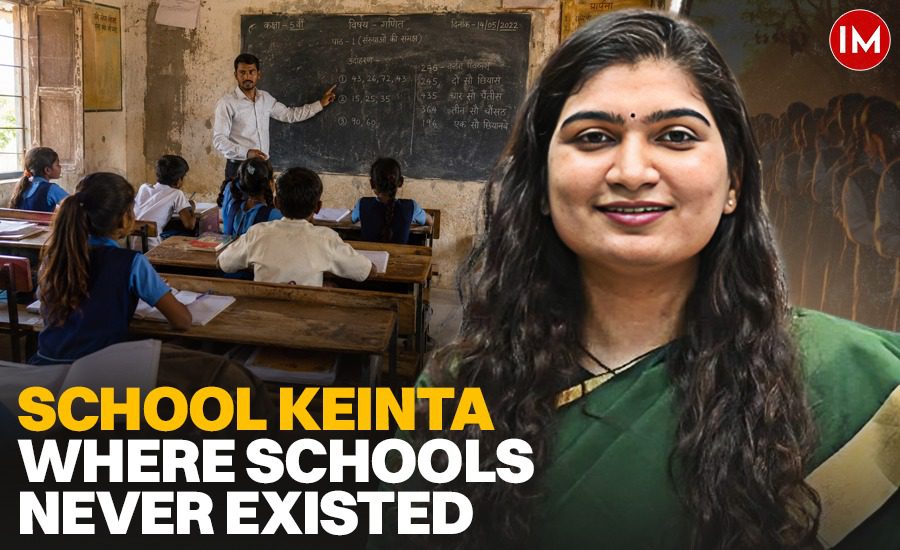
When IAS Namrata Jain, a 2019 batch officer of the Chhattisgarh cadre, took charge as District Collector of Narayanpur, the starting point wasn’t infrastructure.
It was a question.
Not why are children not in school, but who are these children and where are they?
“We had to first acknowledge that a large number of children were outside the system not by choice, but because the system never reached them,” she told Indian Masterminds.
That question led to School Keinta or “School is Calling.” But in Abujhmaad, it was the administration that began doing the calling.
A door-to-door survey covered 22,364 households across 83 Gram Panchayats.
The outcome was precise, almost unsettling:
- 2,965 out-of-school children
- 1,360 never enrolled
- 1,605 had dropped out
Each child was identified individually. No approximations. No assumptions.
“Once every child is visible, responsibility becomes immediate,” Namrata Jain reflects.
WHEN CLASSROOMS BEGAN MOVING CLOSER
What followed was not a typical expansion of schooling. It was a relocation of education itself.
Ten schools that had stopped functioning years ago reopened their doors: Matwada, Gattakal, Nelangur, Padamkot, Toyameta, Diwalur, Vadapenda, Kongali, Balebeda, and Binagunda.
250 children returned.
At the same time, 24 new primary schools appeared in places where none had existed: Kodenar, Ghamandi, Hingenar, Galegunrpara–Hitawada, Gundedkot, Kunjevada, among others.
Nearly 500 children entered a classroom for the first time. In total, over 800 children were no longer outside the system. But numbers don’t tell you what it felt like.
KODENAR AND THE FIRST SONG
Kodenar is a village of just 14 families. Before this year, it had never had a school. When the survey team arrived, they found 25 children completely outside the education system. No prior enrolment. No exposure.
On 25 February 2026, something changed quietly. A school opened. Children gathered with hesitation. Uniforms were new. Books were unfamiliar objects.
And then, something happened that the village had never witnessed before.
The national anthem was sung. Together. For the first time.
“Moments like these remind you that governance is not only about schemes; it is about connection,” says Namrata Jain.
All 25 children were enrolled that day. They received school bags, textbooks, notebooks, and uniforms. A teacher was appointed immediately.
What arrived in Kodenar was not just a school. It was a new routine. A new possibility.
REKAVAYA AND THE CHOICE TO CONTINUE LEARNING
Rekavaya–Aamapara tells a different story.
For years, a Bhoomkaal school run by Maoist groups functioned here: the only available form of education, though outside any formal system. When that structure weakened, the village did not let learning disappear.
People improvised. Spaces were created. Children gathered. Local youth began teaching.
So when the administration reached Rekavaya through School Keinta, it did not begin from scratch; it built upon what already existed.
The school was brought into the formal system. Structure replaced uncertainty. A residential hostel was set up to address the challenge of scattered habitations.
What changed was continuity.
STARTING BEFORE SCHOOL EVEN BEGINS
The initiative also looked at the earliest years. Because in places where schooling has never existed, the gap begins long before Class 1.
49 new Anganwadi centres were made operational, reaching over 1,200 children between 0–6 years.
Nutrition, early learning, and maternal care came together. For many children, this became their first introduction to structured learning, before they ever stepped into a classroom.
WHEN VILLAGES BECOME PART OF THE PROCESS
In Toke village, change did not begin with construction. It began with conversations.
A survey identified 14 out-of-school children. Local youth like Santu Ram Dhruva became the bridge between the administration and families.
A school was started within the village, inside a ghotul. Today, 15 children attend regularly, most of them first-generation learners. A permanent school building is already in process.
MORE THAN ENTRY INTO SCHOOL
School Keinta does not stop at enrolment. For children who are first-generation learners, stepping into a classroom is only the beginning.
“Access alone is not enough. Children must feel comfortable, connected, and willing to return every day. That is when education becomes real,” the officer shared with Indian Masterminds.
By placing schools within communities and strengthening early learning systems, the initiative is slowly turning education into something that belongs to the village, not something external to it.
WHAT HAS STARTED TO CHANGE
In Abujhmaad now, the signs are subtle but clear.
A child walking with a book.
A group repeating lessons aloud.
A parent asking what was taught that day.
School Keinta is not just bringing children into classrooms. It is placing education into everyday life.
And in a region where silence once defined childhood, there is finally a new sound… children learning together.