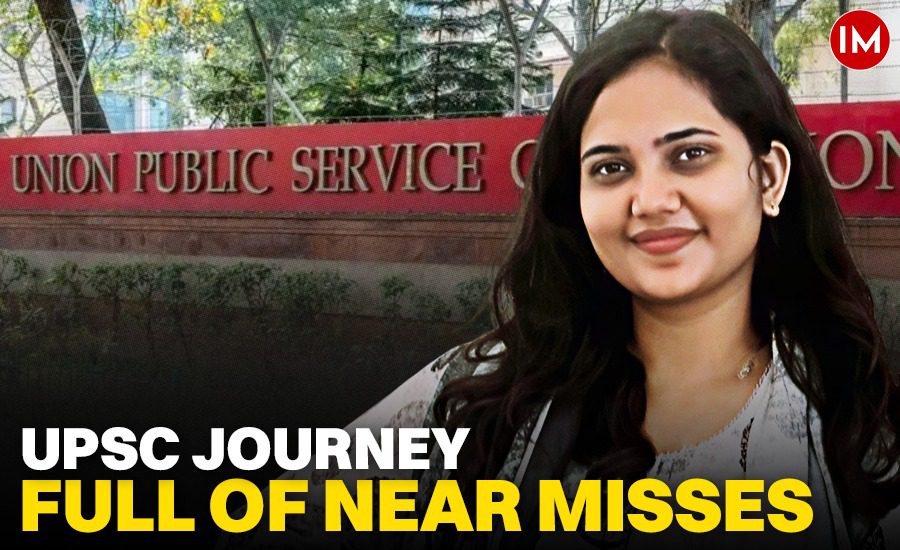
In a traditional joint family in Gwalior, Madhya Pradesh, where expectations often follow familiar paths, Srishti Goyal chose one that demanded uncertainty, patience, and years of self-questioning.
Her father, a businessman, had quietly nurtured a dream, one that Srishti would eventually make her own.
“I come from a traditional joint family… my father is a businessman,” she says, grounding her story in simplicity. But what followed was anything but simple.
She didn’t move to Delhi at the start. She didn’t rely on the usual ecosystem. Instead, she stayed back and prepared from Gwalior itself, away from the conventional hubs of UPSC preparation.
In an exclusive conversation with Indian Masterminds, she shared details about her UPSC journey, near misses, and ultimate success.
ENGINEERING, EXPOSURE, AND A SHIFT IN PURPOSE
A graduate in Computer Science Engineering from Madhav Institute of Technology and Science, Gwalior, Srishti’s initial path seemed set in the world of technology.
But life intervened in quieter ways.
During her college years, she became part of the NGO Make A Difference and was actively involved in the National Service Scheme (NSS). For nearly three years, she worked closely with communities, witnessing problems not through books, but firsthand.
“That gave me the major push to join civil services,” she recalls.
It was no longer just her father’s dream. It became her own calling.
FIVE ATTEMPTS, COUNTLESS NEAR MISSES
Srishti’s journey through UPSC was not defined by a single moment but by a series of ‘almosts’.
- 2021: Missed prelims by a small margin
- 2022: Reached the interview stage, but didn’t make the final list
- 2023: Missed CSAT by just 0.2 marks, a fraction that could have changed everything
- 2024: Again reached the interview stage
- 2025: Finally secured AIR 160
And the pattern wasn’t limited to UPSC.
She missed the RBI exam by 0.2 marks, MPPSC by just one mark, and faced repeated near misses across multiple exams.
“It is more about the story of failures… my success is only one success, but there has been an iceberg of failures,” she told Indian Masterminds.
Each attempt demanded that she rebuild, not just her preparation, but her belief in herself.
THE YEAR THAT CHANGED EVERYTHING
After years of effort, the biggest shift came not from adding more books, but from changing how she approached the exam.
“This year, I focused on building the right mindset and personality,” she explains.
She realised her content was strong. What needed fixing was the interpretation and understanding of what the question truly demanded.
Another critical gap was time management. Preparing from home had limited her exposure to real exam conditions. So, just one month before Mains, she made a bold move: she went to Delhi.
For two months, she wrote one to two tests daily, simulating real exam pressure. This intense routine sharpened her speed, clarity, and confidence. Mentors also played a key role in identifying gaps she couldn’t see herself.
WINNING THE INTERVIEW WITHIN
Despite reaching interviews multiple times and scoring well, there remained a challenge. This time, the change was internal.
“In the interview stage… I worked on staying calm and addressing the demand properly.”
Instead of chasing perfect answers, she focused on clarity, composure, and balance.
One question stood out:
“If you were an alien observing Earth, what three things would you think we’ve done to destroy it?”
Another placed her in a high-pressure administrative situation: handling a riot as an IPS officer. Would she lead from the ground or the control room?
She didn’t pick extremes. She chose balance and stood by it, even when pushed.
Her calm reasoning didn’t just answer the question; it opened a conversation. The chairperson later shared her own real-life experience, turning the moment into a rare exchange filled with insight, and even laughter.
WHEN PREPARATION MEETS BREAKING POINT
Behind the results lies a story that tested her physically and mentally.
At one point, she had cleared prelims and was ready for Mains, but fell so ill that she couldn’t even appear. Repeated failures began affecting her mental health, which soon impacted her physical well-being too.
“There comes a point where you keep doubting yourself…”
But this is where her support system stepped in: parents, friends, mentors.
“They push you, they motivate you… building good relationships becomes very important,” she shared with Indian Masterminds.
CHOOSING ANTHROPOLOGY, BUILDING HER OWN PATH
Coming from an engineering background, Srishti had to carefully choose her optional. She picked Anthropology after evaluating multiple factors like interest, overlap, and performance trends in the exam.
With no prior background, she relied on online coaching in her first attempt and later focused primarily on test series and self-study.
Her preparation remained largely self-driven: structured around practice, analysis, and continuous improvement.
A VISION ROOTED IN EVERYDAY IMPACT
With AIR 160, Srishti now stands at the threshold of joining the services, but her focus isn’t on the designation.
She remains open to any service: IAS, IPS, or even Indian Foreign Service.
Her metric is simple:
“How can I give my best to society… even if I can help someone daily.”
If given the opportunity, she feels strongly about working in the education sector: a space that shaped her own journey.
HER MESSAGE TO ASPIRANTS
After years of preparation, setbacks, and eventual success, her advice is strikingly grounded:
“Have patience and perseverance… and be honest to yourself.”
She emphasizes that success in UPSC is not about hours spent, but about how effectively that time is used. She also highlights a critical gap many aspirants overlook:
“We do not practice enough and then we question.”
Her final takeaway is perhaps the most important: Start thinking like an officer from the beginning.