For decades, India’s Public Distribution System has carried one of the heaviest responsibilities in governance: ensuring food reaches millions of families spread across deserts, forests, mountains, islands, crowded cities, and remote villages. Every month, food grains move through an enormous network of procurement centres, warehouses, rail routes, trucks, fair price shops, and state distribution systems.
It is one of the world’s largest food security operations.
And for years, it also faced one persistent challenge: how do you move food grains across a country as vast and complex as India in the fastest, smartest, and most cost-effective way possible?
The answer emerged through an ambitious initiative called “Anna Chakra.”
What began as a logistics optimization project inside the Department of Food and Public Distribution evolved into a globally recognised model for public-sector analytics. In 2026, the initiative placed India among the world’s top innovators after becoming a finalist for the prestigious Franz Edelman Award, often described as the highest international recognition in operations research and advanced analytics.
Standing alongside technology giants and multinational corporations such as Microsoft, Google, NVIDIA, Chewy, and ECCO Shoes, India’s food distribution network earned its place on the global stage not through flashy consumer technology, but by solving one of humanity’s most fundamental concerns: delivering food efficiently to people who need it most.
At the heart of this transformation were officials, researchers, analysts, and institutions that decided governance could become smarter through mathematics, data science, and operational planning.
And leading that effort from within the system were officers like Anita Karn and Sanjeev Chopra.
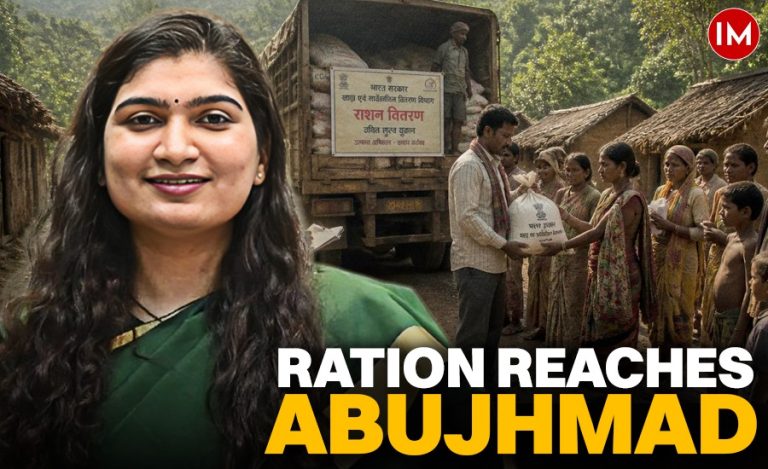
Also read: How IAS Namrata Jain Is Taking PDS Deep Into Abujhmad
REIMAGINING INDIA’S FOOD GRAIN MOVEMENT
India’s Public Distribution System serves more than 81 crore beneficiaries under the National Food Security framework. The sheer scale of movement involved is staggering.
Food grains travel from procurement states to deficit regions through an interconnected chain involving the Food Corporation of India, railways, depots, warehouses, and state governments. Even small inefficiencies in routing, allocation, or transportation planning can translate into massive financial costs and delays.
The challenge was never merely about moving grain.
It was about moving the right quantity to the right state, through the right route, at the right time, while minimizing costs and environmental impact.
That is where Anna Chakra entered the picture.
Developed through collaboration between Department of Food and Public Distribution, World Food Programme, and Indian Institute of Technology Delhi, the initiative introduced operations research into India’s food supply chain on a nationwide scale.
The system uses advanced optimization models and data-driven decision support tools to improve state-specific logistics planning for food grain movement across India.
In simple terms, Anna Chakra studies enormous quantities of logistics data and identifies the most efficient movement strategies by reducing unnecessary transportation, improving allocation planning, and cutting avoidable operational costs.
But implementing such a model inside one of the world’s largest public welfare systems was never going to be simple.
TURNING A MASSIVE WELFARE SYSTEM INTO A DATA-DRIVEN NETWORK
Government systems traditionally rely on layered administrative processes and manual planning structures. Introducing advanced analytics into a nationwide welfare mechanism required more than software.
It required institutional trust.
Officials had to align multiple stakeholders, integrate operational data, study grain movement patterns, map transportation constraints, and build scalable models capable of functioning across states with completely different logistical realities.
Punjab’s grain movement requirements differ from those of the Northeast. Coastal states operate differently from landlocked ones. Seasonal pressures, procurement cycles, storage availability, railway connectivity, and demand patterns constantly shift.
Anna Chakra attempted to create a dynamic planning framework capable of adapting to those variables.
The initiative also represented something larger: a transition in governance thinking.
Instead of relying solely on reactive administrative adjustments, the Department began using predictive and optimization-based planning to strengthen decision-making.
For the first time, advanced operations research was being deployed at this scale in India’s public distribution ecosystem.
And the results were significant.
₹250 CRORE IN SAVINGS, AND A CLEANER SUPPLY CHAIN
Once implemented nationally, Anna Chakra delivered measurable outcomes that immediately drew international attention.
The initiative generated estimated annual savings of nearly ₹250 crore by optimizing logistics and improving transportation planning.
More importantly, the redesigned movement patterns reduced supply-chain emissions by around 35 percent, an achievement that connected food security with sustainability goals.
In a country where food grain movement involves thousands of transportation decisions every day, reducing unnecessary travel distances created both economic and environmental gains.
The impact was not confined to spreadsheets.
Improved logistics planning helped streamline grain movement timelines, strengthen replenishment systems, and support more efficient distribution for over 81 crore beneficiaries dependent on the Public Distribution System.
For global analytics experts, this was not merely a technology story. It was proof that operations research could directly improve governance outcomes at population scale.
THE GLOBAL RECOGNITION THAT CHANGED THE CONVERSATION
The Franz Edelman Award is administered by INFORMS, the world’s leading professional association for operations research, analytics, and data science.
For decades, the award has recognised applications of analytics that deliver measurable real-world impact.
Previous finalists and winners have included global corporations, healthcare systems, technology firms, and major industrial organizations.
India’s entry into this space through a public welfare logistics initiative marked a major moment for governance-led innovation.
Anna Chakra was selected among the six global finalists for the 2026 edition of the award, placing the Department of Food and Public Distribution alongside some of the world’s biggest technology and supply-chain innovators.
The recognition was not symbolic.
The Edelman evaluation process focuses heavily on measurable outcomes, implementation credibility, scalability, and operational impact. Projects are scrutinized for proven results rather than conceptual promise.
Anna Chakra stood out because it demonstrated all of them simultaneously:
- large-scale deployment,
- measurable savings,
- environmental impact,
- operational efficiency,
- and direct public welfare outcomes.
Before reaching the international finals, the initiative had already earned national recognition through the CDSA ORSI Excellence in Management Science and Analytics Practice Award at the Indian Institute of Management Ahmedabad.
That win strengthened the project’s credibility within India’s analytics and management science community before it moved onto the global stage.
ANITA KARN AND THE ADMINISTRATIVE PUSH BEHIND THE PROJECT
As Additional Secretary in the Department of Food and Public Distribution, 1997-batch Indian Forest Service officer of the Gujarat cadre, Anita Karn played a key role in driving the institutional coordination required for a project of this scale.
Known for combining administrative understanding with systems thinking, she became part of the effort to ensure that analytics moved beyond theory and into real-world implementation.
For Karn, the significance of Anna Chakra lies in what it means for governance itself.
“India’s food security system operates at a scale few nations can even imagine. Anna Chakra showed that advanced analytics can strengthen welfare delivery without losing sight of people at the centre of the system,” she shared in an exclusive conversation with Indian Masterminds.
She believes the initiative changed how government departments view data-led decision-making.
“The real achievement is not only the savings or efficiency gains. It is the creation of a framework where scientific planning becomes part of everyday governance.”
Karn also sees the project as an example of collaborative administration.
“Government institutions, academic researchers, and international organizations came together with a shared objective – to make food distribution smarter, faster, and more sustainable. That collaboration became the backbone of Anna Chakra.”
SANJEEV CHOPRA ON BRINGING SCIENTIFIC THINKING INTO GOVERNANCE
As Secretary of the Department of Food and Public Distribution, 1990 batch Odisha cadre IAS officer, Sanjeev Chopra has consistently emphasized modernization, efficiency, and technology integration within public systems.
Under his leadership, Anna Chakra gained national visibility as a model for analytical governance.
For Chopra, the project represents a larger shift in how public institutions can operate.
“Anna Chakra demonstrates that scientific methods and public administration can work together to solve large-scale governance challenges.”
He also underlined the importance of partnerships in achieving the milestone.
“The collaboration between DFPD, WFP India, and IIT Delhi brought together policy understanding, operational expertise, and advanced analytics. That combination made this initiative globally competitive.”
WHY ANNA CHAKRA MATTERS BEYOND AWARDS
Awards create headlines.
But the deeper significance of Anna Chakra lies elsewhere.
India’s Public Distribution System has often been discussed through the lens of scale and subsidy. Anna Chakra changed that conversation by introducing the language of optimization, efficiency, sustainability, and analytics into welfare administration.
It showed that public systems can use the same advanced decision-science frameworks that multinational corporations use for supply chains.
And unlike private-sector optimization models focused primarily on profits, Anna Chakra was built around social impact.
Its success demonstrated that data science can directly strengthen food security for millions of vulnerable citizens.
The initiative also arrived at a time when governments worldwide are searching for scalable governance models capable of balancing welfare delivery with fiscal efficiency and climate considerations.
That made Anna Chakra globally relevant.
A NEW TEMPLATE FOR PUBLIC GOVERNANCE
What makes Anna Chakra remarkable is not only that it optimized logistics.
It changed perceptions.
For years, advanced analytics and operations research were often associated with corporate boardrooms, tech firms, and private industry.
India’s Department of Food and Public Distribution proved those same tools could transform welfare governance at national scale.
In doing so, the department built something larger than an award-winning project. It built a template. A template showing that governance systems serving millions can become smarter, greener, and more efficient through scientific planning.
And perhaps that is why Anna Chakra resonated so strongly on the global stage. Because behind the algorithms, optimization models, and logistics maps lies a simple but powerful objective: making sure food reaches people better, faster, and more responsibly.
Also read: Sonmoni Borah: The IAS Officer Turning Remote Tribal Classrooms Into IIT Launchpads