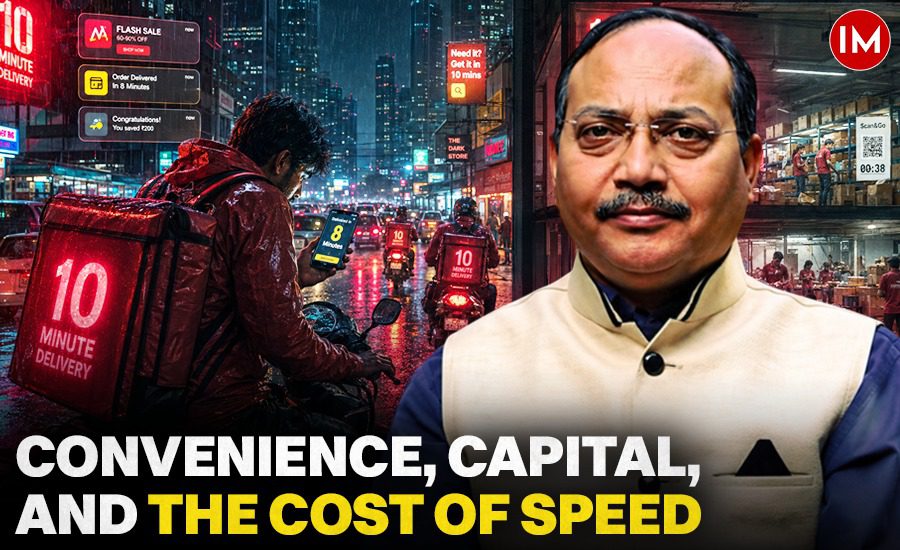
It is eleven o’clock at night, and you suddenly realise you have run out of salt. Until two years ago, that meant either knocking on a neighbour’s door or waiting until morning. Today, you pick up your phone, open an app, and twelve minutes later a packet of salt lands at your doorstep. Whether it is raining cats and dogs or the city is facing extreme temperatures. This is not magic. Your phone is the mythical Aladdin’s lamp. You get whatever is needed wherever needed in record time. This is India’s new economy.
Quick commerce — the model that promises delivery within ten to thirty minutes — is far more than a clever business concept. It is the most visible expression of a deeper transformation that smartphones, dirt-cheap mobile data, and the UPI payments system have together wrought on urban India. A country that once took “it’ll come tomorrow” as a perfectly adequate answer now expects “here in ten minutes” as the baseline.
What mobile internet did to communication between 2005 and 2015, quick commerce is now doing to consumption, employment, and retail – all at once.
The Scale of the Explosion
The numbers behind India’s quick commerce boom are staggering. By 2025, the industry’s total gross merchandise value was estimated at between seven and eight billion dollars — roughly ₹62,000 to ₹71,000 crore. By 2027–28, projections suggest that figure could cross ₹1.5 lakh crore. What makes this growth truly extraordinary is the contrast: while traditional retail expands at a modest 8–10 percent a year, quick commerce clocked annual growth rates of 70 to 100 percent in its early years — a pace that makes every other sector look like it’s standing still.
Zepto, Blinkit, Swiggy Instamart, and Flipkart Minutes have become the new temples of urban India. Zepto, founded in 2021 by twenty-year-olds Aadit Palicha and Kaivalya Vohra, is today valued at over seven billion dollars. Blinkit, which began life in 2013 as a grocery startup called Grofers, is now the fastest-growing engine of the Zomato group — rebranded as Eternal — out pacing even the food delivery business that made Zomato a household name.
How Quick Commerce Compares: Average Annual Growth Rate (CAGR)
| Sector | Growth Rate |
| Traditional Retail | 8–10% |
| FMCG | 7–9% |
| Banking / Financial Services | 10–12% |
| E-Commerce | 20–25% |
| Quick Commerce | 70–100%+ |
Beyond the Grocery Basket
Quick commerce began its life as a solution to a simple problem: the weekly grocery run felt like an ordeal. But the industry has long since outgrown that origin story. Medicines, mobile phones, electronics, fashion, beauty products, meat, ready-to-eat meals — virtually any category of everyday life can now be at your door in under thirty minutes. According to a recent BCG report, India’s e-commerce market could touch 300 billion dollars by 2030, with quick commerce providing its single biggest growth impulse. More tellingly, category-focused platforms of this kind already account for more than 60 per cent of total online consumer spending in the country.
BigBasket, now under the Tata Digital umbrella, is preparing for an IPO. Licious, which built its reputation on fresh meat and seafood, has joined the unicorn club. For India’s neighbourhood kirana stores and sprawling malls alike, the disruption is no longer a distant threat – it has already arrived at the door.
The Invisible Backbone
The entire edifice of quick commerce rests on the shoulders of millions of young men who course through Indian cities every day – delivery bags strapped to their backs, phones in their hands, the clock a constant pressure overhead. India’s gig workforce is projected to reach 80 to 90 million people in the coming years. These are the workers who convert the promise of digital disruption into a physical reality — typically without a permanent job, without social security, and without any safety net beyond the next delivery order.
What happened in December 2025 was this discontent finally spilling over. Led by the Indian Federation of App-Based Transport Workers (IFAT), a nationwide flash strike brought nearly 40,000 delivery workers off the roads on Christmas Day. Mumbai, Delhi, Hyderabad, and Bengaluru ground to a partial halt. On New Year’s Eve, workers in Maharashtra, Karnataka, Tamil Nadu, West Bengal, and Delhi-NCR staged further demonstrations — this time joined by workers from Zepto, Amazon, and Flipkart in addition to Swiggy and Zomato.
Falling incomes, boundless working hours, arbitrary algorithmic control — the companies kept the profits while every risk was quietly loaded onto the workers, the strikers’ manifesto said.
The workers’ demands were unambiguous: scrap the dangerous 10-minute delivery mandate, pay us fairly, give us social security, and recognise us as workers under the law. The government could no longer look away. Union Labour Minister Mansukh Mandaviya summoned executives from Blinkit, Zomato, Swiggy, and Zepto. Following those meetings, the companies agreed to remove the “10-minute delivery” pledge from their branding and public commitments — a symbolic but significant climbdown that marked the first real check on an industry that had operated largely on its own terms.
Breakneck Growth, No Bottom Line
Here lies the industry’s central contradiction. For all its explosive expansion, quick commerce is not yet profitable. Companies are pouring capital into dark stores — small, hyper-local warehouses invisible to the public — AI-driven demand forecasting systems, and the logistics networks that make ten-minute delivery physically possible. This is a war for market share, not a season of settled returns. Startup funding tells its own story: India’s tech startups raised 10.5 billion dollars in 2025, a fall of 17 per cent from the previous year. Investors, it appears, are losing patience with “grow at any cost” and beginning to ask for something more durable.
Economists are asking the harder question: does this model survive in the long run? Most of these companies are kept afloat by venture capital and consumer subsidies — artificially low prices underwritten by investor money. When that support is withdrawn, will users actually pay the real price of ten-minute delivery? Nobody has a clean answer yet.
Where Three Revolutions Meet
Seen in its full context, India’s quick commerce boom is not simply a retail story. It is the point where three massive shifts in Indian society have converged simultaneously. The first is the smartphone-and-UPI revolution, which brought both rural and urban India into a single digital marketplace for the first time. The second is the “instant gratification” psychology of the urban middle class — a mindset that the pandemic didn’t create but dramatically accelerated. The third is the absorption of an enormous unorganised labour force into platform-based work, offering millions of people a new livelihood, however precarious.
The Economic Survey 2025–26 signals that the state is beginning to grapple with this new labour reality. Labour codes have taken tentative steps toward extending social security to gig and platform workers, and the e-Shram portal has registered over 310 million unorganised workers. These are early moves — but they suggest that India’s policymakers can no longer treat gig workers as an afterthought of the digital economy.
The Questions That Remain
And yet, the most important questions are still unanswered. Will India’s neighbourhood kirana shopkeepers — the bedrock of unorganised retail, the backbone of millions of local economies — survive this upheaval? Can platforms continue to call their workers “delivery partners” indefinitely, using language to dodge the obligations that come with employment? And the sharpest question of all: will ten-minute grocery delivery remain a luxury accessible only to the 15–20 per cent of urban India that can comfortably afford it?
The greatest test facing this new economy is whether it can deliver not just speed, but fairness. Quick commerce has demonstrated, beyond any doubt, that the appetite of the Indian market is extraordinary and its capacity to scale is real. But the hands that carry those deliveries to your door are owed a share of the prosperity they make possible. The groceries can reach you in ten minutes. The question is when justice will arrive — and whether it, too, will be on time.