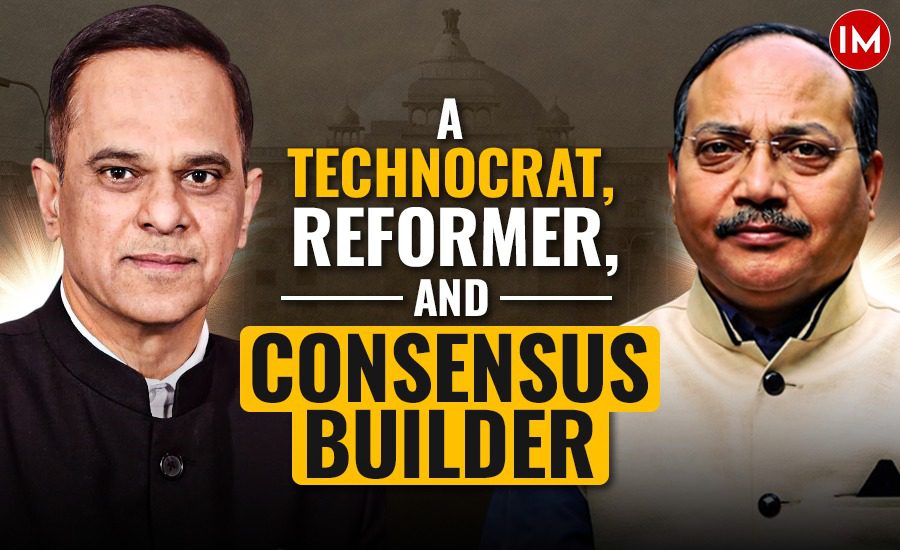
When the Rajasthan government moved swiftly in November 2025 to fill the vacancy left by the departure of Chief Secretary Sudhanshu Pant, the choice of V. Srinivas was not a default — it was a deliberate statement. Here was an officer who had spent the better part of seven years at the nerve centre of India’s governance reform architecture, shaped national policy from some of the most consequential desks in Sardar Patel Bhawan, represented India on the world stage at the International Monetary Fund (IMF) and the International Institute of Administrative Sciences (IIAS) — and yet, chose to come home to Rajasthan.
The sceptics, predictably, raised an eyebrow. Can an officer who has been away from the state for nearly a decade truly connect with the ground realities of governance in the desert state? Can a man steeped in macro-policy and global frameworks navigate the nitty-gritty of district administration, inter-departmental wranglings, and the peculiar dynamics of state-level politics?
Six months later, those questions have their answer — and it is unambiguous.
Bureaucratic Federalism
Back in Rajasthan as Chief Secretary, Srinivas has brought to bear an asset that no amount of state-level experience can substitute: access and trust at the highest levels of the Centre.
In the era of cooperative federalism, the distance between a state proposal and central approval is not measured in kilometres — it is measured in relationships. Files move faster when intent is trusted. Clearances come easier when the person making the case is known for diligence and integrity. Long-pending proposals unlock when the Chief Secretary himself sits across the table from Secretaries who consider him a peer, not a petitioner.
Also Read – A Poet in the Corridors of Power: How Tushar Dhawal Singh Kept Poetry Alive Inside Bureaucracy
Double Engine Bureaucracy
Srinivas’s monthly visits to New Delhi are not ceremonial. They are targeted, purposeful interventions — direct conversations with Secretaries, follow-ups on bottlenecked clearances, negotiations on fund flow, and alignment of state priorities with central schemes.
In Rajasthan’s “double engine” political context — where Centre and State are aligned — this capacity for smooth federal coordination is invaluable. Officers in the Rajasthan Secretariat acknowledge, often quietly, that multiple long-pending proposals have seen movement simply because the Chief Secretary chose to personally pursue them.
A Thorough Gentleman
In a professional culture that sometimes mistakes aggression for leadership, V. Srinivas offers a different model. Across cadres — from Odisha to Rajasthan, from Sardar Patel Bhawan to the IMF’s Washington headquarters — colleagues describe him with a phrase that carries more weight than it seems: a thorough gentleman and an untiring work-horse.
That phrase, in bureaucratic circles, means something specific. It means an officer who does not play politics with files, does not weaponise seniority, does not make working life miserable for subordinates, and does not trade in the currency of obstruction. It means someone whose proposals are taken seriously precisely because he is not seen as pushing a hidden agenda.
A Journey Rooted in the Field
Voruganti Srinivas — he carries the IAS designation as naturally as he carries his reputation — did not arrive at the Chief Secretary’s chair via the corridor of privilege. His journey began in the very dust of Rajasthan’s field administration.
After clearing the Civil Services Examination in 1989, armed with a B.Tech and M.Tech in Chemical Engineering (First Class with Distinction, no less) from Osmania University, Hyderabad, Srinivas was allocated the Rajasthan cadre.
The Delhi Years
At the Department of Administrative Reforms and Public Grievances (DARPG), he rose steadily from Additional Secretary to Special Secretary to full Secretary — carrying with him a singular conviction: that governance reform must be felt by citizens, not just filed in policy documents.
Under his watch, the Centralised Public Grievance Redress and Monitoring System (CPGRAMS) was expanded and deepened — from a 10-step reform framework to a 14-step model that explicitly incorporated citizen connect.
In a system where grievance portals are often digital graveyards for unresolved complaints, Srinivas insisted on what colleagues describe as a “response-oriented” philosophy: not just receiving complaints, but closing them with accountability. The result was the production of a remarkable booklet titled “Effective Grievance Redressal: 100 Stories of Change” — documenting real citizens whose real problems were resolved. That document, understated in its simplicity, is in many ways his manifesto.
He drove the rollout of Special Campaigns 1.0 through 5.0 — massive, government-wide cleanliness and pendency-reduction drives that cumulatively freed over 930 lakh square feet of office space and generated ₹4,120 crore from disposal of scrap and unneeded assets. These were not symbolic exercises; they were behavioural change programmes embedded into the culture of the central secretariat.
He personally authored the 15th Edition of the Central Secretariat Manual of Office Procedure (CSMOP) — the Bible of government functioning — incorporating new-age reforms to make India’s bureaucracy leaner, faster, and more responsive. Union Minister Dr. Jitendra Singh, in his foreword to the manual, specifically commended Srinivas’s leadership in driving this reform.
He published Administrative Reforms: Lessons and Experiences 2019–2023 — a rare act of institutional self-reflection from a senior bureaucrat, documenting what worked, what didn’t, and why. In his own words from that document: “Deep commitment in the case of Redressal of Public Grievances necessitates a holistic merger of technology with citizen engagement.” That is not boilerplate. That is a governing philosophy.
Good Governance
As Director General of the National Centre for Good Governance (NCGG) from 2020 to 2024, he oversaw capacity-building programs for civil servants not just from India but from partner nations — Bangladesh, Bhutan, Nepal, the Maldives, Sri Lanka, and others.
Under his tenure, NCGG was designated by the Ministry of External Affairs as an “institution in focus” — India’s preferred vehicle for sharing its governance model with the world. The training of foreign civil servants was not mere diplomacy; it was an exercise in soft power backed by substance.
India’s First in 95 Years
Perhaps nothing illustrates the stature of V. Srinivas more powerfully than what happened in June 2025 — just months before he returned to Rajasthan. The International Institute of Administrative Sciences (IIAS), headquartered in Brussels, is a 95-year-old global institution that serves as the premier forum for comparative governance, administrative best practices, and civil service reform worldwide. Its members include Japan, Germany, Italy, China, South Korea, Saudi Arabia, South Africa, and Switzerland. For 95 years, India had been a member — but never its President.
Nominated personally by Prime Minister Narendra Modi, Srinivas entered the contest for the Presidency of IIAS for the 2025–2028 term. On June 3, 2025, the votes were counted. India received 87 votes — 61.7% — against Austria’s 54 votes (38.3%). It was a landslide. And with it, V. Srinivas became the first Indian civil servant to lead the IIAS in its entire history.
The IMF Chapter
Before the DARPG years, before NCGG, before the Rajbhasha Kirti Puraskar (which he won in both 2024 and 2025) — there was Washington D.C.
Between 2003 and 2006, Srinivas served as Technical Assistant / Adviser to the Executive Director of the International Monetary Fund — India’s representative at the most powerful financial institution on the planet. Here, among economists and technocrats from across the world, a Rajasthan cadre IAS officer learned the language of fiscal sustainability, macroeconomic risk, and institutional resilience.
The Srinivas Differential
If one were to distil the essence of what makes V. Srinivas a rare administrator, it comes down to a few irreducible qualities: His impact is visible not in dramatic declarations, but in smoother Centre–State coordination, faster clearances, a perceptible ease in federal engagement, and a working culture in the Rajasthan Secretariat that reflects the values of its leader: diligent, purposeful, and quietly effective.
He took charge at a moment of transition — when Rajasthan needed stability more than spectacle, when it needed a navigator more than a performer, when it needed a man whose phone calls from Delhi get returned. It got all three in one.