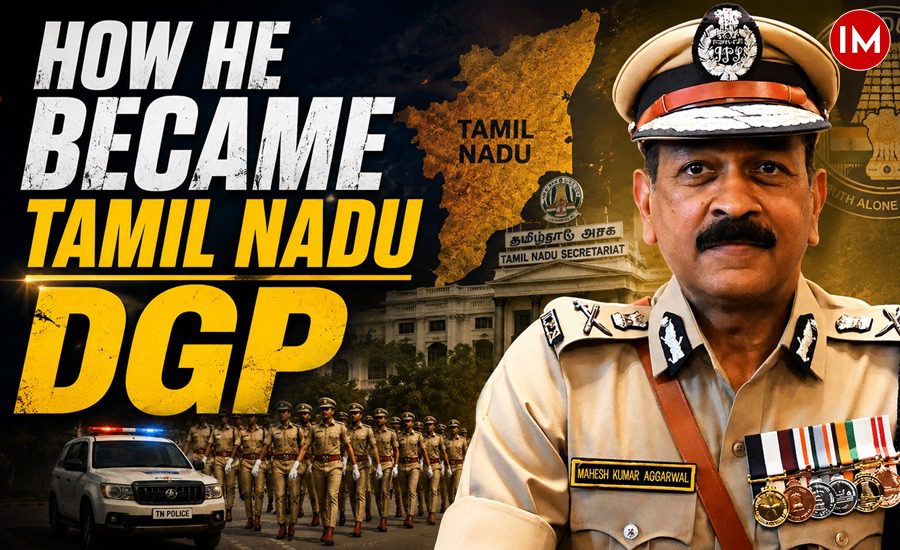
In the world of policing, some careers are defined by a single landmark achievement. Others are shaped by the sheer breadth of experience gathered across districts, cities, investigative agencies, and national security institutions. The story of Mahesh Kumar Aggarwal belongs firmly to the latter.
In 2026, when he took charge as the Director General of Police and Head of Police Force of Tamil Nadu, he arrived at the state’s highest policing position carrying more than three decades of experience. It was a journey that had begun far from Tamil Nadu, in Punjab.
Also read: Ravada A. Chandrasekhar: The Intelligence Strategist Now Steering Kerala Police
A LAWYER WHO CHOSE THE IPS
Born in 1972 and hailing from Bathinda in Punjab, Mahesh Kumar Aggarwal built a strong academic foundation before entering public service. Armed with a Bachelor’s degree in Law, an LL.B., and further qualifications in personnel management, he entered the Indian Police Service through the 1994 batch and was allotted the Tamil Nadu cadre.
What followed was a career that would take him through almost every major dimension of policing.
LEARNING THE GROUND REALITIES
Like many officers who eventually rise to leadership positions, Aggarwal’s early years were spent understanding policing at the grassroots level.
As Superintendent of Police in Theni and later Thoothukudi, he worked in districts that presented very different challenges. From maintaining law and order to tackling crime and managing public expectations, these assignments provided him with firsthand exposure to the realities of field policing.
Those years helped shape an officer who would later handle much larger responsibilities.
INTO THE WORLD OF INVESTIGATIONS
Aggarwal’s career soon moved into one of the most demanding areas of policing: criminal investigations.
His tenure as Deputy Inspector General in the Crime Branch-Criminal Investigation Department (CB-CID) placed him at the centre of complex and sensitive cases. The assignment demanded patience, analytical thinking, and the ability to navigate investigations that often attracted public and media attention.
His investigative experience expanded further when he served with the Central Bureau of Investigation. The exposure to national-level investigations and inter-state crime networks added another important layer to his professional journey.
COMMANDING TWO HISTORIC CITIES
Few policing assignments are as visible, or as challenging, as leading major cities.
Aggarwal would go on to serve as Commissioner of Police in Madurai, one of Tamil Nadu’s most culturally significant cities. Managing law and order in a city known for massive gatherings, religious events, and constant public activity required a delicate balance of firmness and public engagement.
An even larger challenge awaited him in Chennai.
As Commissioner of Police, Chennai, he led the police force of one of India’s biggest metropolitan centres. The role brought together every aspect of modern policing—crime prevention, traffic management, intelligence coordination, public safety, VIP security, and urban law and order.
It was a position that placed him under constant public scrutiny and further strengthened his reputation as an experienced administrator.
LEADING CRIME AND OPERATIONS ACROSS TAMIL NADU
As his responsibilities grew, Aggarwal moved into senior leadership positions at the state level.
As Additional Director General of Police (Operations), he became involved in coordinating statewide policing initiatives and operational strategies.
Later, as ADGP Crime, he oversaw crime monitoring and major investigations across Tamil Nadu. The assignment placed him at the heart of the state’s efforts to combat serious criminal activity and strengthen investigative systems.
His experience also included serving as Director General of Police, Armed Police, where he supervised reserve forces that play a critical role during elections, emergencies, and major law-and-order situations.
FROM STATE POLICING TO BORDER SECURITY
Aggarwal’s career eventually extended beyond Tamil Nadu through a senior leadership role in the Border Security Force.
At the BSF, he handled key responsibilities, including Human Rights and additional charge of the Eastern Command. His work involved reviewing operational preparedness along the India-Bangladesh border, monitoring security infrastructure, and overseeing sensitive border management issues.
The assignment gave him a national security perspective that few state police officers get the opportunity to experience.
THE RETURN HOME
By the time he returned to Tamil Nadu, Aggarwal had accumulated experience across district policing, metropolitan administration, criminal investigations, armed police operations, and border security.
In May 2026, the Tamil Nadu government selected him as the state’s Director General of Police and Head of Police Force.
It was the culmination of a career built across multiple layers of policing rather than a single defining chapter.
THE ROAD AHEAD
As DGP, Aggarwal has identified three key priorities—curbing narcotics networks, strengthening action against crimes targeting women, and addressing the growing challenge of cybercrime.
These priorities reflect the changing nature of policing in modern India, where traditional law-and-order responsibilities increasingly intersect with digital threats and organised criminal networks.
From the fields of Punjab to the highest office in Tamil Nadu Police, Mahesh Kumar Aggarwal’s journey is the story of an officer who has experienced policing from nearly every angle. And now, as the state’s top cop, all those experiences converge into one responsibility: leading one of India’s largest and most influential police forces into a rapidly changing future.
Also read: How N.S. Raja Subramani Rose Through India’s Toughest Military Frontiers