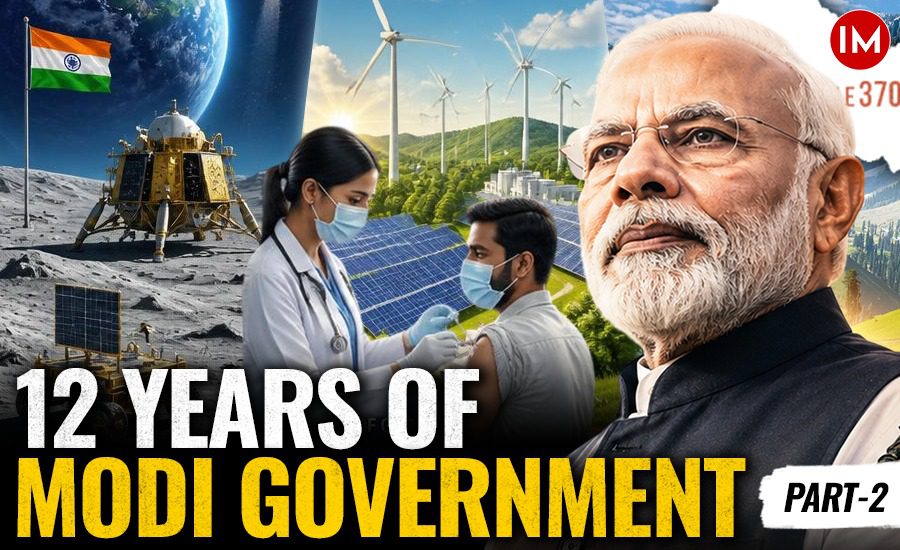
As Prime Minister Narendra Modi completes 12 years in office, the scale and scope of change witnessed across India continue to fuel both discussion and debate. While the first part of this special Indian Masterminds series explored six major achievements in defence, infrastructure, taxation, digital payments, financial inclusion, and welfare delivery, the story of the Modi years extends far beyond these domains.
The past decade has also been marked by significant milestones that reshaped India’s economic standing, constitutional framework, scientific ambitions, public health response, social landscape, and energy future. From emerging as the world’s fourth-largest economy and achieving a historic lunar landing through Chandrayaan-3 to undertaking one of the most consequential constitutional decisions in independent India through the abrogation of Article 370, the period has been defined by several landmark developments.
In Part II of this three-part series, we examine six more achievements that have left a lasting imprint on the nation: India’s rise as a global economic power, breakthroughs in space exploration, the abrogation of Article 370, the world’s largest vaccination drive, major socio-economic reforms, and the rapid expansion of renewable energy. Together, these initiatives reflect the government’s efforts to position India as a stronger, more self-reliant, and globally influential nation.
Fourth Largest Economy
When the Modi government assumed office in 2014, India was the 10th or 11th largest economy globally, with a GDP of roughly $2 trillion. By 2026, India has surged to become the world’s fourth largest economy, with a GDP exceeding $4 trillion — having overtaken Japan. This economic ascent was underpinned by consistent 6–7% growth rates (except for the COVID-disrupted year), strong Foreign Direct Investment (FDI) inflows, and a manufacturing renaissance driven by Production Linked Incentive (PLI) schemes across 14 sectors ranging from electronics and semiconductors to pharmaceuticals and textiles. The Atmanirbhar Bharat vision and ‘Make in India’ initiative repositioned India as a serious global manufacturing destination, helping attract investments from leading international corporations seeking to diversify supply chains away from China.
Read Also: How India Changed in 12 Years: Six Reforms That Altered India’s Security, Economy and Society
Chandrayaan-3 and Beyond
India’s space programme reached a historic milestone in August 2023 when the Chandrayaan-3 mission successfully soft-landed the Vikram lander and Pragyan rover near the lunar South Pole — a first for any nation. This made India only the fourth country in history to achieve a soft landing on the Moon, and the first to do so at the lunar south pole, a region of immense scientific interest for water-ice reserves. The mission was accomplished at a fraction of comparable international mission costs, underscoring ISRO’s world-class engineering efficiency. India also launched the Aditya-L1 solar observatory mission and advanced its plans for Gaganyaan, the country’s first crewed spaceflight programme, firmly establishing India as a major space-faring nation.
Abrogation of Article 370
In a momentous and far-reaching constitutional move in August 2019, Parliament revoked Article 370, ending Jammu & Kashmir’s special autonomous status that had been in place since 1949. The state was also reorganised into two Union Territories — Jammu & Kashmir (with a legislature) and Ladakh (without). The government’s stated aim was the full constitutional, legal, and economic integration of the region with the rest of India, opening it up to national laws, investment, and development programmes. In subsequent years, the region witnessed significant infrastructure investment, a decline in militancy incidents, and the restoration of statehood processes. The decision fulfilled a longstanding BJP electoral commitment and remains one of the most consequential political acts of the Modi era, though it continues to attract debate on questions of democratic process and regional aspirations.
World’s Largest Vaccination Drive
When the COVID-19 pandemic struck in 2020, India mounted one of the world’s largest public health responses. An early nationwide lockdown in March 2020 helped buy time to build healthcare infrastructure. India then developed two indigenous vaccines — Covaxin (by Bharat Biotech with ICMR) and Covishield (manufactured by Serum Institute of India) — with remarkable speed. The subsequent vaccination drive administered over 220 crore doses, making it the largest inoculation campaign in human history by volume, largely free of charge to citizens. India also played the role of ‘pharmacy of the world,’ supplying vaccines to over 100 countries under the Vaccine Maitri initiative. While the devastating second wave in April–May 2021 exposed gaps in oxygen and hospital capacity, India’s overall recovery and economic rebound were among the strongest globally.
Socio-Economic Reforms
The Modi years saw several landmark social and economic reforms. The Muslim Women (Protection of Rights on Marriage) Act, 2019, criminalised instant triple talaq, upholding the rights of Muslim women and fulfilling a long-pending demand of women’s rights advocates. In January 2024, the consecration of the Ram Mandir in Ayodhya marked the culmination of a decades-long legal and social journey, drawing millions of pilgrims and carrying immense cultural and emotional significance for a large section of the population. On the economic side, the Startup India initiative, launched in 2016, has helped India emerge as the world’s third-largest startup ecosystem, with over 1.5 lakh DPIIT-recognised startups and more than 100 unicorns, fostering entrepreneurship and innovation across the country.
Renewable Energy Expansion
India made a dramatic pivot towards clean energy under the Modi government, emerging as a credible global voice on climate action. India’s total installed renewable energy capacity crossed 200 GW by 2025, with solar power capacity leaping from a mere 2.6 GW in 2014 to over 90 GW — one of the fastest expansions in the world. India met its Paris Agreement NDC target of achieving 40% of power capacity from non-fossil fuel sources nine years ahead of the 2030 deadline. The International Solar Alliance (ISA), co-founded by India and France in 2015, grew into a 120-nation platform promoting solar energy across the Global South. Ambitious targets for green hydrogen, offshore wind, and nuclear energy were also set, positioning India as a key player in the global energy transition while simultaneously strengthening energy security.
Also read: MP CM Mohan Yadav Hails PM Narendra Modi’s 12-Year Tenure, Calls It Era of Transformational Development