New Delhi: The Government of India is set to launch Central Bank Digital Currency (CBDC)-based Direct Benefit Transfer (DBT) under the Pradhan Mantri Garib Kalyan Anna Yojana (PMGKAY) in Chandigarh and Dadra & Nagar Haveli on August 14, 2026.
The initiative marks a significant step towards integrating the Digital Rupee with India’s welfare delivery system and is aimed at making food subsidy transfers more transparent, traceable and technology-driven.
The launch will be attended by Union Minister for Consumer Affairs, Food and Public Distribution Pralhad Joshi, Governor of Punjab and Administrator of Chandigarh Gulab Chand Kataria, Union Minister for Agriculture and Farmers Welfare Shivraj Singh Chouhan, Minister of State for Consumer Affairs, Food and Public Distribution Nimuben Jayantibhai Bambhaniya, and other dignitaries.
Chandigarh, Dadra & Nagar Haveli to Become First UTs
With the rollout, Chandigarh and Dadra & Nagar Haveli will become the first Union Territories in India to operationalise food subsidy transfers through programmable CBDC tokens.
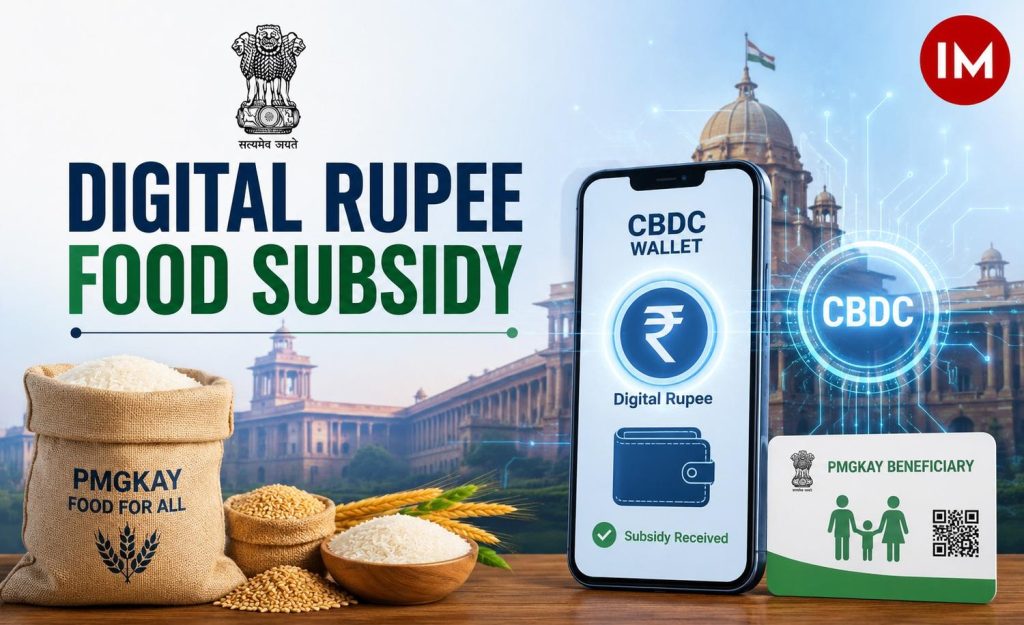
Eligible PMGKAY beneficiaries will receive their food subsidy directly into their CBDC wallets rather than through conventional bank account transfers.
The subsidy can then be used to purchase foodgrains from empanelled merchants through a secure and traceable digital payment mechanism.
The government said the rollout builds on earlier pilot implementations carried out in Puducherry and Gujarat. The latest phase will enable complete digital adoption and saturation among eligible beneficiaries in the targeted Union Territories.
How CBDC-Based Food Subsidy Transfers Will Work
Under the new model, the food subsidy amount will be transferred directly to the beneficiary’s CBDC wallet in the form of programmable Digital Rupee tokens.
Beneficiaries can use these tokens to purchase foodgrains from designated merchants. The digital nature of the transactions is expected to allow the government to monitor the movement and utilisation of subsidy funds in real time.
The system is designed to create an end-to-end traceable welfare delivery mechanism, reducing dependence on cash and conventional fund-transfer processes.
Aim to Reduce Leakages and Diversion
One of the key objectives of the CBDC-enabled DBT model is to strengthen transparency in the delivery of government subsidies.
According to the government, the system is expected to help reduce leakages, diversion and cash handling associated with traditional subsidy delivery mechanisms.
The use of programmable digital currency could also enable more targeted utilisation of welfare funds, while providing authorities with improved visibility over subsidy transactions.
The model is also expected to facilitate instant and secure transfers and promote financial inclusion through relatively simple wallet-based transactions.
Real-Time Monitoring of Subsidy Utilisation
The CBDC system will provide a digital trail for subsidy transactions, strengthening accountability and monitoring.
The government expects the initiative to provide greater insight into how food subsidies are utilised by beneficiaries and merchants. Real-time monitoring could also help authorities identify irregularities and improve the overall efficiency of welfare delivery.
The rollout therefore combines DBT, CBDC and digital public infrastructure in an effort to modernise the delivery of food subsidies.
From Pilot Projects to Wider Adoption
The initiative follows earlier CBDC-based welfare delivery pilots in Puducherry and Gujarat.
The Chandigarh and Dadra & Nagar Haveli rollout is being positioned as a larger-scale implementation involving eligible beneficiaries across the targeted Union Territories.
The government views the initiative as a proof of concept for the country that could eventually be adapted by other States and Union Territories.
The operational experience gained from the rollout is expected to help policymakers assess how CBDC technology can be integrated with welfare schemes on a larger scale.
Digital Rupee as a Future Welfare Delivery Tool
The launch also highlights the government’s efforts to explore wider applications of the Digital Rupee beyond conventional digital payments.
By integrating CBDC with a major welfare programme such as PMGKAY, the government aims to demonstrate how programmable digital currency can support targeted, transparent and accountable public fund delivery.
The experience from Chandigarh and Dadra & Nagar Haveli could provide a template for future adoption of CBDC-based welfare payments across India and contribute to the broader development of India’s Digital Public Infrastructure.
Key Highlights
- Launch date: August 14, 2026
- Scheme: Pradhan Mantri Garib Kalyan Anna Yojana (PMGKAY)
- Technology: Central Bank Digital Currency (CBDC/Digital Rupee)
- Beneficiaries: Eligible PMGKAY beneficiaries
- Initial UTs: Chandigarh and Dadra & Nagar Haveli
- Payment mode: Programmable CBDC tokens deposited into CBDC wallets
- Use: Purchase of foodgrains from empanelled merchants
- Key objective: Transparent, traceable and real-time subsidy delivery
- Earlier pilots: Puducherry and Gujarat
- Future goal: Scalable model for other States and Union Territories