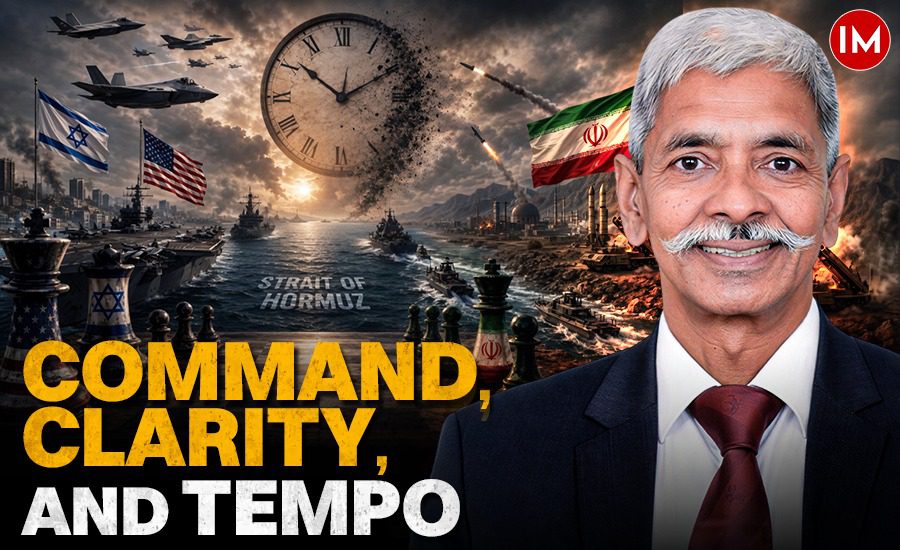
Wars are rarely lost only on the battlefield. Many are weakened long before that inside command rooms where hesitation quietly replaces clarity.
The ongoing confrontation involving the United States, Israel, and Iran has exposed an uncomfortable reality of modern power politics. Superior military capability does not automatically translate into strategic success. Technology matters. Intelligence matters. Alliances matter. But in prolonged conflicts, timing of decisions often matters even more.
That is where the US-Israel coalition struggled.
And Iran understood it.
The Strategic Trap of Waiting Too Long
History repeatedly punishes leaders who wait too long for perfect conditions. Waterloo did not collapse merely because Napoleon faced a stronger coalition. Delay, fatigue, fractured timing, and the inability to impose tempo changed the outcome. Panipat too carried similar lessons. Momentum lost at the strategic level often becomes irreversible at the tactical level.
The present West Asian conflict reflects a modern version of the same strategic dilemma.
Despite overwhelming air superiority, advanced surveillance systems, cyber capabilities, precision weapons, and diplomatic backing, the US-Israel coalition has been unable to terminate the conflict fully on its own terms. The expectation was rapid coercion. The reality became prolonged escalation management.
Why?
Because Iran refused to fight the war the coalition had prepared for.
More importantly, Iran identified decision latency inside its adversaries.
Decision latency is the hidden delay between recognizing a threat and acting decisively against it. In corporate boardrooms, it weakens execution. In geopolitics, it enlarges conflict windows. In warfare, it can become fatal.
The United States and Israel operated under multiple constraints simultaneously. Domestic political calculations. International diplomatic pressure. Energy market sensitivities. Escalation concerns involving the Strait of Hormuz. Risks of regional spillover. Concerns over global oil supply chains. Every move required layered consultation.
Also Read – N. R. Pillai: The Civil Servant Who Defined India’s Administrative Backbone
Iran exploited exactly this friction.
Tehran understood that the coalition’s military superiority came attached with political caution. The more complex the approval chains became, the slower the operational rhythm turned. Iran therefore avoided seeking outright battlefield parity. Instead, it focused on strategic endurance.
Iran’s Real Advantage Was Not Military Superiority
This is where military leadership offers a powerful lesson.
Combat environments teach a harder truth: waiting for perfect information often worsens the situation. Experienced commanders learn to act with 70 percent clarity rather than wait for 100 percent certainty that may never arrive. Speed, adaptability, and initiative frequently outweigh flawless planning.
Modern battlefields are fluid. Conditions change by the hour. Delayed decisions create operational vacuums, and adversaries exploit those gaps immediately.
Good commanders therefore focus on preserving initiative.
Leadership Principle – The Military Way
The military institutionalises this through command intent.
Once strategic intent is understood, subordinate leaders are empowered to act without waiting endlessly for instructions. This reduces friction, accelerates execution, and allows operational flexibility under uncertainty. Clarity of purpose compensates for fog of war.
Iran, despite economic pressures and sanctions, demonstrated greater comfort operating inside ambiguity.
It decentralised pressure.
Instead of relying exclusively on conventional military confrontation, it expanded strategic depth through proxy networks, missile signalling, maritime threats, cyber pressure, information operations, and calibrated escalation. Every response was designed not necessarily to defeat the coalition militarily, but to complicate its decision cycle.
That distinction matters.
Iran did not need outright victory.
It only needed to ensure that the coalition could not impose decisive closure quickly.
And once conflict duration increased, the balance slowly shifted.
Oil markets became nervous. Global shipping concerns resurfaced. Insurance costs rose. Regional actors recalibrated their positions cautiously. Questions emerged internationally about escalation limits and long-term sustainability.
Strait of Hormuz: The Pressure Point That Changed Calculations
The Strait of Hormuz became central to this equation.
Nearly every strategic planner understands its importance. A narrow maritime artery carrying a major percentage of global energy traffic possesses disproportionate geopolitical value. Iran repeatedly leveraged this reality psychologically as much as militarily.
This again reflects an old military principle: when direct strength is limited, increase the adversary’s cost of decision-making.
Iran imposed strategic hesitation.
The coalition, meanwhile, often appeared trapped between competing objectives — punish Iran strongly enough to restore deterrence, but avoid triggering uncontrolled regional escalation.
That balancing act slowed momentum.
And momentum in conflict is never neutral.
Some observers mistake caution for wisdom automatically. That is not always true. Strategic patience and decision paralysis are not identical concepts.
Military professionals understand this distinction instinctively.
During operations, uncertainty is constant. Yet commanders are trained to create clarity amid confusion. Deliberation exists, but it cannot become endless. Once intent is defined, action follows quickly. Delayed execution frequently increases casualties, weakens morale, and allows adversaries to regroup.
Why Decision Latency Matters Beyond Battlefields
This lesson extends beyond warfare.
Corporate leadership faces similar challenges today.
Boards often possess enormous data yet struggle to act decisively. Governments conduct endless reviews while crises deepen. Institutions become trapped inside procedural caution. Competitors meanwhile move faster.
The silent tax is not always incompetence.
Often it is latency.
The inability to convert awareness into timely execution.
Emerging Lessons for India
For India, the evolving conflict carries important strategic lessons.
First, future conflicts will not be won solely through military hardware superiority. Decision superiority will matter equally.
Second, distributed command structures and mission-oriented leadership must deepen further across national security institutions. Faster adaptation under uncertainty is becoming central to modern warfare.
Third, strategic communication and escalation management are now inseparable from kinetic operations. Wars are fought simultaneously across military, economic, diplomatic, cyber, informational, and psychological domains.
Fourth, India must continue strengthening energy resilience and maritime preparedness, especially considering the vulnerability of global supply chains linked to the Gulf.
The Doctrinal Shift India Must Embrace
Finally, doctrine must increasingly reward initiative.
The side that compresses its decision cycle faster often shapes the conflict narrative first.
That is exactly what Iran attempted successfully.
The Final Strategic Message
The larger lesson emerging from this conflict is unequivocable not to be overlooked is-
Power without decisiveness produces diminishing returns.
The US-Israel coalition possessed superior capability. Iran possessed superior tolerance for ambiguity and strategic delay.
And in prolonged contests, the side willing to operate faster inside uncertainty often gains disproportionate leverage.
Field Marshal William Slim once observed that morale is the greatest single factor in war. Today, one could add another dimension – tempo.
Nations that hesitate excessively under pressure gradually surrender initiative to adversaries willing to move first.
The battlefield may appear distant from the boardroom. In reality, the principle is identical.
Leadership is ultimately tested not when information is perfect, but when uncertainty is unavoidable.
That is where decision latency becomes either a hidden weakness or a decisive advantage.
Also Read – India’s Farms Feed the Nation – But Fail to Prosper Its Workers