In the tumultuous early years of the Republic, when India was still learning the grammar of self-governance, institutions did not arrive pre-packaged. They had to be imagined, forged, and carefully stabilised. While the spotlight naturally fell on political leaders shaping the destiny of a newly independent nation, the real work of building durable administrative structures often rested with a handful of understated professionals working away from public view.
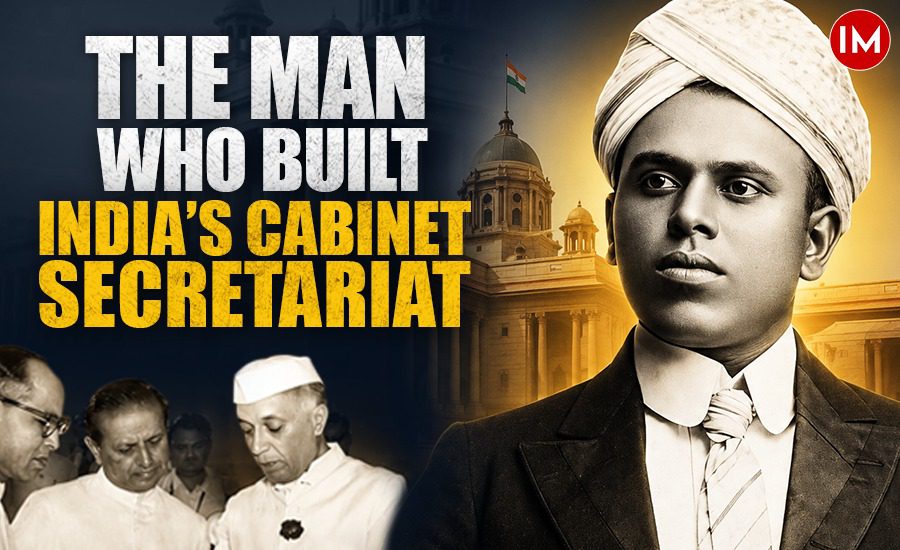
Among them stood N. R. Pillai — independent India’s first Cabinet Secretary and the man who would give concrete shape and enduring character to what Sardar Vallabhbhai Patel famously called the “Steel Frame” of Indian administration.
Born on 24 July 1898 in Travancore (present-day Kerala), Narayanan Raghavan Pillai hailed from a family with a quiet tradition of public service. His academic brilliance was evident early. After securing first-class honours from the University of Madras, he proceeded to Trinity Hall, Cambridge, where he pursued the unusual combination of Natural Sciences and Law. This rare blend of analytical precision and legal acumen would later become the defining strength of his long administrative career.
Pillai joined the Indian Civil Service (ICS) in 1922, during a period when the service embodied both the authority and the methodical efficiency of colonial governance. Over the next two decades, he served in varied assignments across commerce, customs, and general administration, steadily building a reputation for competence, intellectual clarity, and unimpeachable integrity. By the 1940s, he had risen to become Secretary in the Commerce Department, one of the most senior positions in the colonial bureaucratic hierarchy.
Yet, it was after Independence that Pillai’s most significant contributions would unfold.
Also Read – Feeling Freedom by Losing It: Telangana is Rethinking Justice
The Birth of a New Role
The transition from colonial rule to sovereign democracy demanded more than mere continuity of administration. It required a fundamental recalibration. The new political leadership, under Prime Minister Jawaharlal Nehru, needed an administrative system capable of coordinating multiple ministries, ensuring policy coherence across a vast and diverse nation, and maintaining bureaucratic discipline within a democratic framework.
It was in this context that the post of Cabinet Secretary was conceived. In February 1950, N. R. Pillai was appointed as independent India’s first Cabinet Secretary. There was no blueprint, no established convention, and no institutional memory to guide him. The role had to be defined almost from first principles.
Pillai approached this responsibility with characteristic rigour. He transformed what could have remained a largely secretarial function into the central coordinating nerve centre of the Government of India. Under his stewardship, the Cabinet Secretariat evolved into:
● The principal coordinating authority across ministries
● The vital institutional link between the Prime Minister’s Office and various departments
● The guardian of administrative procedures, conventions, and discipline
In an era devoid of settled precedents, Pillai laid down enduring norms for inter-ministerial consultation, the preparation of Cabinet notes, decision-making protocols, and the critical principle of bureaucratic neutrality in a vibrant political democracy. These may appear as routine procedures today, but in 1950 they were foundational acts of institution-building.
His tenure from 1950 to 1953 coincided with one of the most intense periods of nation-building in modern Indian history — managing large-scale refugee rehabilitation, initiating economic planning, establishing key institutions, and defining India’s place in the emerging global order. Ensuring coherence and synergy across these diverse and often competing demands required not merely administrative competence, but genuine institutional imagination. Pillai provided both.
The Art of Coordination
If one word captures the essence of Pillai’s legacy, it is coordination.
The central challenge before the young republic was not simply formulating policies but ensuring their effective alignment — between ministries, between the Centre and the states, and crucially, between political vision and administrative execution. Pillai recognised early that fragmentation posed the greatest threat to effective governance.
Through the Cabinet Secretariat, he institutionalised mechanisms that prevented decisions from being taken in silos. Ministries were encouraged — and at times gently prodded — to work in synchrony. The Prime Minister began receiving structured, comprehensive, and actionable inputs rather than fragmented departmental views. In doing so, Pillai elevated the Cabinet Secretary from a mere coordinator of paperwork to the true nerve centre of governance.
Senior bureaucrats who worked with him later recalled his insistence on thoroughness, his ability to see the interconnectedness of issues, and his quiet but firm commitment to due process. He understood that in a democracy, the civil service’s legitimacy rested not on power, but on its capacity to serve as a neutral, competent, and reliable instrument of the elected government.
A Life of Continued Service
After laying the foundations of the Cabinet Secretariat, Pillai continued to serve the nation with distinction. From 1953 to 1959, he served as Secretary-General in the Ministry of External Affairs, playing a key role during a formative phase of Indian diplomacy. He later served as India’s Ambassador to France, demonstrating that his skills extended comfortably from domestic administration to international statesmanship.
He was also closely associated with the establishment of the National Council of Applied Economic Research (NCAER), reflecting his deep conviction in the value of rigorous, evidence-based policymaking.
In 1960, the Government of India conferred upon him the Padma Vibhushan, one of the country’s highest civilian honours, in recognition of his exceptional service.
An Enduring Institutional Legacy
Today, the Cabinet Secretary is universally acknowledged as the senior-most civil servant in the country and the head of the Indian civil services. The position is widely regarded as the pivot around which the entire governmental machinery rotates. These attributes did not evolve organically. They were consciously designed, refined, and institutionalised — beginning with the quiet, methodical work done by N. R. Pillai in the early 1950s.
Unlike more visible reformers such as T. N. Seshan or institution-builders like V. P. Menon, Pillai’s contributions were largely invisible to the general public. He did not lead dramatic campaigns or oversee high-profile political integrations. Instead, he performed a more profound and lasting task: he built the processes, conventions, and institutional culture that allow governance to function smoothly even amidst political change and increasing complexity.
His legacy lies in the quiet strength of systems that continue to operate decades later — often taken for granted precisely because they work reliably.
Lessons for Contemporary Governance
For today’s policymakers and senior civil servants, N. R. Pillai’s life offers several enduring lessons.
First, institutions are not self-sustaining. They require constant reinforcement through clarity of roles, respect for established procedures, and uncompromising integrity in execution.
Second, in an era of increasing specialisation and departmental silos, the ability to coordinate effectively remains the highest administrative skill. Complex governance challenges — whether in economic reform, national security, climate action, or digital transformation — demand seamless alignment across ministries and between the Centre and states.
Third, bureaucratic neutrality and intellectual honesty are not abstract virtues but practical necessities for democratic governance. Pillai’s career demonstrated that the civil service earns its legitimacy not by exercising power independently, but by serving as a competent and impartial instrument of the elected executive.
As India navigates an increasingly complex, fast-paced, and fragmented governance landscape in the 21st century, the foundational principles that N. R. Pillai embedded into the system — coordination, procedural integrity, and institutional discipline — remain remarkably relevant.
In an age that often celebrates visible disruption, Pillai reminds us of the profound value of quiet, methodical institution-building. The steel frame he helped strengthen continues to support the world’s largest democracy — largely invisible, yet utterly indispensable.
Also Read- The Engineer Who Left High-Frequency Trading to Crack UPSC in One Shot