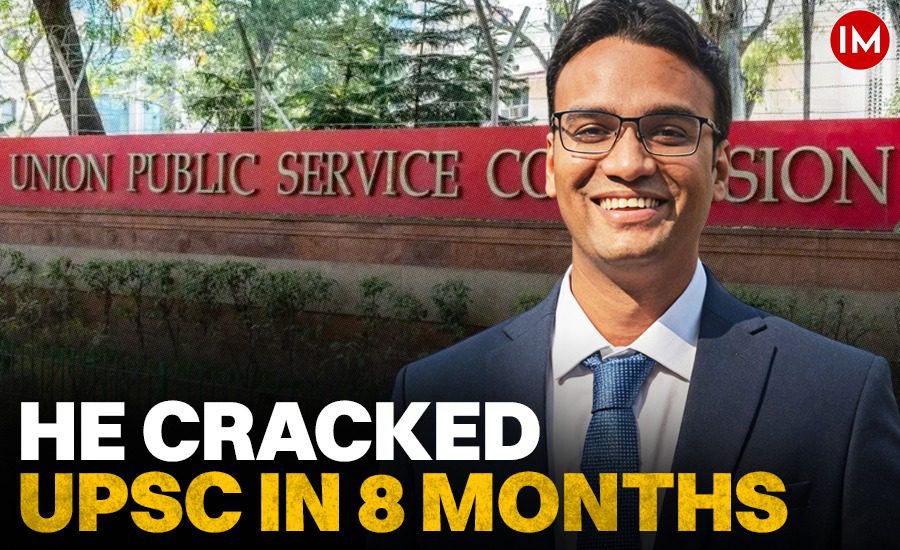
For six years, Shreyansh Barodiya was building a thriving career in the fast-moving world of high-frequency trading. An IIT Bombay computer science graduate, he was working in Gurgaon, solving complex technological problems and even leading his second company.
From the outside, it looked like the perfect career graph.
But somewhere amid algorithms, code, and market speeds, another thought kept surfacing: the idea of stepping into public service. And when he finally decided to act, he did what engineers often do best: he approached it like a problem to be solved.
The result? UPSC Civil Services Examination 2025, All India Rank 194, in his very first attempt.
“I started preparing in September 2024. May 2025 was my first prelims, and this was my first attempt,” he shared in an exclusive conversation with Indian Masterminds.
Yet behind that calm statement lies a story of sharp planning, disciplined execution, and remarkable clarity.
A FAMILY BUILT ON LEARNING
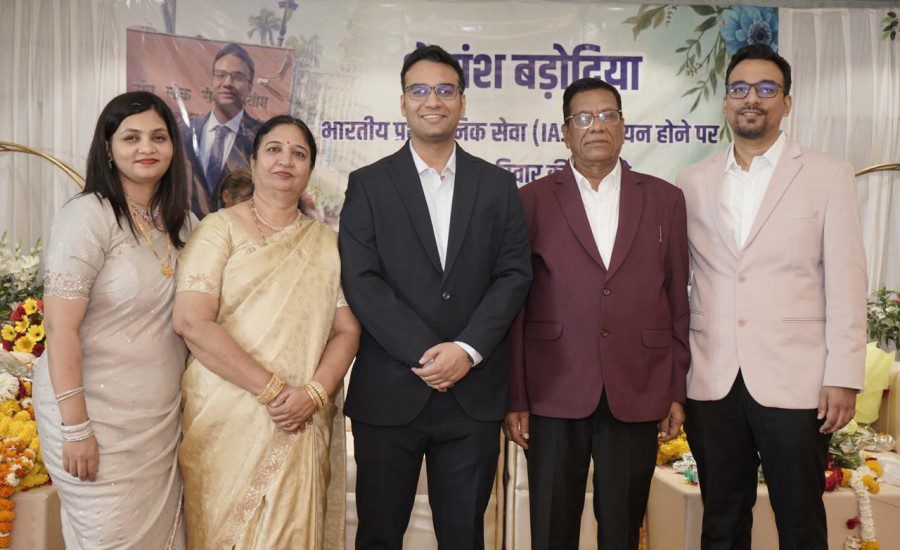
Shreyansh grew up in a household where education was not merely encouraged; it was lived every day. His father, armed with degrees in BCom, MCom and LLB, served the Madhya Pradesh government and retired as Joint Director of Finance.
His mother, a homemaker, chose to pursue an MBA in her 50s, a decision that quietly reflected the family’s belief that learning has no age.
His elder brother, an IIT Bhubaneswar civil engineering graduate, later pursued an MBA and now works as a consultant at Deloitte. His sister-in-law, a cybersecurity specialist, completed her MTech from NIT Kurukshetra.
It was a home where academic conversations were routine, curiosity was natural, and growth never stopped.
His own childhood was shaped by movement. Because of his father’s frequent transfers, Shreyansh studied across several small towns in Madhya Pradesh.
Those constant shifts exposed him to different environments and perspectives early in life, something that later helped him adapt quickly to the vast UPSC syllabus.
THE IIT BOMBAY FOUNDATION
Shreyansh completed his Computer Science and Engineering from IIT Bombay in 2018, one of the country’s most competitive academic spaces. The years at IIT sharpened his analytical instincts, problem-solving ability, and comfort with structured thinking.
After graduation, he entered the private sector, joining high-frequency trading firms in Gurgaon. His growth was rapid. He worked as a software engineer and eventually took on leadership responsibilities in his second company.
By every conventional standard, he was on a strong professional path. But after six years in the industry, he chose to walk away. Not because the career lacked promise.
Because he wanted something else.
ONE ATTEMPT. ONE CLEAR STRATEGY.
Shreyansh had no humanities background. That could have been a challenge. Instead, he treated it as a gap to be bridged systematically.
“My strategy was very simple. Since I did not have a humanities background, I had to watch a lot of coaching videos.”
Time was limited. So, he accelerated everything.
He consumed lectures at 1.5x, 1.75x, and even 2x speed, focusing first on foundational subjects like poverty, economy, geography and environment.
His logic was straightforward: build the base first, then move to testing. And testing became central.
He solved a large number of prelims tests while simultaneously preparing for mains-specific subjects such as science and technology, international relations, internal security, and society.
Meanwhile, mathematics optional preparation continued independently using coaching notes and inputs from friends. It was a layered preparation model running in parallel. Efficient, structured, and intensely practical.
WHY MATHEMATICS?
Choosing an optional subject was easy. There was no computer science option available. Mathematics felt like the closest fit.
“Mathematics came the closest to computer science because both are mostly logical.”
For Shreyansh, mathematics offered clarity. It was objective. It was insulated from daily current affairs fluctuations. And perhaps most importantly, it offered a mental switch.
“Sometimes, while reading general studies papers, you can switch to mathematics to sort of switch off your mind from current events.”
That balance helped him maintain focus through an otherwise demanding preparation cycle.
THE MENTORSHIP ADVANTAGE
A major pillar of his success was guidance. He had two close friends helping him throughout his preparation. One was an IAS officer of the 2023 batch in the Maharashtra cadre. The other had written three mains but narrowly missed final selection.
This gave him something invaluable: both success patterns and cautionary lessons. He could identify what worked and what didn’t.
Their support shaped his strategy all the way to the interview stage.
PACKING MAINS PREPARATION BETWEEN PRELIMS AND MAINS
Unlike many aspirants who spend months answer-writing before prelims, Shreyansh had to compress that phase.
“I did not have a lot of time to write answers before prelims, so all that had to be packed up between prelims and mains,” he shared with Indian Masterminds.
It was a compressed schedule that demanded complete focus.
And it worked.
His engineering habit of operating under constraints became an advantage.
MASTERING THE PERSONALITY TEST THROUGH PEER SIMULATION
For the interview stage, preparation took a highly collaborative turn. He joined multiple discussion groups. Each had a focused purpose.
One was dedicated entirely to Madhya Pradesh-related discussions. Another revolved around newspaper analysis and building informed opinions on current affairs.
Members conducted mock interviews with each other almost daily over video calls. They challenged perspectives, tested responses, and refined articulation.
This process gave him confidence and conversational depth. It also helped him answer real interview questions effectively.
WHEN CHATGPT BECAME A PREPARATION TOOL
In an interesting blend of technology and preparation, Shreyansh also used AI as part of his interview strategy.
“I used ChatGPT a lot for creating different kinds of questions and exploring different dimensions in which a conversation can go.”
He even experimented with AI-led mock interviews.
Though he admits that the simulation did not work perfectly, it helped broaden his thinking. It was yet another example of how he integrated technology intelligently into preparation.
BUILD THE FOUNDATION FIRST
For those preparing for UPSC, Shreyansh’s advice is clear.
“Completing the foundation courses is very, very important because later it helps you understand everything comprehensively.”
He strongly advocates reading newspapers consistently, not obsessively, but thoughtfully.
He never made detailed newspaper notes. Instead, he focused on repeated exposure. The idea was simple: when you read the same issue through multiple lenses and multiple writers, clarity develops naturally.
And importantly, he encourages aspirants to be realistic with themselves. If exhaustion hits, skipping a day is fine. Consistency matters more than rigid perfection.
A STORY OF SMART EXECUTION
Shreyansh Barodiya’s journey is not about a dramatic overnight transformation. It is about intelligent planning. About applying engineering precision to one of India’s most unpredictable examinations.
From small-town schooling across Madhya Pradesh to IIT Bombay, from high-frequency trading floors to the UPSC final list, his path reflects a powerful truth:
Success in UPSC is not reserved for any one background.
With clarity, structure, and focused execution, even the steepest transitions can be made.
And for Shreyansh Barodiya, that transition has just opened the door to a much larger journey.