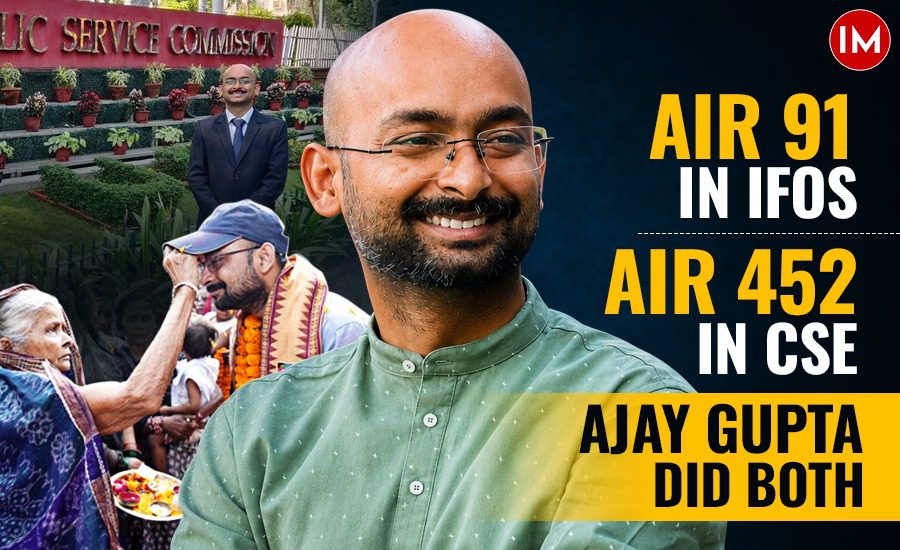
For many UPSC aspirants, the journey often begins with a dream. For Ajay Gupta, it began with circumstances, exposure, and a gradual realisation that public service could become a meaningful career.
Ajay Gupta, who secured AIR 91 in the UPSC Indian Forest Service Examination 2025 and AIR 452 in the UPSC Civil Services Examination 2025, comes from a small village called Sambalpuri in Chhattisgarh’s Raigarh district. With a population of nearly 1,000 people, the village shaped much of his early understanding of life, agriculture, and rural realities.
Raised in a farming family, Ajay’s parents were engaged not only in agriculture but also in forest produce collection activities. Until 2019, these activities remained an important part of the family’s livelihood.
“My parents are farmers. Along with agriculture, they were also involved in forest produce gathering like mahua and tendupatta,” Ajay shared in an interview with Indian Masterminds.
He completed his primary education in a government school in his village before moving to Mukti Prakash Mali Higher Secondary School under the Chhattisgarh Board. Later, he pursued metallurgical engineering from the National Institute of Technology Raipur.
Interestingly, UPSC was never a childhood ambition.
“There was no childhood dream that I had to go for UPSC. Even I did not know much about the examination initially,” he says.
However, life at NIT Raipur gave him exposure to seniors who had cleared the examination. That slowly changed his perspective. Yet financial realities at home prevented him from immediately taking the risk of full-time preparation after graduation.
Instead, Ajay joined PRADAN, a development sector organisation, and spent nearly four years working in the Bastar district of Chhattisgarh. Those years became a turning point.
Working closely on rural development, tribal livelihoods, agriculture, and forest-based livelihoods, he witnessed governance from close quarters.
“So there I got more exposure to how governance works. I interacted with IAS officers and saw how they work,” he explains.
His experience in Bastar went beyond office work. He lived among tribal communities, stayed in their homes, shared meals, and understood local culture and language. Those interactions shaped both his worldview and interview personality later.
By then, the idea of joining civil services had become clearer.
“I felt that through civil services I could work at a greater scale and with greater pace,” he says.
THE PREPARATION STRATEGY THAT WORKED
Ajay’s UPSC journey was not short. The Civil Services Examination 2025 was his sixth attempt and third personality test. The Indian Forest Service examination, however, turned out to be different — it was his first interview for IFoS and eventually resulted in AIR 91.
His preparation strategy evolved significantly over the years.
“For prelims, I focused more on the static subjects like polity, geography and modern history. For dynamic subjects, current affairs became more important,” he says.
He relied heavily on standard books and extensive test paper practice. But according to him, simply solving tests is not enough.
For mains preparation, note-making became central to his strategy. “I think your quality of answers depends on the quality of notes you are having,” he says.
Ajay consistently updated his notes using feedback from mentors and model answers from coaching institutes. He also focused heavily on answer writing during his later attempts, especially for general studies papers.
Rather than studying endlessly without direction, he emphasises prioritisation.
“Your hard work should be driven by strategy. Follow previous year questions, prioritise topics, and understand what is important,” he advises.
WHY AGRICULTURE BECAME HIS OPTIONAL SUBJECT
Ajay chose agriculture as his optional subject for both CSE and IFoS. The choice was deeply connected to his upbringing and field experience.
Growing up in a farming household gave him practical exposure, but his years in Bastar strengthened his academic interest in the subject.
For the Indian Forest Service examination, he selected botany as his second optional.
Interestingly, Ajay did not rely heavily on coaching for optional preparation. He focused on self-made notes, previous year questions, and freely available study material, including Tamil Nadu Agricultural University notes.
“I prepared each keyword from standard sources and practised PYQs extensively,” he says.
That strategy paid off. He believes agriculture played a major role in helping him clear both examinations in the same year.
FROM HINDI INTERVIEWS TO ENGLISH COMMUNICATION
Ajay openly speaks about struggling with English communication during the early phase of his UPSC journey. In fact, he gave his first two interviews in Hindi.
“I was not very good in English initially,” he admits.
A major improvement came after 2023, when he started mentoring students and teaching certain subjects in Andhra Pradesh, where communication in English became necessary.
That regular practice significantly improved his confidence and fluency.
For interview preparation, he focused on detailed preparation of every keyword mentioned in his DAF (Detailed Application Form) and attended multiple mock interviews.
He describes one of his interviews as particularly memorable because the board took keen interest in his Bastar experience and tribal work. Another interview began with a difficult question on Mahatma Gandhi’s ideas and disagreements with them.
Different boards, different experiences — but each interview added learning.
REFLECTIVE WRITING AND PERSONAL GROWTH
One unique aspect of Ajay’s profile is his hobby: reflective writing.
During his time in Bastar, he wrote articles based on his field experiences. Some of them were published on platforms such as Sampark.net and Agriculture World magazine.
“That writing habit helped me in essay and GS answer writing,” he says.
In UPSC CSE 2025, he scored around 119 marks in the essay paper.
A RESULT THAT BECAME BIGGER THAN AN EXAMINATION
When the final results were declared, Ajay says the first feeling was not excitement but relief.
Before returning home, he visited Bastar and celebrated the result with the tribal communities he had worked with for four years. Watching their happiness made the achievement deeply emotional for him.
Later, when he reached his village, celebrations had already begun.
“My whole village was dancing. For us, it was not just a job but an opportunity for many young people to dream bigger,” he says.
MESSAGE FOR ASPIRANTS
After six CSE attempts and multiple interviews, Ajay Gupta says UPSC preparation should be guided by strategy, not random hard work.
He advises aspirants to focus on previous years’ questions, prioritise important topics, and avoid blindly following what everyone else is studying.
Ajay also speaks about handling disappointment during the long UPSC process.
“Do not let fortune decide whether you will succeed or not. Let your hard work decide,” he says.
According to him, consistency matters because results may not come immediately despite sincere preparation.
He also highlights the importance of having supportive people and good mentors during preparation.
Apart from this, he recommends regular answer writing, proper note-making, mock interviews, and continuous self-evaluation. He believes improving communication skills gradually through practice can make a major difference during the interview stage.
Today, Ajay Gupta’s story stands out not because it followed a perfect path, but because it evolved through exposure, repeated attempts, field experience, and continuous refinement of strategy.