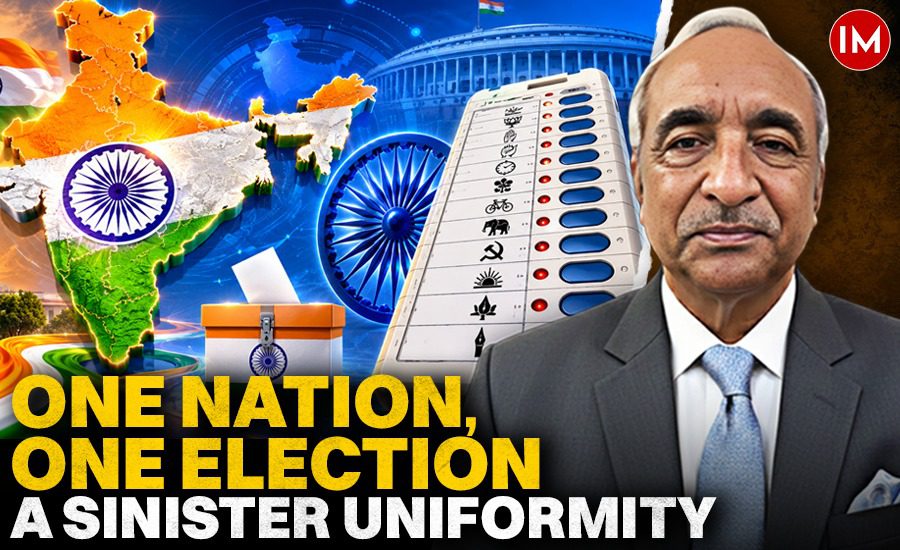
Supporters of One Nation, One Election frequently invoke the spectre of the Model Code of Conduct as a governance paralytic — a perpetual brake on development because some election is always approaching. This argument, while superficially attractive, does not survive scrutiny. The Model Code does not prohibit governance; it prohibits the abuse of state resources for electoral advantage. If a government finds itself unable to announce or implement policy except outside election season, the problem is not the election calendar. The problem is a governance culture addicted to populist announcements rather than systematic administration, writes former IAS officer V.S.Pandey
India is once again roiled by a debate that affects the very foundations of its republic. The proposal for ‘One Nation, One Election’ — the simultaneous conduct of Lok Sabha and all State Assembly elections — has returned to the centrestage of national discourse with renewed political momentum. Its proponents argue it will save money, reduce administrative burden, and allow governments to focus on governance rather than perpetual electioneering. But beneath this veneer of efficiency lies a proposal that is, at its core, a challenge to the pluralist, federal, and democratic DNA of the Indian republic.
Let us begin with the most uncomfortable truth about this proposal: it would concentrate enormous political advantage in the hands of whoever holds power at the Centre at the time of synchronisation. In a simultaneous national election, the ruling party at the Centre commands not merely policy but spectacle — national media converges on the Prime Minister, central government schemes dominate the narrative, and state-level issues are drowned in the flood of theCentre’s propagated narratives. For regional parties, whose very identity is rooted in local culture, language, and grievance, this is not an inconvenience. It is an existential threat.
Also Read- A Career Forged at Sea : The Sailor-Scholar Leading the Indian Navy Into a New Era
The resources commanded by the party in power at the national level — administrative machinery, Doordarshan, central investigative agencies (wielded, as critics have long noted, with selective zeal), and the enormous financial muscle of a governing party — would alter the playing field grotesquely. A voter in Kerala or Tamil Nadu, asked to choose their state government and central government simultaneously, would find the identity and concerns of their state overwhelmed by the gravitational pull of a national campaign machine.
The framers of the Indian Constitution were acutely aware of the country’s staggering diversity. B.R. Ambedkar and Jawaharlal Nehru — however different in temperament — shared the conviction that India could only be governed as a federation, not a unitary state with decorative provinces. The Constitution’s division of powers between the Union and the States is not a bureaucratic artefact; it is a political acknowledgment that the people of Nagaland, Gujarat, Bengal, and Kerala inhabit distinct political universes that must be allowed to speak in their own voice, at their own pace.
From 1952 to 1967, elections were indeed held simultaneously — not by constitutional design, but by coincidence of timing. The fragmentation of this cycle began organically: state governments fell, Assemblies were dissolved, and mid-term polls were necessitated by political reality. The Emergency of 1975-77 and its aftermath further disrupted the calendar. The suggestion that we must now engineer a return to simultaneity through constitutional amendments — including provisions that could force elected state governments to cut short or extend their terms — is to use the mechanics of democracy to subvert its spirit.
Supporters of One Nation, One Election frequently invoke the spectre of the Model Code of Conduct as a governance paralytic — a perpetual brake on development because some election is always approaching. This argument, while superficially attractive, does not survive scrutiny. The Model Code does not prohibit governance; it prohibits the abuse of state resources for electoral advantage. If a government finds itself unable to announce or implement policy except outside election season, the problem is not the election calendar. The problem is a governance culture addicted to populist announcements rather than systematic administration.
Furthermore, frequent elections are not a bug in democracy — they are a feature. Every election is an opportunity for accountability. When a state government goes to the polls, its five years of governance are examined, rewarded, or punished by the people. Staggered elections mean that citizens across India are, at various moments, exercising their sovereign right to judge their governments. To compress this into a single quadennial moment is to dramatically reduce the frequency of democratic accountability.
Those who advocate for synchronised elections often point to the United States, where Congressional and Presidential elections operate on fixed cycles, or to South Africa, which holds national and provincial elections simultaneously. But the comparison is instructive in ways its proponents do not intend. The United States, far from achieving stable governance through its fixed cycle, has become a case study in gridlock — a political system in which the mid-term elections of 2022 and the presidential cycle of 2024 produced divided government, legislative paralysis, and a nation ina near-permanent campaign mode regardless of electoral timing.
Germany, a federal democracy often cited as a model of governance efficiency, holds elections at different levels — federal (Bundestag), state (Landtag), and local — at entirely different times. Far from generating confusion, this staggered system ensures that citizens engage meaningfully with each level of governance on their own terms. The state election in Bavaria is about Bavarian concerns; the federal election is about federal ones. German voters are not asked to simultaneously judge their village mayor, their Land government, and their federal Chancellor as if these were interchangeable expressions of a single political will.
Sweden, Denmark, Canada, and Australia — all stable, well-governed democracies — hold national and sub-national elections at entirely different times. Canada’s provinces go to the polls independently of the federal parliament. Australia’s states elect their governments on distinct timelines from Canberra. None of these countries have found their democratic health imperilled by the lack of synchronisation. Indeed, the robustness of their democracies owes much to the fact that accountability is dispersed across multiple electoral moments rather than concentrated in a single event.
The practical implementation of One Nation, One Election requires constitutional amendments of extraordinary scope. Articles 83, 85, 172, and 174, which govern the duration and dissolution of Parliament and State Assemblies respectively, would all need to be altered. The Anti-Defection Law would require reinforcement to prevent artificial floor-crossings engineered to trigger elections at convenient moments. Most troublingly, any mechanism to synchronise elections must grapple with the possibility of a hung Assembly or a failed government mid-term — and the solutions proposed (President’s Rule, caretaker governments, or appointed bodies) all represent a retreat from democratic self-governance.
The Ram Nath Kovind Committee report of 2024, which recommended a phased implementation, acknowledged many of these difficulties without resolving them. The suggestion that state governments whose terms expire outside the synchronised window simply serve truncated or extended terms is constitutionally problematic and politically unacceptable to the states concerned. It would require the consent of precisely those regional parties who stand to lose the most from the proposal — a political paradox that no committee report can resolve.
There is a deeper philosophical point to be made here, one that goes beyond logistics or constitutional law. India is not a nation that achieved its unity by erasing its diversity. It is a civilisation that achieved its unity by celebrating, accommodating, and institutionalising its diversity. The election calendar, with its staggered plurality of state polls — each with its own dominant languages, its own caste equations, its own historical grievances and aspirations — is not a dysfunction. It is democracy living and breathing in real time across the subcontinent.
When Telangana goes to the polls in one season and Himachal Pradesh in another, when Odisha and Andhra Pradesh hold elections that turn on the specific promises of state-level parties rooted in local realities, they are expressing the irreducible specificity of their political identities. To flatten all of this into a single national election day is to treat India as a country of 1.4 billion identical citizens rather than as a federation of peoples whose political expressions are as varied as their landscapes.
Governance efficiency is a worthy goal. Reducing electoral expenditure is a worthy goal. But neither goal justifies the restructuring of India’s democratic architecture in ways that entrench central power, disadvantage regional parties, reduce the frequency of accountability, and demand that state electorates compress their distinct political judgements into a single national moment dominated by the politics of New Delhi.
India’s democratic journey has been, for all its imperfections, a story of expanding participation, deepening accountability, and growing assertion by previously marginalised communities — many of them organised precisely through state-level and regional politics. The Mandal revolution, the rise of Dalit politics, the assertion of linguistic and tribal identities, the growth of women’s representation — all of these have been nurtured in the fertile, staggered, gloriously untidy soil of India’s multi-tiered election calendar.
We do not need uniformity. We need accountability. We do not need a single election day. We need free, fair, and frequent elections at every level. The call for One Nation, One Election, however garbed in the language of modernisation and efficiency, is ultimately a call for the centralisation of democratic power. And that, in a country as vast, as diverse, and as ingeniously plural as India, is a call that must be firmly, thoughtfully, and democratically refused.
(Vijay Shankar Pandey is former Secretary Government of India)