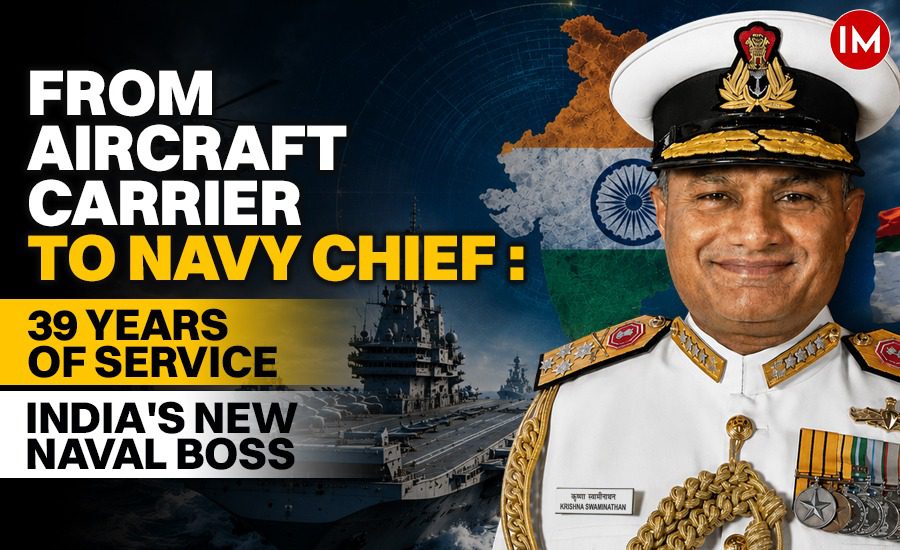
On 31 May 2026, as Admiral Krishna Swaminathan stepped into the office of the Chief of the Naval Staff, he brought with him nearly four decades of experience spent across warships, aircraft carriers, fleet commands, and some of the Indian Navy’s most critical leadership positions. From commanding frontline combat vessels to steering the Navy’s modernisation efforts, his journey reflects the evolution of a sailor who rose through the ranks by combining operational excellence, strategic vision, and a deep commitment to national security. Today, as the 27th Chief of the Naval Staff, he takes charge at a time when the Indian Navy is expanding its reach, strengthening self-reliance, and preparing for the challenges of a rapidly changing maritime world.
ROOTED IN DISCIPLINE, SHAPED BY LEARNING
Born in Bengaluru to D. Swaminathan and Shanta Swaminathan, both teachers, Krishna Swaminathan grew up in a household where education and discipline were deeply valued. The family lived in NR Colony in Basavanagudi, one of Bengaluru’s oldest neighbourhoods.
After attending Bishop Cotton Boys’ School, he joined Sainik School, Bijapur, a decision that set him firmly on the path toward a military career. From there, he entered the National Defence Academy, laying the foundation for what would become one of the most distinguished careers in the Indian Navy.
His academic achievements are as impressive as his operational credentials. He holds a BSc degree from Jawaharlal Nehru University, an MSc in Telecommunications from Cochin University of Science and Technology, an MA in Defence Studies from King’s College London, an MPhil in Strategic Studies from Mumbai University, and a PhD in International Studies from Mumbai University.
He is also an alumnus of the Joint Services Command and Staff College in the United Kingdom, the College of Naval Warfare in India, and the prestigious United States Naval War College in Rhode Island.
A CAREER BUILT AT SEA
Commissioned into the Indian Navy on 1 July 1987, Admiral Swaminathan specialised in Communication and Electronic Warfare, a field that would later become increasingly important in modern naval operations.
His early years were spent gaining operational experience aboard ships and learning the realities of life at sea. Over time, he emerged as one of the Navy’s most accomplished operational commanders.
He commanded the guided missile vessels INS Vidyut and INS Vinash, followed by the guided missile corvette INS Kulish. As his responsibilities grew, he took command of the guided missile destroyer INS Mysore, one of the Navy’s frontline warships.
Among his most notable commands was INS Vikramaditya, India’s flagship aircraft carrier. As only the second commanding officer of the carrier, he oversaw its operational deployment and led it during the International Fleet Review in 2016. Under his command, the carrier was adjudged the Best Ship of the Western Fleet, a reflection of both operational excellence and leadership.
RISING THROUGH THE RANKS
Admiral Swaminathan’s rise through the senior ranks of the Navy was marked by a blend of operational expertise and strategic leadership.
After promotion to Rear Admiral, he served as Chief Staff Officer (Training) at the Southern Naval Command in Kochi. In this role, he played a key part in shaping naval training and was instrumental in establishing the Indian Navy Safety Team, which oversees operational safety across the force.
He later served as Flag Officer Sea Training before taking command of the Western Fleet, often referred to as the “Sword Arm” of the Indian Navy. Commanding the fleet placed him at the centre of India’s maritime operations in the Arabian Sea and the wider Indian Ocean Region.
His leadership responsibilities expanded further when he was appointed Flag Officer Defence Advisory Group and Advisor for Offshore Security and Defence to the Government of India, a role that connected maritime security with critical offshore infrastructure and national energy interests.
FROM STRATEGIC COMMANDS TO NAVAL HEADQUARTERS
Promoted to the rank of Vice Admiral, he held a series of influential appointments that shaped policy, personnel management, and operational planning.
He served as Chief of Staff of the Western Naval Command, followed by appointments as Controller of Personnel Services and Chief of Personnel at Naval Headquarters. These positions gave him deep insight into the human resource and organisational dimensions of naval readiness.
In May 2024, he became the 46th Vice Chief of Naval Staff, one of the Navy’s highest appointments.
Before becoming the Navy Chief, he served as Flag Officer Commanding-in-Chief of the Western Naval Command, one of the most strategically important commands in the Indian Navy, responsible for safeguarding India’s western maritime front and key sea lanes.
A LEADER FOR A NEW ERA
Admiral Swaminathan takes charge at a time when maritime security is becoming increasingly important for India.
Throughout his recent appointments, he has emerged as a strong advocate for technological transformation within the Navy. He has consistently supported the induction of indigenous technologies, artificial intelligence platforms, advanced electronic warfare systems, and other emerging capabilities that can strengthen India’s maritime edge.
He has also been closely associated with efforts to expand the Navy’s self-reliance programme, supporting indigenous shipbuilding, submarine construction, and the broader vision of Aatmanirbharta in defence manufacturing.
Operational preparedness has remained another defining priority. During his leadership roles, he has overseen maritime security deployments, anti-piracy operations, and efforts to safeguard India’s interests across the Indian Ocean Region.
DECORATED FOR DISTINGUISHED SERVICE
A career spanning nearly 39 years has brought with it numerous honours and recognitions.
Admiral Swaminathan has been awarded the Vishisht Seva Medal in 2017, the Ati Vishisht Seva Medal in 2021, and the Param Vishisht Seva Medal in 2026 for distinguished service of the highest order.
These awards reflect not only professional achievement but also decades of commitment to national service.
COMMANDING THE FUTURE
Behind the uniform is a family man. He is married to Mrs. Laila Swaminathan, and the couple have two daughters.
As Admiral Krishna Swaminathan assumes charge as the 27th Chief of the Naval Staff on 31 May 2026, he inherits a Navy that is larger, more technologically advanced, and more strategically significant than ever before.
Yet his journey—from a student in Bengaluru to the commander of aircraft carriers, fleets, and naval commands—suggests he is uniquely prepared for the task ahead. In an era defined by maritime competition, technological disruption, and strategic uncertainty, the Indian Navy’s new chief brings a rare combination of operational experience, academic depth, and forward-looking vision to the helm.
Also Read – Development on Trial as Judiciary Weigh Growth Against Ecology