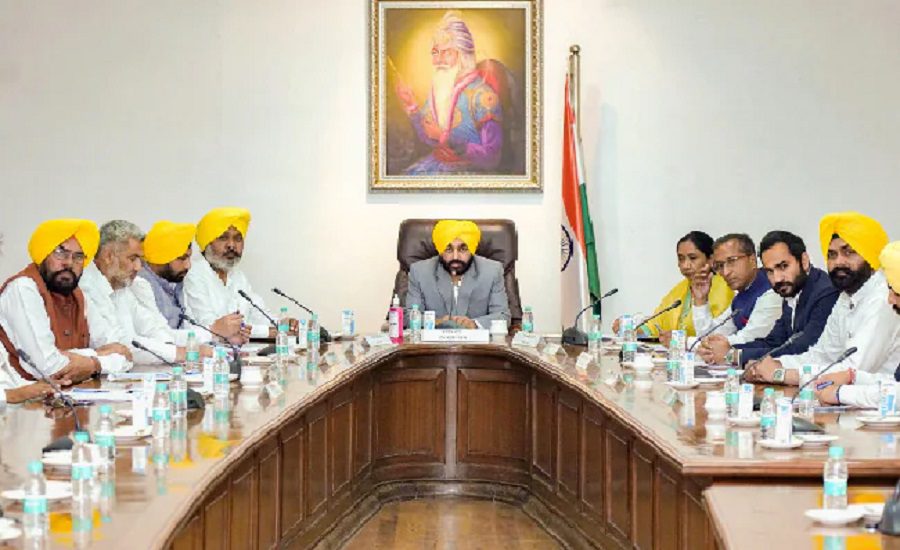
Chandigarh: The Punjab Cabinet, chaired by Chief Minister Bhagwant Mann, has approved a series of major policy decisions aimed at strengthening education, employment, environmental protection, and governance in the state. Among the most significant decisions is a proposal to cap annual fee hikes in unaided private schools at 5%, providing relief to parents and increasing transparency in the education sector.
The Cabinet also approved proposals for three new private digital open universities, a Punjab Protection of Trees Bill, relief measures for outsourced employees, the extension of veterinary services, and direct recruitment to vacant civil posts in the Public Works Department (PWD).
Punjab Cabinet Caps Private School Fee Hike at 5%
The Cabinet approved converting the existing ordinance regulating private school fees into a Bill.
Under the proposed law:
- Private unaided schools can increase annual fees by a maximum of 5%.
- Any fee hike beyond 5% will require prior approval from the designated regulatory authority.
- Schools may be subjected to financial scrutiny and forensic audits if required.
The legislation will come into force after it is passed by the Punjab Legislative Assembly and receives the Governor’s assent.
The government said the move is intended to prevent arbitrary fee hikes and make private school fee structures more transparent.
Special Money Bill to Benefit Outsourced Employees
The Cabinet also approved a proposal to introduce a special Money Bill to provide relief to employees appointed through outsourcing agencies during previous governments.
The proposed legislation seeks to:
- Bring eligible outsourced employees directly under the state government on a contractual basis.
- Improve job security for eligible workers.
- Streamline employment arrangements within government departments.
Finance Minister Harpal Singh Cheema said the proposal has been sent to the Governor for approval before being introduced in the Assembly.
Three New Private Digital Open Universities Approved
To strengthen higher education through technology-driven learning, the Cabinet approved the establishment of three new private digital open universities under the Punjab Private Digital Open University Policy.
The approved institutions include:
- Punjab’s first Cloud University on the Hoshiarpur-Chandigarh Road.
- MS Digital University at Fatehpur village in Patiala district.
- Physics Wallah Digital University at Anandpur Keshav village in Patiala district.
These institutions aim to expand access to higher education through advanced digital learning platforms.
Punjab Protection of Trees Bill Gets Cabinet Approval
To promote environmental conservation and address climate change concerns, the Cabinet approved the Punjab Protection of Trees Bill.
The proposed legislation provides that:
- Anyone cutting down one tree must plant 10 new saplings.
- Violations will attract financial penalties:
- ₹10,000 for the first offence.
- ₹35,000 for the second offence.
- Up to ₹50,000 for the third and subsequent violations.
The government said the Bill will strengthen tree conservation efforts across Punjab.
Veterinary Services Extended Until March 2027
The Cabinet approved the extension of services for veterinary personnel under the Rural Development, Panchayats and Animal Husbandry Departments.
The extension covers:
- 582 Veterinary Sub-Centres
- 449 Veterinary Pharmacists
- 552 Sanitation Workers
Their services have been extended from April 1, 2026, to March 31, 2027, ensuring continuity in veterinary healthcare services across the state.
Direct Recruitment Approved for Punjab PWD
In another important decision, the Cabinet approved direct recruitment to vacant civil category posts in the Punjab Public Works Department (PWD).
The move is expected to strengthen public infrastructure development while creating new employment opportunities.
Government Aims to Strengthen Education, Employment and Governance
Addressing the media after the Cabinet meeting, Finance Minister Harpal Singh Cheema said the decisions reflect the government’s commitment to:
- Improving the education system.
- Protecting parents from arbitrary school fee hikes.
- Expanding employment opportunities.
- Supporting environmental conservation.
- Enhancing administrative transparency and efficiency.
He said these reforms will contribute significantly to Punjab’s long-term development while benefiting students, employees, and citizens across the state.