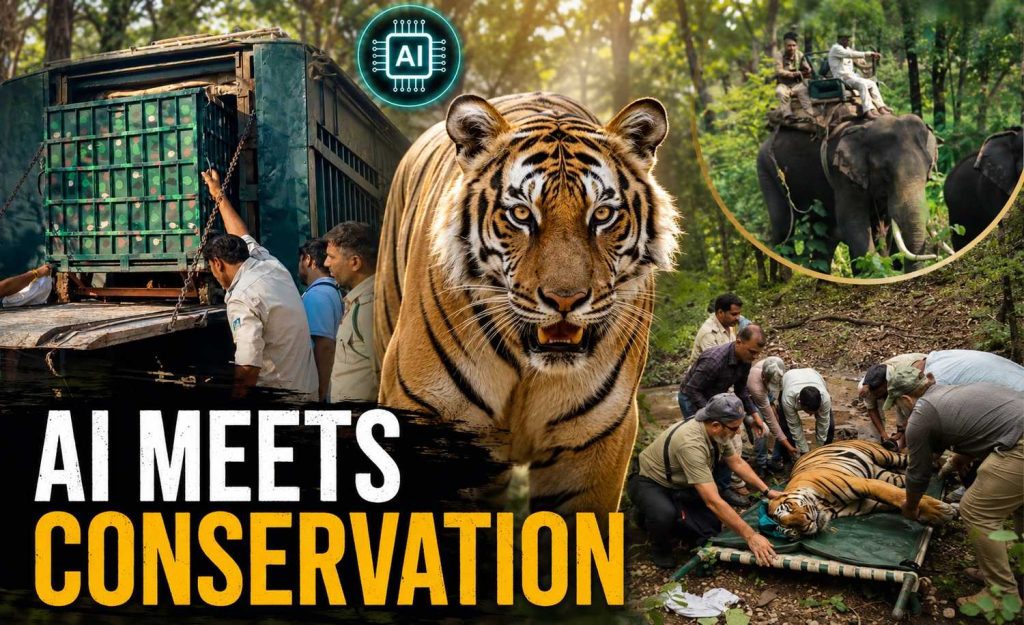
Wildlife conservation is entering a transformative phase where cutting-edge technology is becoming as crucial as courage and commitment in protecting endangered species. As human settlements continue to expand closer to forest landscapes, managing human-wildlife conflict has become one of the greatest challenges for conservation authorities. Recognising this need, the Madhya Pradesh Forest Department has embraced Artificial Intelligence (AI), scientific monitoring, and data-driven decision-making to strengthen wildlife conservation and rescue operations.
A remarkable example of this innovative approach emerged from the forests of Seoni district, where forest officials successfully rescued a nine-year-old male tiger, PN-103, after an intensive two-month-long operation. Combining Artificial Intelligence-enabled cameras, DNA profiling, trained elephants, and the unwavering dedication of over 60 forest personnel, the Forest Department not only ensured the safety of local communities but also secured the future of an aging tiger. The operation stands as a landmark example of how technology and conservation can work hand in hand to safeguard wildlife while reducing human-animal conflict.
The Challenge: A Tiger Roaming Near Villages
The rescue operation centered around PN-103, an approximately nine-year-old male tiger that had been roaming across the Barghat-Lamta landscape in Madhya Pradesh’s Seoni district.
For nearly four months, repeated incidents of human-tiger conflict had created fear among residents living in villages bordering the forest. The tiger’s movement close to human settlements increased concerns about the safety of both villagers and the animal itself.
The Forest Department therefore prioritised two equally important objectives:
- Ensuring the safety of local communities.
- Protecting the tiger through a safe scientific rescue instead of allowing further conflict.
However, rescuing PN-103 proved far more difficult than anticipated.
Explaining the situation, Devaprasad J., an Indian Forest Service (IFS) officer of the 2006 batch and Director of Pench Tiger Reserve, said, “Male tiger PN-103, which had been moving near villages in the Barghat-Lamta region, has been successfully rescued using modern AI camera technology.”
Why Identifying the Tiger Was the Biggest Challenge
The forests of the Barghat-Lamta region are home to rich biodiversity.
The rescue team discovered that the same landscape contained:
- Seven different tigers
- Leopards
- Bears
- Wild dogs (Dholes)
Distinguishing one particular tiger from several others roaming across the same forest became the greatest obstacle.
Highlighting the complexity of the operation, IFS Devaprasad said, “Seven other tigers, along with leopards, bears and wild dogs (dholes), were present in the same landscape, making identification of the target tiger a major challenge.”
Capturing the wrong tiger would have not only failed to solve the conflict but could also have disrupted the natural ecological balance.
Forest officials therefore decided that scientific certainty – not guesswork – would guide every step of the operation.
How AI Changed the Course of the Rescue
To accurately identify PN-103, the Madhya Pradesh Forest Department adopted Artificial Intelligence-based monitoring technology for the first time on such a scale during a tiger rescue operation.
Approximately 80 state-of-the-art AI-enabled cameras were strategically installed throughout the forest and sensitive locations.
For nearly two months, these cameras continuously captured thousands of photographs and videos.
Using AI-powered digital analysis, officials carefully monitored:
- Tiger movements
- Travel routes
- Behaviour patterns
- Activity timings
- Physical characteristics
- Identity of the target tiger
The technology enabled the rescue team to continuously track the tiger while minimising unnecessary disturbance inside the forest.
Describing the scientific strategy behind the rescue, he said, “The joint team developed a strategy based on scientific and technical principles. Around 80 state-of-the-art AI cameras were installed across the forest, while DNA samples collected from various locations, combined with evidence from the AI cameras, enabled us to accurately identify the target tiger. Based on this scientific evidence, permission for the rescue was obtained from the Chief Wildlife Warden of Madhya Pradesh.”
DNA Profiling Confirmed the Tiger’s Identity
Artificial Intelligence alone was not considered sufficient.
To eliminate every possibility of error, the Forest Department also relied on scientific DNA analysis.
DNA samples collected from multiple locations visited by the tiger were carefully examined and matched with the photographic evidence gathered through the AI camera network.
The combination of AI surveillance and DNA profiling conclusively established that the animal under observation was indeed PN-103.
Only after this scientific confirmation did officials seek and obtain permission from the Principal Chief Conservator of Forests (Wildlife) and Chief Wildlife Warden of Madhya Pradesh to proceed with the rescue.
This scientific approach ensured that the correct tiger was captured while the remaining wildlife remained undisturbed.
A Two-Month Mission of Persistence and Precision
The rescue operation demanded extraordinary patience.
For nearly two months, PN-103 repeatedly evaded the rescue teams despite continuous surveillance.
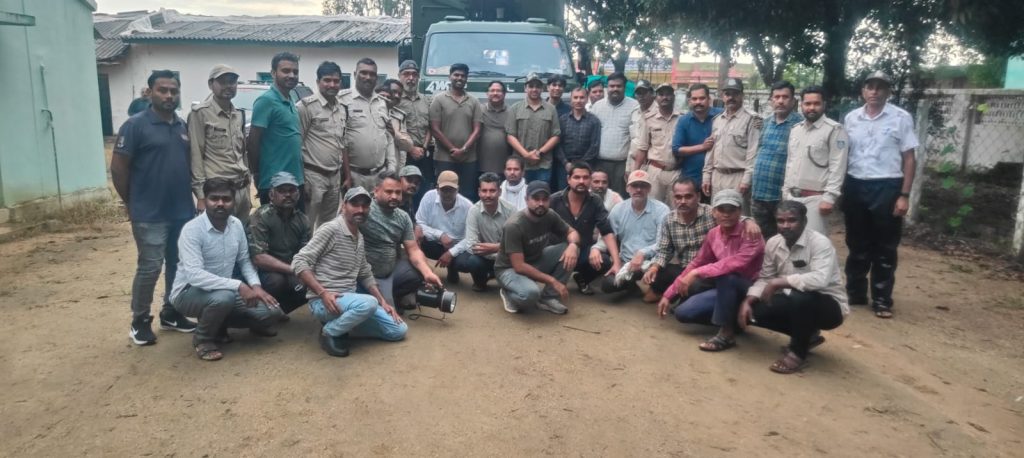
Around 60 forest officers and frontline staff remained engaged throughout the operation, working day and night under difficult field conditions.
The joint rescue mission involved officials from:
- Pench Tiger Reserve
- Barghat Project Unit
- Lamta Project Unit
- South Balaghat Forest Division
- South Seoni Forest Division
The operation was carried out under the guidance of Dr. Samita Rajora, Principal Chief Conservator of Forests (Wildlife) and Chief Wildlife Warden, Madhya Pradesh.
According to IFS Devaprasad, the rescue became exceptionally difficult because the tiger was moving through rugged terrain situated close to several villages, making every attempt both technically demanding and operationally sensitive.
He further noted that the rescue was conducted under the guidance of Dr. Samita Rajora, Principal Chief Conservator of Forests (Wildlife) and Chief Wildlife Warden, Madhya Pradesh, and was a coordinated effort involving the Pench Tiger Reserve rescue team, the Barghat and Lamta project units, and the South Balaghat and South Seoni forest divisions.
“The rescue operation was extremely difficult and challenging because the tiger was moving through rugged forest terrain bordering several villages,” he said.
The Crucial Role of Trained Elephants
Technology alone could not accomplish the mission.
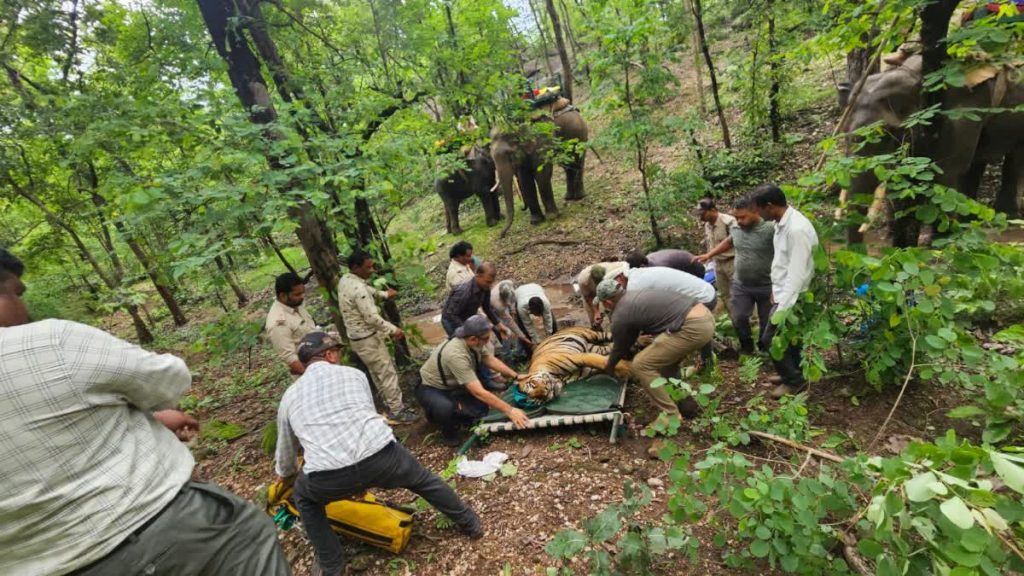
To safely approach the tiger inside dense forests and inaccessible terrain, the Forest Department deployed three trained elephants.
These included:
- Two elephants from Kanha Tiger Reserve
- One elephant from Pench Tiger Reserve
The elephants enabled forest personnel to safely navigate difficult landscapes and reach locations where vehicles or foot patrols were ineffective.
Their support proved instrumental in ensuring that the tiger could be approached and tranquilized without causing injury to either the animal or the rescue team.
Protecting Villagers While Saving Wildlife
Throughout the rescue mission, public safety remained the department’s highest priority.
Because human-tiger conflict incidents had been reported over the previous four months, an atmosphere of fear had spread across villages in the Barghat-Lamta region.
Forest officials, supported by local administration and law enforcement agencies, continuously monitored the tiger’s movements and managed the situation on the ground.
Despite challenging circumstances, the joint team successfully balanced wildlife conservation with community protection, ensuring that no unnecessary risks were posed during the operation.
The Successful Rescue of Tiger PN-103
After two months of relentless surveillance and planning, the rescue team finally succeeded on August 2.
Veterinary experts safely tranquilized the tiger before conducting a detailed health examination.
The operation marked the successful conclusion of one of the state’s most scientifically coordinated tiger rescue missions.
Health Examination Revealed an Aging but Healthy Tiger
Following the rescue, the tiger underwent a comprehensive medical examination conducted by:
- Dr. Akhilesh, veterinarian from Pench Tiger Reserve
- Dr. Prashant Deshmukh, wildlife expert from the Wildlife Conservation Trust
The examination revealed:
- Estimated age: approximately nine years
- Weight: around 240 kilograms
- Overall health: Good
- Teeth: Significantly worn due to age
Although the tiger showed signs of aging through its worn-down teeth, veterinarians confirmed that it remained otherwise healthy.
A Safe New Home at Van Vihar National Park
After completing all prescribed wildlife management protocols and official formalities, PN-103 was safely transported to Van Vihar National Park, Bhopal, where it will now reside under expert care.
The relocation not only ensures the tiger’s long-term welfare but also significantly reduces the possibility of future human-wildlife conflict in the Barghat-Lamta region.
A Landmark Achievement in AI-Based Wildlife Conservation
The successful rescue of PN-103 has demonstrated the immense potential of integrating Artificial Intelligence with traditional wildlife management techniques.
The operation showcased how:
- AI-enabled camera surveillance
- DNA-based identification
- Scientific planning
- Continuous monitoring
- Skilled veterinary care
- Trained elephants
- Inter-departmental coordination
- Dedicated field personnel
can collectively transform wildlife rescue operations.
The Forest Department considers Artificial Intelligence to have played a decisive role in identifying and monitoring the correct tiger, making the rescue safer, more efficient, and scientifically accurate.
The Road Ahead: Technology Shaping the Future of Conservation
Encouraged by the success of this operation, the Madhya Pradesh Forest Department has indicated that Artificial Intelligence and other modern technologies will be adopted on a much larger scale in future wildlife monitoring and rescue initiatives.
The department believes that advanced technologies can significantly improve wildlife tracking, reduce human-animal conflict, enable faster decision-making, and strengthen conservation efforts across protected landscapes.
The rescue of PN-103 is therefore much more than the successful capture of a single tiger – it is a milestone in India’s evolving conservation journey. It demonstrates that when scientific innovation is combined with dedicated field staff, experienced veterinarians, trained wildlife personnel, and community-focused planning, it is possible to protect both people and wildlife. As forests face increasing ecological pressures, this pioneering operation from Seoni offers a powerful model for the future of wildlife conservation, where Artificial Intelligence and human commitment work together to secure a safer future for endangered species.