“No nation becomes a great power by standing alone. It becomes one by building trusted partnerships that multiply its strength.”
For decades, India’s foreign policy rested on a powerful principle – Strategic Autonomy. It enabled New Delhi to pursue an independent course during the Cold War and later navigate an increasingly complex multipolar world without becoming tied to any single bloc.
That doctrine served India well.
But today’s world demands something more.
The geopolitical landscape is no longer defined solely by military alliances or economic competition. It is shaped by technology, resilient supply chains, maritime security, critical minerals, cyber resilience and trusted partnerships. Power is increasingly measured not just by what a nation possesses, but by the quality of the networks it builds.
India appears to have recognised this shift.
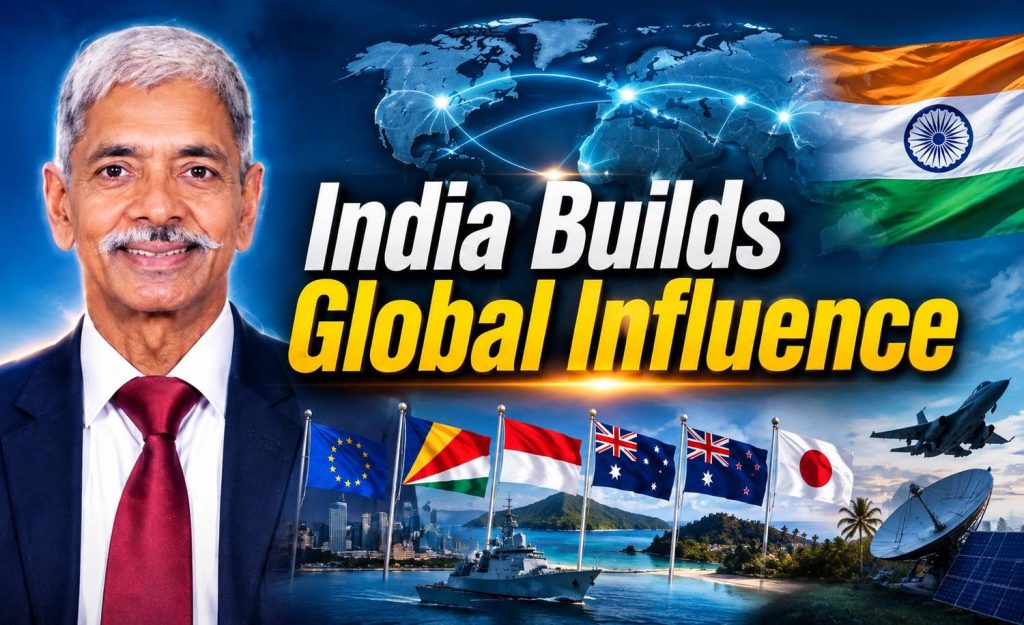
Recent diplomatic engagements by Prime Minister Narendra Modi from Europe to the Seychelles, Indonesia, Australia and New Zealand, culminating in the India–Japan Summit in New Delhi should not be viewed as a series of bilateral visits. They represent something much larger: the emergence of an Indian Partnership Doctrine.
This doctrine does not abandon strategic autonomy. It builds upon it.
Read Also: Partnerships, Not Power Politics: How India Is Quietly Shaping the New Global Order
Its objective is simple yet profound to transform India from a nation that balances competing powers into one that shapes the strategic environment through trusted partnerships.
As a military professional, I have learnt that no campaign is won by concentrating only on the battlefield. Victory depends upon logistics, intelligence, secure communication, reliable allies and strategic depth. Commanders prepare these long before the first shot is fired.
The same principle applies to nations.
Every major partnership India has forged over the past few months contributes to a different dimension of national power.
Europe offers advanced technology, innovation, clean energy collaboration and investment. At a time when supply chains are being reconfigured, deeper engagement with European partners reduces strategic dependence and strengthens economic resilience.
The Seychelles may appear a small island nation, but geography often outweighs size. Located in the western Indian Ocean, it occupies an important position along vital sea lines of communication. Stronger maritime cooperation enhances India’s ability to monitor the Indian Ocean Region, respond to humanitarian crises and safeguard commercial shipping.
Indonesia occupies an equally significant position. Sitting astride the approaches to the Malacca Strait, one of the world’s busiest maritime chokepoints, it is indispensable to India’s Indo-Pacific vision. Maritime cooperation with Jakarta strengthens regional stability while ensuring that one of the world’s most critical trade routes remains secure.
Australia has emerged as a natural strategic partner. Cooperation today extends well beyond defence exercises. Critical minerals, cyber security, clean energy, education and resilient supply chains now form the backbone of the relationship. These are not merely economic initiatives; they are investments in long-term national security.
New Zealand, though geographically distant, represents India’s growing engagement with the South Pacific. As geopolitical competition expands across the Indo-Pacific, trusted relationships with like-minded democracies become increasingly valuable.
Among all these engagements, however, India’s partnership with Japan deserves special attention.
The India–Japan Summit in New Delhi was far more than another annual diplomatic event. It reflected the maturity of one of India’s most consequential strategic relationships.
Japan contributes advanced technology, manufacturing excellence and investment. India offers scale, talent, innovation and a rapidly expanding market. Together, they are strengthening cooperation in semiconductors, artificial intelligence, green hydrogen, infrastructure, resilient supply chains and defence industrial collaboration.
Most importantly, both nations share a common vision for a free, open and inclusive Indo-Pacific.
This convergence carries significance far beyond bilateral ties. It demonstrates how two democracies can strengthen regional stability without creating exclusive military blocs.
That is strategic influence in practice.
Viewed collectively, these partnerships reveal a larger strategic pattern.
India is no longer conducting diplomacy transaction by transaction.
It is building a network.
This distinction is critical.
Traditional diplomacy focused primarily on bilateral relationships.
The emerging Partnership Doctrine creates an interconnected strategic ecosystem where every partnership reinforces another. Technology partnerships support economic resilience. Maritime partnerships strengthen energy security. Supply-chain cooperation enhances industrial competitiveness. Defence collaboration reinforces regional stability.
Together, they create strategic resilience.
This offers an important lesson not only for governments but also for corporate leaders and public institutions.
Many organisations still focus on individual transactions. The most successful institutions think differently. They invest in long-term relationships, diversify partnerships, reduce concentration risks and build networks that continue to deliver value during periods of disruption.
Boards should take note.
In today’s world, geopolitical risk has become boardroom risk. Supply chains, cybersecurity, climate resilience and technology partnerships are no longer operational concerns alone. They are strategic issues requiring oversight at the highest level.
The military has long understood the importance of redundancy and resilience. No responsible commander depends upon a single route, a single supplier or a single plan. Alternatives are prepared before they become necessary.
The same philosophy should guide governance.
India’s Partnership Doctrine is therefore as much about preparedness as it is about diplomacy.
Preparedness is not simply stockpiling resources.
It is building trusted relationships before crises emerge.
The world today is witnessing simultaneous disruptions—wars, cyberattacks, energy insecurity, technological competition and economic coercion. Nations that rely excessively on one market, one technology or one partner expose themselves to strategic vulnerability.
India’s answer is diversification through partnership.
This approach also strengthens India’s role as a bridge between developed economies and the Global South. Unlike traditional alliance systems, India’s partnerships are based on mutual respect, shared interests and practical cooperation. They are inclusive rather than exclusive.
That may well become India’s greatest diplomatic advantage.
As a soldier, I often witnessed how trust built during training proved invaluable during operations. Partnerships forged in peace determine success during crises.
The same applies to nations.
Trust cannot be created overnight.
It is cultivated through consistent engagement, credibility and shared purpose.
India’s recent diplomatic outreach reflects exactly that philosophy.
The coming decade will reward nations that can build resilient networks rather than rigid alliances; those that combine economic strength with technological capability; and those that inspire confidence instead of dependence.
India has begun that journey.
The Partnership Doctrine is not merely about expanding India’s diplomatic footprint. It is about expanding India’s strategic influence.
Strategic autonomy gave India the freedom to choose its path.
The Partnership Doctrine gives India the opportunity to shape the path of the emerging global order.
That is the hallmark of a confident nation.
And perhaps the clearest indication that India’s rise is no longer defined only by economic growth or military capability, but by its ability to build enduring partnerships that advance peace, prosperity and stability across continents.
The future will not belong to nations with the largest number of allies. It will belong to those with the most trusted partners. India is quietly positioning itself to be one of them.
(This is second part of the two part series on Indian Partnership Doctrine in the new global order. First Part’s link is given above.)
(Colonel M V Shashidhar (Retd) is a Defence & Strategic Affairs Expert, Certified Independent Director (IICA), ESG Advocate and Governance Thought Leader.)