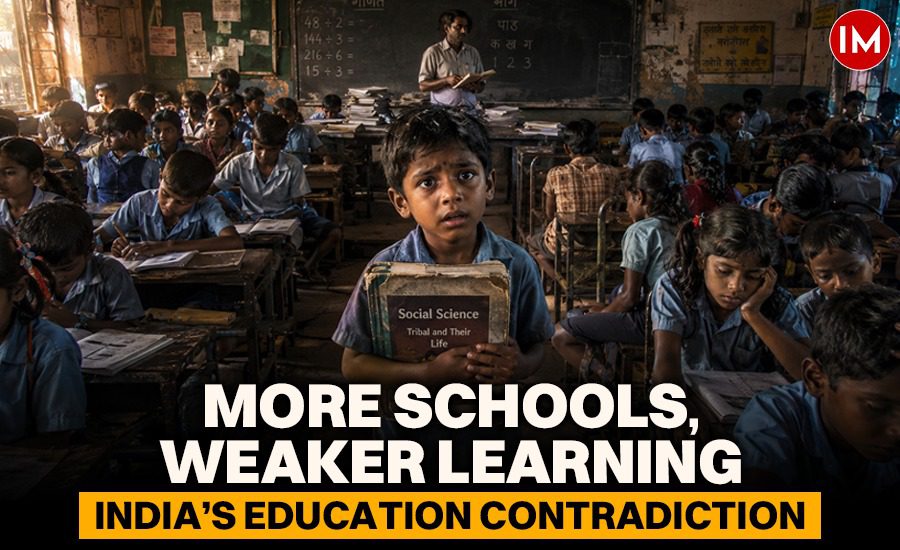
When NITI Aayog released its recent report “School Education System in India: Temporal Analysis and Policy Roadmap for Quality Enhancement” under the leadership of Suman Bery and Nidhi Chhibber, it offered a detailed account of both progress and persistent gaps in India’s school system. Yet, beyond the data and recommendations, the report leaves behind a quiet but unmistakable unease. India has succeeded in expanding schooling, but not in ensuring education. When this reality is placed alongside global experiences, from Germany to Japan, China to the United States, it begins to look less like a temporary challenge and more like a structural fault line.
Education in India is Expanding but not Sustaining
India’s schooling umbrella, as the report points out, is fundamentally discontinuous. It resembles a pyramid, wide at the base, with over 7.3 lakh primary schools, but narrowing sharply at higher levels, where only a small fraction of institutions offers uninterrupted education up to Class 12. Barely 5% of schools provide a continuous pathway. For millions of students, education is not a steady journey but a series of disruptions. Each transition, from primary to upper primary, and then to secondary, becomes a moment of uncertainty.
The consequences are visible in the numbers. While dropout rates at the primary stage have nearly disappeared, they rise sharply to 11.5% at the secondary level. The Gross Enrolment Ratio at higher secondary remains at 58.4%, suggesting that a large proportion of students never make it to the final stages of schooling. In States such as West Bengal, Karnataka, Assam, Meghalaya, and Arunachal Pradesh, the situation is particularly severe. West Bengal records dropout rates close to 20%, while Karnataka and Arunachal Pradesh report figures above 18%. By contrast, States like Kerala, Uttarakhand, and the Union Territory of Chandigarh fare better, indicating that outcomes are not inevitable but shaped by policy and governance.
Also Read – From Kandla to Global Gateway : How Deendayal Port Is Emerging as India’s Future Maritime Hub
Behind these numbers are lived realities. Infrastructure gaps, teacher shortages, and unequal access to quality schooling continue to push students out of the system. Rural schools in many regions still struggle with basic facilities, internet connectivity, and adequate staffing. Economic pressures at home, seasonal migration, language barriers, and exam-related stress further compound the problem. Transition points in schooling remain especially fragile, particularly for students from disadvantaged backgrounds and remote areas.
Illusion of Access and the Reality of Learning
The expansion of access remains India’s most visible success. With more than 24 crore students across nearly 15 lakh schools, the scale of the system is unmatched. Policy initiatives under the National Education Policy 2020 and the NIPUN Bharat Mission have sought to address foundational learning gaps.
Yet, the evidence from multiple assessments, from ASER to PARAKH, points to a persistent learning crisis. A significant proportion of students in upper primary grades struggle to read texts meant for much younger children. Fewer than 30% of Grade 6 students demonstrate competency in fractions. This is not just weak learning; it is shallow learning, knowledge that does not translate into understanding.
The decline is gradual but indicative. In 2014, about 74.7% of Grade 8 students could read a Grade 2 text. By 2024, that figure had slipped to 71.1%. In mathematics, the challenge is even more pronounced, with only 45.8% of Grade 8 students able to solve a basic division problem. Students often perform better on familiar, rote-based patterns but struggle when asked to apply concepts in unfamiliar contexts.
Teachers at the Edge of the System
The report’s findings on teachers hints towards a system stretched to its limits. More than one lakh schools function with a single teacher, who must juggle multiple grades, subjects, and administrative responsibilities. Nearly 14% of teaching time is lost to non-academic duties, reducing the already limited space for meaningful classroom engagement.
Equally worrying are the gaps in teacher preparedness. Many struggle to demonstrate proficiency in the subjects they teach, and only a small proportion of candidates clear eligibility tests with adequate scores. Training programmes remain sporadic, often detached from the realities teachers face on the ground.
China’s experience highlights what sustained attention to teacher systems can achieve. Through continuous evaluation and structured accountability, it has managed to translate comparable levels of investment into stronger outcomes. India’s challenge is not only to fill vacancies, but to rethink how teachers are trained, supported, and valued within the system.
Private School Shift and Crisis of Trust
The steady movement of students from government to private schools reflects a deeper erosion of confidence. Enrolment in public institutions has declined from 71% in 2005 to 49.24% in 2024–25, while private schools, particularly low-fee ones, have expanded rapidly.
Yet, the assumption that private schooling guarantees better learning does not hold consistently. A substantial proportion of students in these institutions also fail to meet basic reading and arithmetic benchmarks. The preference for private schools is often shaped by perception: English-medium instruction, visible discipline, and better infrastructure, rather than demonstrable learning outcomes.
The United States offers a parallel of a different kind. Despite spending nearly 5.8% of its GDP on education, it continues to grapple with uneven outcomes and inequalities across districts. The lesson is not that spending does not matter, but that it must be accompanied by accountability and equity. In India, the absence of transparent measures of school performance has allowed perception to substitute for evidence.
Spending Patterns and the Limits of Percentages
India’s public expenditure on education, at around 4-4.5% of GDP, appears comparable to that of several other economies. Germany spends a similar share, China operates at roughly 4%, and Japan spends even less, around 3.3%.
But these comparisons conceal an important reality. Per-student expenditure in countries like the United States, Germany, and Japan is significantly higher than in India. Even China, with a similar GDP share, spends more per student due to a larger economic base and more efficient allocation of resources.
This divergence explains why similar percentages produce very different outcomes. Spending as a share of GDP is only a broad indicator; what truly matters is how much reaches each classroom and how effectively it is used. Japan’s experience shows that efficiency and societal commitment can compensate for lower spending, while the U.S. case shows that high investment alone does not guarantee results.
India, therefore, faces a dual challenge: raising overall investment toward the long-standing 6% target, while ensuring that existing resources are used with far greater precision and accountability.
Infrastructure Gains and the Question of Priorities
The report acknowledges real progress in infrastructure, improvements in electricity, sanitation, and digital access across schools. Yet, these gains remain uneven. Thousands of schools still lack functional water sources handwashing facilities and separate toilets for boys and girls. Many operate without science laboratories, and a significant number remain disconnected from the internet. The presence of nearly 8,000 zero-enrolment schools points to deeper administrative inefficiencies.
At the same time, policy discussions have increasingly turned toward integrating advanced technologies such as artificial intelligence into classrooms. While this signals ambition, it also raises questions about sequencing. India may aspire to introduce cutting-edge domains like quantum computing, but many classrooms still struggle with basic subtraction and division. The gap between technological aspiration and foundational capability is difficult to ignore.
Reform Ambitions and Implementation Realities
The report’s roadmap is comprehensive. It calls for a shift from the existing pyramidal structure to a more integrated “cylindrical” model, enabling students to move seamlessly from primary to higher secondary education. It emphasises the creation of school complexes under the National Education Policy 2020, allowing for shared resources and better institutional coordination.
The recommendations extend to strengthening regulatory frameworks, improving quality assessment mechanisms, building a “whole-of-society” approach, empowering School Management Committees, and developing unified digital infrastructure through platforms like PM e-Vidya and BharatNet. Vacancy mapping and time-bound recruitment are also identified as priorities.
Yet, the underlying challenge remains unchanged. India’s education system has rarely lacked ideas; it has struggled with execution. Administrative fragmentation, varying state capacities, and competing priorities have often diluted reform efforts. The gap between intent and implementation continues to define the sector.
Germany’s institutional consistency, China’s administrative discipline, and Japan’s cultural commitment to education all point to a common lesson: sustainable reform depends as much on governance as on policy design. India’s difficulty has been in translating vision into sustained, ground-level change.
Developmental Contradiction
At a broader level, the report reveals a contradiction at the heart of India’s growth story. The country seeks to position itself at the forefront of technological and economic transformation, investing in innovation, digital infrastructure, and emerging sectors.
At the same time, its school system continues to struggle with foundational learning outcomes. A large number of students leave school without the ability to read fluently or perform basic arithmetic with confidence. The report’s cautious stance on introducing artificial intelligence from early grades reflects an awareness of this tension. Without proper teacher training and ethical safeguards, such initiatives risk widening, rather than bridging, the learning gap.
A knowledge economy cannot rest on weak educational foundations. The promise of a demographic dividend depends not just on the number of young people, but on the quality of their education.
Real Measure of Reform
The NITI Aayog report serves as both a reflection and a warning. It recognises progress, but also makes it clear that incremental change will not suffice.
The task ahead is not simply to expand access, but to ensure continuity, deepen learning, strengthen teaching, and align resources with outcomes. Global experiences show that this is achievable, but only with sustained commitment, clarity of priorities, and consistent execution.
Until then, the contradiction will remain unresolved. India will continue to project the ambitions of a future-ready nation, even as many of its classrooms struggle to deliver the most basic promise of education.