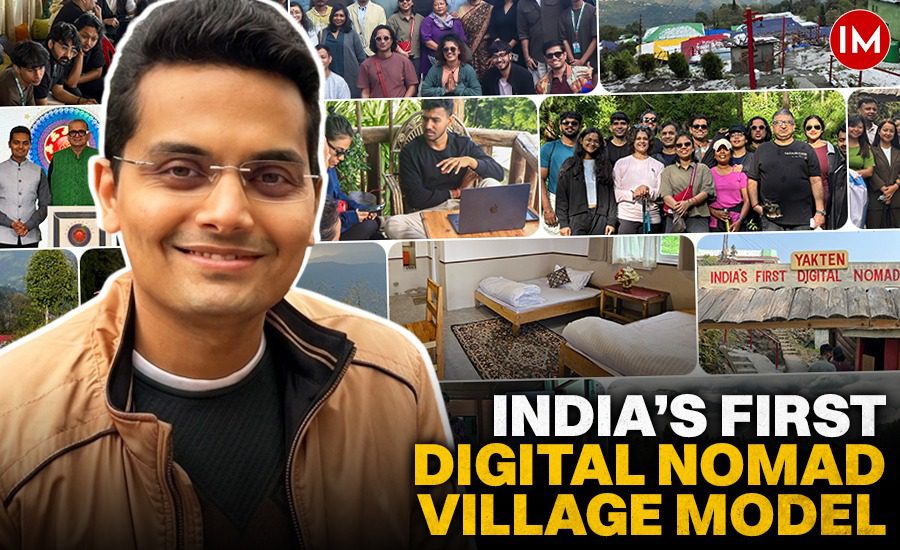
At a time when remote work is reshaping lifestyles across the world, a unique experiment in Sikkim is attempting to connect global professionals with rural India. Led by IAS officer Rohan Agawane (2017 batch, Sikkim Cadre), the Nomad Sikkim initiative is transforming villages into long-stay work destinations for digital nomads while creating entrepreneurship opportunities for local communities.
The project began when Mr Agawane was serving as District Collector of Pakyong. Mr Agawane is now posted as District Collector, Gangtok. Today, the model is already expanding to multiple districts in Sikkim, with ambitions to eventually position the Northeast as a major hub for digital nomads.
SOLVING TWO RURAL ECONOMIC PROBLEMS
The idea emerged from two clear administrative challenges identified in the Pakyong district. The first was low tourist footfall compared to other districts of Sikkim. The second was the seasonal nature of tourism income.
“Pakyong had very limited tourist footfall compared to other districts. Tourism is one of the biggest income generators for rural families here, so we wanted to find a way to increase that flow sustainably,” Mr Agawane shared in an exclusive interview with Indian Masterminds.
Traditional tourism in the region was largely concentrated within a few months of the year. During monsoons and harsh winters, homestays often remained empty, leaving families without regular income.
The administration began exploring whether remote workers and digital professionals could become long-duration visitors instead of short-term tourists. Sikkim’s clean environment, scenic landscape, organic food culture, and peaceful surroundings offered the lifestyle many remote workers actively seek.
“If you just connect good internet here, this can become one of the best co-working spaces for professionals across the world,” Mr Agawane explains.
BUILDING INDIA’S DIGITAL NOMAD VILLAGE MODEL
To turn the concept into reality, the district administration partnered with an NGO called Sarvahitey. Together, they developed what is now known as the Nomad Sikkim model.
Unlike commercial tourist destinations, the focus was not on luxury infrastructure. The aim was to create authentic village-based workspaces where visitors could stay for weeks or months while experiencing local culture.
The administration standardised homestays for hygiene, internet connectivity, and basic work requirements but intentionally avoided over-modernisation.
“From day one, the idea was not to modernise the village completely. Digital nomads come here because they want to experience local culture and local traditions,” says the officer.
The average stay of visitors is currently around three weeks, though some have stayed for several months. Professionals visiting the villages include IT employees, entrepreneurs, teachers working remotely, and people from creative industries.
According to Mr Agawane, visitors have come not only from different parts of India but also from the United States, Europe, Southeast Asia, and West Asia.
RURAL ENTREPRENEURSHIP GETS A GLOBAL PUSH
One of the most innovative aspects of the initiative is its entrepreneurship mentorship model.
The administration realised that once digital nomads begin staying in villages, they generate demand for several auxiliary services — laundry, bike rentals, cafés, gyms, transport, and local experiences. This creates opportunities for rural youth and aspiring entrepreneurs.
“It creates several opportunities for the youth because once the digital nomad ecosystem is set up, you require many support services around the village,” Mr Agawane says.
To strengthen this ecosystem, the administration introduced a one-on-one mentorship programme connecting visiting professionals with local entrepreneurs.
In one cohort conducted in October, 18 digital nomads from different countries were paired with 18 local budding entrepreneurs. The visitors stayed in the village, studied their businesses, and mentored them directly during their visit. Even after returning home, many continued interacting with the entrepreneurs online.
“Not all stories became successful, but at least six strong success stories emerged from that single cohort itself,” Mr Agawane notes.
The mentorship model has helped local entrepreneurs access exposure and business guidance that were previously unavailable in remote rural areas.
WOMEN AT THE CENTRE OF THE INITIATIVE
The project has also created strong economic opportunities for women because most homestays participating in the programme are managed by women.
The shift from short-term tourism to longer professional stays has changed not only income patterns but also the social environment within villages.
“Earlier, tourists would come for two days, party, and leave. Now children see professionals working on laptops, attending meetings, and discussing careers. That exposure itself is creating curiosity and aspiration,” says IAS Rohan Agawane.
The initiative has also accelerated financial inclusion and digital literacy. Since most payments are handled digitally, homestay owners have become more familiar with banking systems, online transactions, and structured accounting practices.
BALANCING TOURISM WITH LOCAL CULTURE
One concern often associated with tourism growth is cultural dilution. However, the administration consciously designed the project to avoid aggressive commercialisation.
The focus has remained on preserving local identity rather than converting villages into generic tourist hubs. Homestays continue to retain traditional architecture, local food, and community-driven hospitality.
Simultaneously, efforts are being made to develop zero-waste village systems and strengthen local waste management practices to reduce ecological pressure.
The administration believes this balance between economic opportunity and cultural preservation is one of the key reasons the project has received positive feedback from both visitors and local residents.
Many digital nomads reportedly value the isolation and distraction-free environment that allows them to focus deeply on work while also engaging with local communities.
INFRASTRUCTURE CHALLENGES IN THE HIMALAYAS
Despite the positive response, the initiative has faced several operational hurdles.
Reliable internet connectivity became the biggest challenge because remote work depends entirely on uninterrupted digital access. Landslides, heavy rainfall, and difficult Himalayan terrain often disrupt internet infrastructure.
To address this, the district administration arranged backup internet lines, alternative connectivity systems, and power backup solutions for participating homestays.
Another major challenge was convincing local homestay owners to trust a completely new concept.
“Initially, there was a lot of suspicion because this idea had not been implemented anywhere before. People were unsure whether professionals from across the world would actually come and stay in their villages,” Mr Agawane recalls.
The administration addressed this by first convincing respected community members, who later helped build trust among others in the village.
EXPANDING BEYOND PAKYONG
What began as a district-level experiment is now evolving into a larger regional model.
Work has already started in Gangtok and Soreng districts, with three out of Sikkim’s six districts now actively developing similar digital nomad ecosystems.
The long-term vision is far bigger.
“The vision is not just to create one digital nomad village in Pakyong. We want to take this model beyond Sikkim and eventually position the entire Northeast as a hub for digital nomads,” Mr Agawane told Indian Masterminds.
As remote work continues to redefine travel and lifestyle choices globally, Sikkim’s experiment offers an alternative development model — one that combines tourism, entrepreneurship, women-led economic participation, and rural sustainability without depending on large-scale urban infrastructure.
For many villages in the region, the laptop may now become as important as the tourist camera.