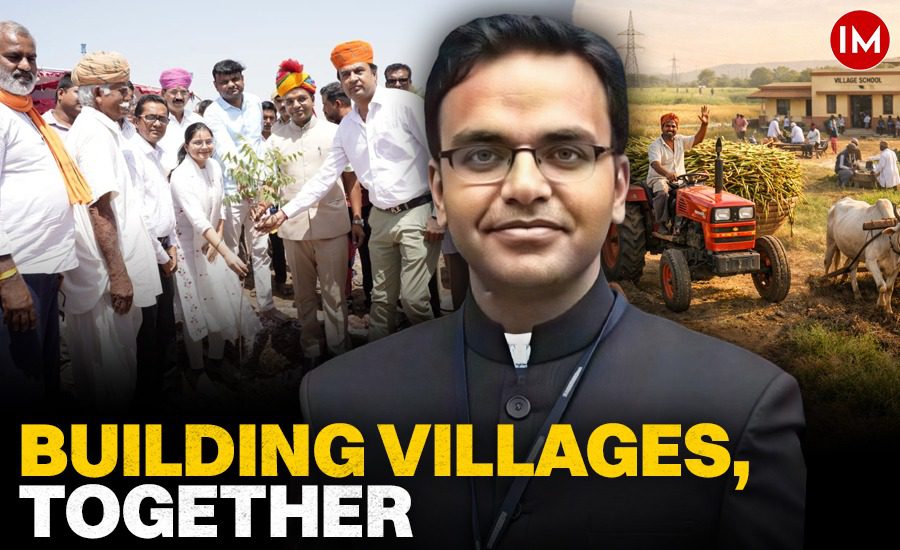
Every village has a story of someone who left.
Someone who grew up on its dusty lanes, studied in its government school, played beneath its trees, and then moved away in search of opportunities. Some went to cities. Others crossed oceans. But no matter how far they travelled, a part of them remained behind, in the village they still call home.
For years, that emotional connection existed quietly, often without a channel through which it could be transformed into meaningful action.
In Rajasthan’s Pali district, IAS officer Dr. Ravindra Goswami is attempting to change that.
As the District Collector of Pali, the 2016-batch Rajasthan cadre officer has launched “Aao Gaon Chalen” (Let’s Go Back to the Village), an initiative that seeks to reconnect migrant and non-resident Pali residents with their roots and invite them to participate directly in the development of their native villages.
The idea is simple. Instead of asking people to donate money to a government fund, the administration creates a bridge between those willing to contribute and the institutions that genuinely need support. The donor identifies a need, undertakes the work directly, and watches the impact unfold.
But behind this seemingly straightforward concept lies a powerful vision of community-driven development.
Also read: Saving Lives in Kota: IAS Officer Dr. Ravindra Goswami’s Crusade Against Student Suicides
A CALL FROM THE HOMELAND
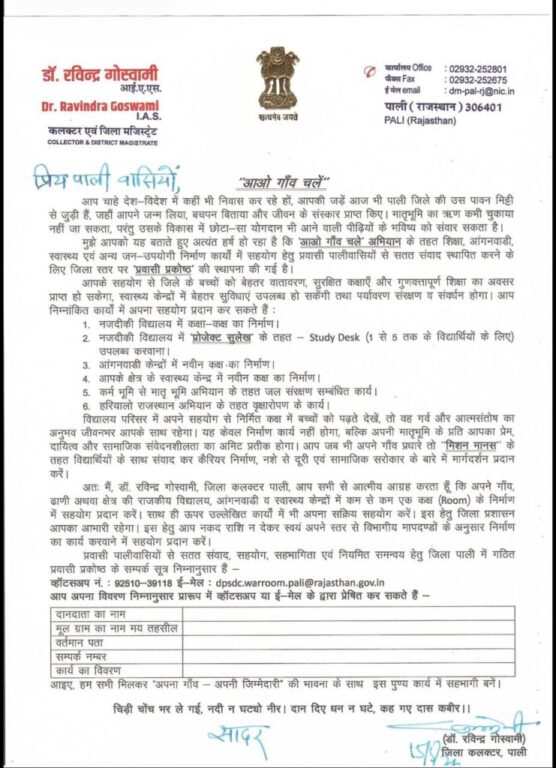
When Dr. Goswami issued his appeal to Pali residents living across India and abroad, it was less an administrative notification and more a heartfelt letter.
“Your roots are still connected to the sacred soil of Pali,” he wrote.
He reminded people that while the debt owed to one’s motherland can never truly be repaid, even a small contribution towards its development can shape the future of generations to come.
The campaign invites people to support schools, anganwadis, health centres, water conservation projects and plantation drives in their native villages. The appeal struck a chord because it tapped into a feeling many migrants already carry within them, the desire to give back.
Explaining the inspiration behind the initiative, Dr. Goswami exclusively told Indian Masterminds:
“Whoever goes outside always has a desire that I should do something for the place where I belong.”
But there was another side to the story as well. Government resources, he points out, cannot address every infrastructure gap immediately.
“Infrastructure gaps exist everywhere. The question is how to fill them. The government can do it, or we can facilitate support from people who want to contribute. We simply brought the donor and the department together.”
That meeting point became “Aao Gaon Chalen”.
NOT DONATIONS. ONLY PARTICIPATION.
One of the most distinctive features of the initiative is its structure. No money is collected by the administration. No funds are deposited into government accounts.
Instead, individuals directly support projects in accordance with departmental norms.
A classroom can be constructed in a government school. Study desks can be provided to young students under Project Sulekh. An anganwadi can receive a new room. A health centre can get an additional facility. A pond can be revived. A plantation drive can be undertaken.
The administration’s role is that of a facilitator.
As Dr. Goswami puts it: “No single penny will be deposited. The donor will do the work directly. We only provide the platform and connect them with the right institution.”
This model not only creates transparency but also gives contributors a personal connection with the work they support.
A donor can visit a school and watch children study in a classroom built through their contribution. That sense of ownership often becomes more meaningful than a conventional donation.
BUILDING A BRIDGE THAT NEVER EXISTED
The initiative was also born from an observation Dr. Goswami made after taking charge in Pali. The district already had a long tradition of philanthropy.
Many successful individuals had supported schools, community infrastructure and public institutions over the years. Yet there was a problem. No consolidated database existed.
The administration did not know who had contributed, where they had contributed, or how they could be engaged again. As a result, many donors felt disconnected after making their contributions.
Dr. Goswami told Indian Masterminds, “People had done a lot of work earlier, but the government had no database of who contributed and where. When there is no record, there is no continuity. Some people felt that after they helped, nothing further happened.”
To address this gap, the district administration created a Pravasi Prakoshth (Migrant Cell) and launched an open invitation to all migrant Pali residents.
The objective is not only to facilitate current projects but also to create a long-term database that can strengthen collaboration in the future. Today, the administration is systematically documenting contributors and creating channels for regular communication.
FROM CLASSROOMS TO WATER CONSERVATION
While education remains a major focus area, the initiative extends far beyond schools.
The campaign encourages support for five broad sectors:
- Government schools
- Anganwadi centres
- Health institutions
- Water conservation works
- Plantation drives
Several ideas have already begun flowing in from contributors. Some have expressed interest in building school infrastructure. Others want to provide benches and study desks.
There are proposals for donating medical equipment to hospitals. One group has proposed planting 20,000 trees. Others want to undertake pond restoration and cleaning projects.
“People are coming forward with different ideas,” says Dr. Goswami. “Some want to plant trees. Some want to clean ponds. They only need administrative support and permissions. We are trying to bridge that gap.”
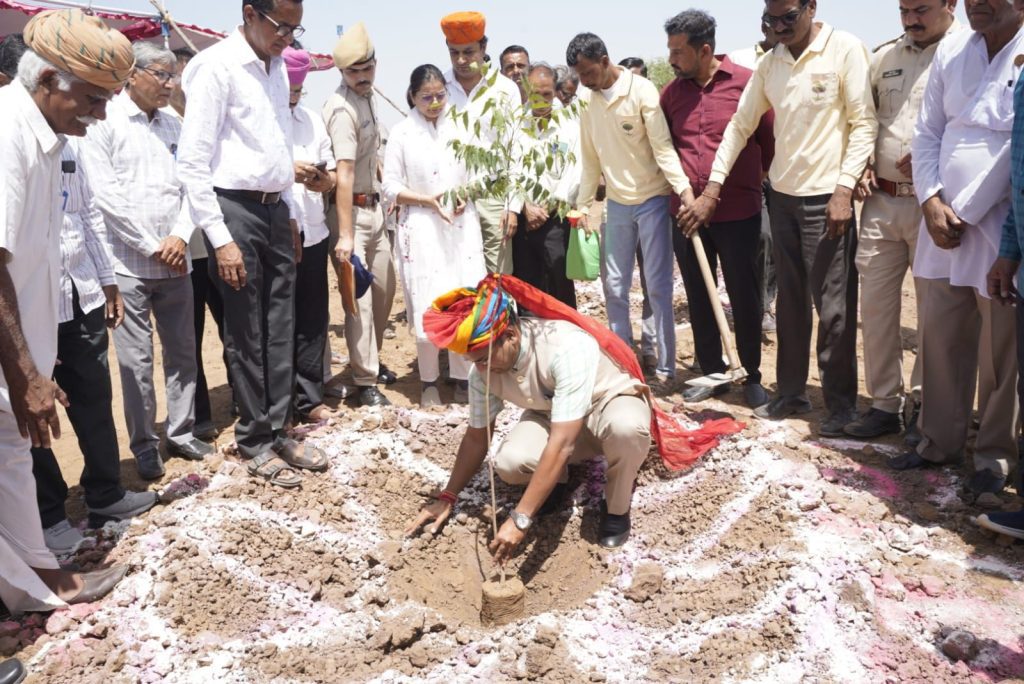
The initiative also complements Rajasthan’s broader environmental efforts through the Hariyalo Rajasthan plantation campaign and the Karmabhoomi Se Matrubhoomi water conservation initiative.
THE PRINCIPAL, THE DONOR AND THE MISSING CONVERSATION
Perhaps one of the most innovative aspects of “Aao Gaon Chalen” is the way it creates direct communication between institutions and contributors.
Traditionally, many donations were based on assumptions. A donor might decide to build a classroom without knowing whether the school actually needed one.
The administration wants to change that.
School principals have been asked to identify local migrants connected to their villages and directly communicate their institution’s requirements.
A school that already has sufficient classrooms may instead need computers, furniture, sports facilities or laboratory equipment. By enabling this conversation, the initiative ensures that contributions address actual needs rather than perceived ones.
“Money is not the issue,” says Dr. Goswami. “People often want to help. The challenge is informing them about what is genuinely required.”
The result is a more efficient partnership between community members and public institutions.
YOUTH AS THE MISSING LINK
The campaign also places local youth at the centre of the process. Young residents often know which families from their villages have migrated and achieved success elsewhere.
They help the administration identify potential contributors and establish contact. At the same time, they provide valuable insights into local requirements.
Whether it is a sports ground, a school facility or another community need, young people help shape the development agenda.
“They act as a bridge,” says Dr. Goswami. “They help us identify migrants and also tell us what their village actually needs.”
INSPIRED BY A FAMILIAR STORY
Interestingly, one of the inspirations behind the campaign comes from popular culture. Dr. Goswami referenced the iconic film Swades. The story of a successful professional reconnecting with his village and contributing to its development resonated deeply with him.
“Somewhere in the back of my mind was the theme of Swades,” he told Indian Masterminds. “After watching it, I felt that everyone wants to do something for the place they belong to.”
That sentiment forms the emotional core of “Aao Gaon Chalen”. It is not about charity. It is about belonging. It is about transforming memories into action. And it is about creating a future where migration does not weaken a village’s connection with its people; it strengthens it.
A VILLAGE’S DEVELOPMENT, EVERYONE’S RESPONSIBILITY
At its heart, “Aao Gaon Chalen” asks a simple question:
What if every person who left a village contributed just one meaningful change back home? A classroom. A study desk. A health facility. A pond restored. A grove of trees planted.
The answer could reshape hundreds of villages.
For IAS officer Dr. Ravindra Goswami, the campaign is an attempt to turn that possibility into reality.
Not through grand announcements or large government budgets, but through something far more enduring: the bond between people and the place they come from.
And in Pali, that bond is finding a new purpose.
Also read: Addressing Students’ Emotional Health Through ‘Kamyab Kota’