There are officers who are known by their designations. And then there are rare individuals whose inner worlds are far larger than the positions they hold.
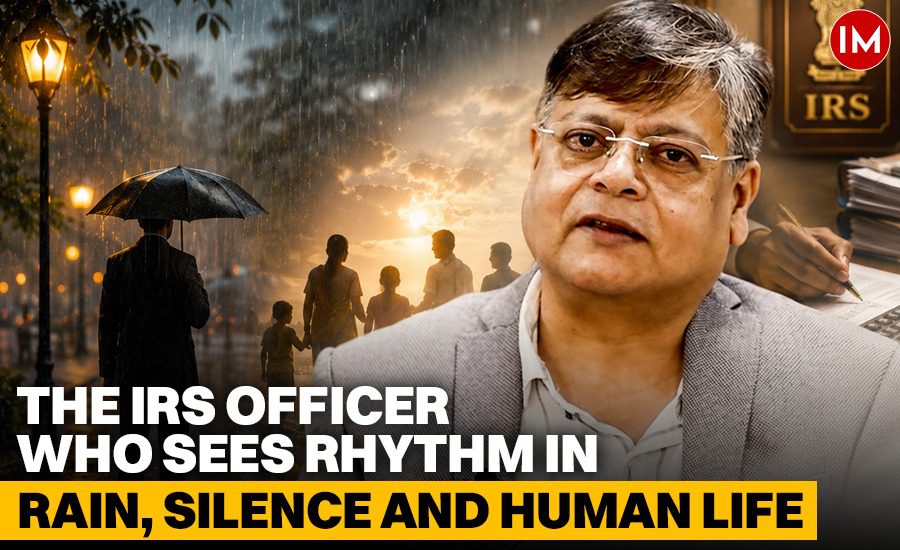
In one part of his life, Tushar Dhawal Singh handles investigations, administration, files, financial systems, and the demanding responsibilities of the Indian Revenue Service. As Principal Commissioner & Principal Director (Investigation) of Income Tax, Bihar of 1996 batch, he occupies one of the most sensitive positions in the bureaucracy.
But somewhere behind the official chair sits another man entirely.
A man who notices the rhythm of rain falling on rooftops. Who pauses to observe birds in flight. Who writes poetry suddenly, almost uncontrollably. Who sketches, paints, meditates, and thinks deeply about life, existence, and human emotions.
Speaking to Indian Masterminds, Tushar Dhawal Singh opened the doors to this quieter world — a world shaped by literature, art, memory, and reflection.
He is also the author of three books, including Ye Aawazen Kuchh Kahati Hain and Magic Muhalla. Yet even today, he speaks about writing not as achievement, but as something deeply natural.
Almost inevitable.
Also Read – The Civil Servant Who Finds Peace in Poetry
THE CHILD WHO TURNED WALLS INTO CANVAS
Long before he became an IRS officer, he was a child carrying paintbrushes around the house.
At the age of three or four, he had already started drawing endlessly on walls. Family members often saw it as harmless childhood mischief. But in his mind, every sketch carried meaning.
“Every drawing had a story,” he recalled.
Writing entered his life soon after. By Class 2, he had begun scribbling short lines and thoughts. By Class 5, writing had become a habit. And after that, it never really stopped.
“There were pauses sometimes,” he told Indian Masterminds. “But the flow always came back.”
By middle school, classmates had stopped calling him by his actual name. They had given him a new identity — “Kaviraj.”
Even then, nobody knew that creativity would remain with him throughout life, quietly surviving alongside bureaucracy and official responsibilities.
ROOTS IN BIHAR, CHILDHOOD IN BOKARO
Though his family originally belonged to Bihar’s Banka district and his maternal side came from Munger, Bokaro became the emotional centre of his life.
His father worked at the Bokaro Steel Plant, and the family eventually settled there permanently.
But literature already existed in the atmosphere around him.
His maternal great-grandfather, known as “Bhramar Ji,” was both a freedom fighter and a poet. Some of his poems still survive in old family collections.
His father, despite being a science student, had an extraordinary love for Hindi language and literature. That influence deeply shaped the young Tushar.
One memory remains especially vivid.
When he was in Class 4, his father brought home the famous novel Anandamath. Because of his shift duties at the steel plant, there were afternoons and late evenings when father and son sat together reading passages aloud.
But these were not ordinary reading sessions.
His father would stop between lines and explain how words changed emotional meaning depending on context.
“He taught me sensitivity toward language,” Singh said.
Slowly, the child began experimenting with new words in school essays and assignments. Even his father was surprised by how quickly he absorbed language.
THE ESSAY THAT CHANGED EVERYTHING
Sometimes, life changes direction through very small moments.
For Tushar Dhawal Singh, one such moment arrived during a school summer vacation.
Students had been asked to write an essay titled How I Spent My Holidays. He completely forgot about it until the very morning school reopened.
In panic, he hurriedly wrote something just before the school bus arrived.
He believed it was terrible.
But the next day, his teacher read the essay aloud in front of the entire class as an example of excellent writing.
He was stunned.
Later, when he showed the piece to his father, family friends interested in literature praised it repeatedly.
For the first time, he felt something shift internally.
“Maybe I can actually write,” he remembered thinking.
That small moment quietly changed the course of his life.
WHY POETRY ALWAYS RETURNS TO HINDI
Interestingly, Singh writes both in English and Hindi. His analytical and formal writings are often in English.
But poetry, he says, comes only in Hindi.
Not because he consciously chose it. It simply happens naturally.
“I tried writing poetry in English,” he told Indian Masterminds. “But it never truly happened.”
For him, poetry is deeply connected to emotional memory. The language one grows up hearing carries hidden rhythms, cultural echoes, and emotional textures that cannot easily be recreated elsewhere.
And for him, that emotional language remains Hindi.
This emotional relationship with language can also be seen in his books. His writings often blend simplicity with reflection, focusing not on complexity, but on feeling.
“POETRY CANNOT BE MANUFACTURED”
Singh speaks about poetry almost like a living force.
He strongly dislikes over-intellectualising art. In his view, poetry should communicate directly with human emotion.
“If a poem touches you, that is enough,” he said.
He questions why art must always be “explained” before people are allowed to feel it.
For him, rhythm exists everywhere — in rain, breathing, birds, silence, even in everyday conversations.
And poetry emerges from that rhythm.
Perhaps his most striking observation comes when he describes his creative process itself.
“I cannot sit down and decide to write poetry,” he explained. “It comes suddenly. Like vomiting. If you do not release it at that moment, the train leaves.”
Unlike prose, which can be revised repeatedly, he believes poetry loses life when over-edited. Most of his first drafts remain close to the final version.
For him, poetry is not constructed carefully. It erupts naturally.
ART, SPIRITUALITY, AND INNER RHYTHM
Over the years, his writing has evolved.
Earlier poems were more emotional and instinctive. Today, they increasingly move toward philosophy, contemplation, and spirituality.
He believes meditation and life experiences gradually changed his inner world.
One idea appears repeatedly in his thinking — “laya,” or rhythm.
According to him, existence itself survives through rhythm. When rhythm breaks, destruction begins.
This applies not just to music or poetry, but also to relationships, societies, emotions, and even human behaviour.
That is why he feels much of modern creative expression often becomes emotionally hollow.
“People imitate forms,” he observed, “but inner sensitivity is missing.”
LIVING TWO PARALLEL LIVES
The contrast between his profession and personality surprises many people.
Even Singh admits that bureaucracy does not naturally match his sensitive temperament.
But over time, he learned to balance both worlds.
“One side of my brain handles administration,” he said with a smile. “The other keeps observing life.”
He writes poems inside offices. Sketches during meetings. Observes people silently while travelling through towns and villages.
For him, creativity is not separate from life.
It is simply another way of experiencing reality.
THE QUESTION THAT STAYS
Toward the end of the conversation, Singh reflected on life itself.
He does not believe life is meaningless. But he also avoids rigid philosophical answers.
Instead, he returns to one quiet but powerful question:
“What did you do with the time given to you between birth and death?”
He often asks younger officers to think about what they would want written on their tombstone someday.
Not generic praise.
Something meaningful.
Something personal.
“What did you create?”
“How did you change lives?”
“Why should the world remember you?”
Perhaps that search itself continues to guide him.
Not merely as an officer.
But as a poet quietly breathing beneath the uniform.
Also Read – A Policeman’s Poetry: An IPS Officer’s Journey to Capturing Life’s Essence