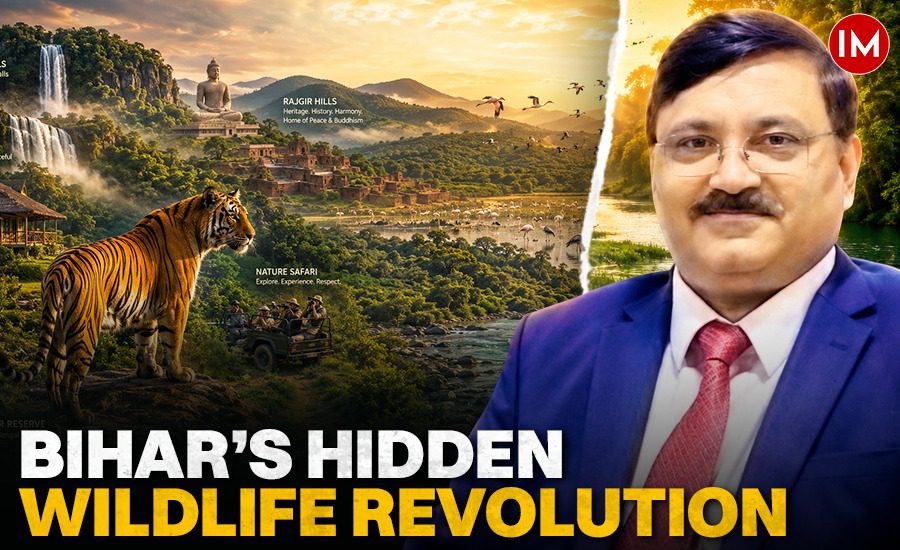
For decades, Bihar was rarely spoken about in conversations around wildlife tourism or eco-tourism. The state was known more for its history, migration, and political discourse than forests, wetlands, tigers, or biodiversity. But quietly, away from national headlines, a transformation has been unfolding.
Tiger numbers are rising. Wetlands are attracting migratory birds again. Gangetic dolphins are finding protection. Forest cover has nearly doubled. And eco-tourism circuits are emerging across Rajgir, Kaimur, Rohtas, Valmiki, Bhimband, and several other regions.
At the centre of this transformation is Mr. Arvinder Singh, a 1995-batch Indian Forest Service (IFS) officer currently serving as Principal Chief Conservator of Forests (Hoff), Bihar, and Chief Wildlife Warden. An author of two books on Indian wildlife, a travel enthusiast, and a lifelong learner, Singh brings together science, conservation, policy, and public engagement in a rare combination.
Born in Tarn Taran, Punjab, and raised across cities like Pune, Kanpur, and Bengaluru, his life has been shaped by movement, curiosity, and discipline. He believes hard work eventually becomes personality, and personality opens new horizons. But life also taught him something deeper and more personal after the sudden demise of a close batchmate during IFS training — that time is fragile, and life must be lived fully.
In this conversation with Indian Masterminds, Arvinder Singh speaks about Bihar’s emerging eco-tourism revolution, rising tiger population, rhino restoration plans, dolphin conservation, green cover expansion, and why he believes Bihar could become one of India’s most surprising nature destinations in the coming years.
Bihar is not usually seen as a major eco-tourism destination. What are the possibilities and plans for eco-tourism in the state?
In the last one-and-a-half years, Bihar has started focusing on eco-tourism in a very big way. Earlier also, we had developed a few sites for eco-tourism, especially Rajgir. A lot of infrastructure has been created there very meticulously.
Read Also: From IIT-IIM to IAS: Why Dr. S Siddharth Still Believes in Dreams Beyond Power
We developed the Nature Safari, Jungle Safari, and upgraded the overall tourism infrastructure in Rajgir. The idea was that when somebody visits Rajgir, they should stay there for one or two days instead of just making a day trip.
Now Rajgir has world-class infrastructure. Apart from being an eco-tourism destination, it is also a very important religious site connected to Lord Buddha. Places like Ghora Katora and other Buddhist-linked sites have also been developed by the Forest Department, attracting a large number of tourists.
We are now entering the next phase where we want to increase tourist engagement through adventure sports and other activities.
Which other regions are being developed for eco-tourism apart from Rajgir?
After seeing the success of Rajgir, we expanded the model to other districts with high tourism potential, especially Kaimur and Rohtas.
These areas have wildlife sanctuaries and national park regions, along with beautiful landscapes outside protected areas. A lot of investment is currently going into these districts.
For instance, there is a project funded by the Government of India through the Tourism Department under the Swadesh Darshan scheme. Excellent infrastructure is being created there.
The idea again is not “go and come back” tourism. We want tourists to stay, explore waterfalls, forests, scenic spots, wildlife, and religious circuits together.
There are nearly 56 identified locations in these circuits, including beautiful waterfalls and nature spots. A tourist can move from one place to another and experience a complete tourism ecosystem.
Are more sites being identified across Bihar?
Yes. In Nawada, Kakolat Falls is being developed further. Similar infrastructure is being created in Munger and other districts.
Under the CM Pragati Yatra, nearly 20 sites with eco-tourism potential have already been identified and development work is underway.
Apart from that, many parks previously managed by urban bodies have now been transferred to the Forest Department. More than 150 parks across Patna and other districts are now being managed by us.
Has tourism increased after these developments?
Definitely. Places like Rajgir and Bodh Gaya receive a large number of international tourists, especially from Southeast Asian countries because of Buddhist tourism.
Earlier, tourists would only visit Bodh Gaya and leave. Now they are staying longer and exploring Rajgir and nearby circuits as well.
The footfall has increased tremendously, although I do not have the exact figures at the moment.
Does Bihar still struggle with perception issues when it comes to tourism?
Yes, definitely. Earlier there was a perception that Bihar was unsafe. But that perception is changing rapidly.
Many IAS and forest officers from outside the state have visited Bihar recently and they were surprised to see infrastructure comparable to, or even better than, several other states.
Law and order has improved dramatically. Roads and connectivity have improved significantly. If tourism has to grow, you need support infrastructure like roads, hotels, and safety.
Over the last decade, Bihar has worked extensively on all these aspects. The only thing we lacked was proper publicity and outreach. Now we are focusing on that as well.
We are also hosting a major Chintan Shivir where forest officers from across India will come and experience firsthand how Bihar and its forest infrastructure have transformed.
Bihar has significantly increased its green cover over the years. How was that achieved despite limited forest land?
When Bihar was separated from Jharkhand, our forest cover was only around 6–7%.
Since Bihar is primarily an agricultural state, a Krishi Cabinet was formed and all departments were asked to collaborate to improve agricultural productivity and environmental sustainability.
Because notified forest land in Bihar is very limited — only about 7.1% — we decided to move beyond traditional forests and focus on agroforestry.
We started large-scale plantation drives under agroforestry schemes. Every year, nearly 5 crore saplings are planted. MNREGA and several other schemes also contributed.
Urban greens were another focus area. Parks and green spaces were developed aggressively because cities were becoming too concrete-heavy.
As a result, Bihar’s green cover has now increased to nearly 15%, and our target is to reach 17%.
Bihar now has a rising tiger population, yet people rarely associate the state with wildlife tourism. Why?
That is a very important question.
When I joined, Valmiki Tiger Reserve had only four reported tigers. Today, the number is close to 70.
This is one of the fastest-growing tiger populations in the country.
But unlike Ranthambore, Kanha, Bandipur, or Corbett, Bihar’s tiger reserve did not receive visibility because of historical law-and-order issues, poor connectivity, and lack of tourism infrastructure.
Ironically, that became a blessing in disguise because the forests remained less disturbed and wildlife flourished naturally.
Now the situation has changed. Roads, connectivity, and safety have improved. A major convention centre and high-end tourism infrastructure are coming up in Valmiki Tiger Reserve.
The Forest Department is also constructing 30 world-class cottages in Kerala-style architecture. These are expected to be completed within the next one-and-a-half years.
Once the infrastructure improves, visibility will automatically improve.
Bihar is also planning rhino conservation. Could you explain that?
Yes. We have started the process of introducing one-horned rhinoceros in Valmiki Tiger Reserve.
Historically, rhinos existed in this landscape but became locally extinct.
Now rhinos from Nepal’s Royal Chitwan National Park occasionally enter Bihar territory. Currently, two rhinos are staying in VTR, but that is not a viable population.
We are planning to introduce zoo-bred captive rhinos into the landscape to establish a stable population.
If successful, it will become a landmark conservation achievement because we would be rebuilding an extinct mega-herbivore population.
What about bird conservation and wetlands in Bihar?
Bihar has done extensive work in bird conservation over the last few years.
We conduct citizen-centric bird census operations every year with the help of NGOs, forest officials, and birding groups.
Bihar has numerous wetlands and water bodies that attract migratory birds. Earlier, there was no systematic counting mechanism. Now detailed surveys are conducted annually and the trends are very encouraging.
The number of bird species and migratory birds has increased.
We are also conserving endangered species like the Lesser Adjutant Stork in Bhagalpur.
Wetlands like Gogabil, Kanwar Lake, and other Ramsar sites are receiving focused conservation attention.
Bihar is also known for Gangetic dolphins. What conservation efforts are underway there?
Bihar is uniquely positioned because we have a very large Gangetic dolphin population.
We are fortunate that noted dolphin conservationist Dr. R.K. Sinha played a major role in pushing these efforts forward.
A National Dolphin Research Centre has been established in Bihar to study river ecosystems and understand the ecological importance of dolphins.
By conserving dolphins, we are essentially conserving the entire Gangetic ecosystem.
Currently, around 2,300 dolphins have been reported in the state.
Which wildlife destinations should tourists explore in Bihar apart from Valmiki Tiger Reserve?
Apart from Valmiki Tiger Reserve, tourists should definitely explore:
- Kaimur Wildlife Sanctuary
- Bhimband Wildlife Sanctuary
- Gautam Buddha Wildlife Sanctuary
- Gogabil Wetland
- Kanwar Lake
- Other Ramsar wetlands and bird habitats across the state
Bihar has tremendous biodiversity and scenic beauty. Earlier, many of these areas were affected by Left-Wing Extremism, so tourism could not develop.
But now those challenges have largely been addressed.
Today, the government is seriously investing in eco-tourism because it has the potential to transform Bihar’s image and economy.
Eco-tourism, wildlife tourism, religious tourism, and nature tourism together can become a major strength of Bihar in the coming years.