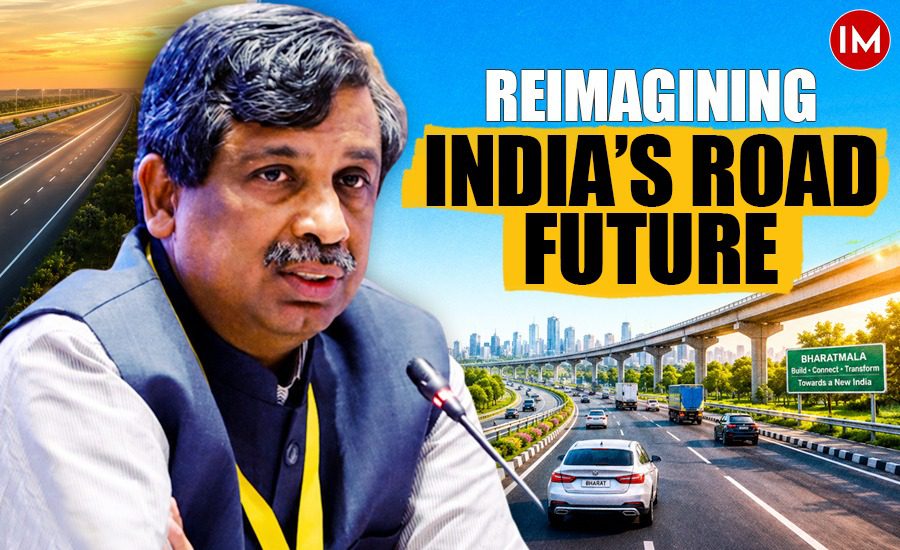
V. Umashankar, a 1993 batch IAS officer of the Haryana cadre and Secretary of the Ministry of Road Transport and Highways, outlines how India is transforming its road infrastructure through high-speed expressways, AI-based tolling, EV charging networks, green highways, and logistics reforms to support the vision of Viksit Bharat 2047, in this exclusive interview with Sharad Gupta of Indian Masterminds.
1. India has one of the world’s largest road networks and over 391 million registered vehicles – how is policy evolving to manage congestion and sustainability simultaneously?
India has the second-largest road network (~64 lakh km) in the world, after the United States (~66 lakh km). While roads carry 70% of the total freight movement in the country, National Highways form the arterial backbone of the transport network by carrying ~52% of total road freight movement in the country while only accounting for 2.3% of the total ~64 lakh km road network.
A key measure of logistics efficiency is the average freight vehicle speed:
- Currently, freight vehicles operate at average speeds of 35–40 kmph on National Highways.
- While the average speed of freight vehicles increases to 45–50 kmph on High-Speed Corridors, we lag behind global benchmarks such as the USA (80–90 kmph) and China (60 kmph).
Hence, improving freight efficiency on NH continues to remain a key focus area of MoRT&H.
Read Also: A Relentless Gadkari Building India’s Road Infrastructure | Nitin Gadkari Interview
Efficient logistic movement and congestion reduction
To enable efficient logistic movement and reduce congestion on National Highways, MoRT&H has taken initiatives across three levels:
i. Development of Network of High-Speed Corridors
- MoRT&H has operationalized a network of 3,644 km of National High-Speed Corridors (increase from 93 km from 2014).
- Network of 20,000–22,000 km of High-Speed Corridors planned to be developed by FY2032–33.
ii. Ring Roads and Bypasses around Urban Centers
- MoRT&H has introduced the policy for decongestion of major urban centers with integrated Ring Road planning aligned with City Masterplan
- The policy covers all cities with population above 1 lakh, prioritizing 83 cities with population above 5 lakhs
- 1,552 km of ring roads and bypasses of Rs. 1.2 lakh crore prioritized for FY 2026–27
iii. Seamless Tolling
- Introduction of Electronic Toll Collection has significantly reduced the congestion and waiting time at toll plazas (Average waiting time at toll plazas has reduced from 12 mins to 40 seconds). MoRT&H is in the process of implementing Multilane Free Flow (MLFF) Tolling through AI-based Automatic Number Plate Recognition (ANPR) to further reduce congestion and wait time at toll plazas, effectively cutting waiting time to 0 seconds.
- 18 plazas have been awarded for MLFF tolling and bids have been issued for another 36 toll plazas
- MoRT&H targets to implement MLFF tolling on 800 toll plazas on 4L+ NHs by 2027
iv. Vehicle Engineering Reforms
- MoRT&H is in consultation with freight vehicle OEMs and logistics operators to identify key bottlenecks like Power to Weight Ratio, aerodynamic improvements, engine design for fuel efficiency optimization, safety changes to safely increase the speed of freight vehicle operations from avg. 30–40 kmph to 75–80 kmph
(Table Summary – Vehicle Comparison)
India currently has lower power-to-weight ratios compared to global benchmarks (USA, UK, China)
Heavy and Medium Goods Vehicles in India prioritize cost efficiency and load optimization over high-speed performance
Key Insight (highlighted in document):
India’s M&HCV segment currently operates with the lowest power-to-weight ratio among the compared markets, reflecting a design philosophy centered on cost efficiency and load optimization rather than high-speed performance.
Sustainability
Additionally, in line with India’s commitment to net zero emissions by 2070, MoRT&H has undertaken reforms focusing on sustainable construction and operations, usage of alternate materials, and promoting circularity in the sector.
i. Use of alternate construction material
- Using inert waste and plastic in subgrade/bituminous mixes to promote circularity.
- Over 37 lakh tonnes of inert material from landfill sites has been used in UER II, Spur of Delhi-Mumbai Expressway and other highway projects.
- 2,900 km of highways have been constructed with the use of plastic waste.
- Over 200 Mn MT of fly ash has been utilized in the construction of highway projects.
- Pilot and scaling of multiple alternates like bio-bitumen from sugar molasses, rice husk, pine needles.
- Rubber (CRMB) from discarded tyres, promoting resource recovery and bitumen efficiency.
- Use of steel slag permitted in embankment, subgrade, GSB, WMM, and base courses, ensuring volume stability and environmental safety.
ii. Greening of Highways
- 5.26 crore saplings planted from FY16 to FY26. Further, MoRT&H targets to plant an additional 40 lakh saplings in FY27.
- Success and survival of plantation is monitored through a geo-tagged Green Cover Index in collaboration with National Remote Sensing Centre.
- NH Beautification has been undertaken on 43 NH stretches in 35 cities, completed through 3.6 lakh plantations in FY25–26.
- New initiatives like Bee Corridor and Arogya Van — thematic medicinal and pollen/nectar-rich tree plantations planned on median/vacant land parcels along NHs, in addition to ornamental species, are being undertaken by MoRT&H.
iii. Solar Generation
- Solar panels installed along NHs to power highway operations and contribute to the grid wherever possible.
- Underway across multiple sections across the country
Unlocking Solar Generation Potential along NHs
(Table summary)
Various use-cases are being implemented to harness solar energy along National Highways, including:
- Solarisation of toll plazas for operational energy needs
- Solar power generation at interchanges for lighting and ATS systems
- Solar installations on highway structures such as bridges
- Development of solar parks along highway corridors to improve project viability
- Feeding surplus solar energy into the power grid through partnerships with DISCOMs and the Ministry of New and Renewable Energy
iv. Voluntary vehicle fleet modernization program
- Transport sector accounts for ~12% of India’s CO₂, out of which Road Transport is ~94%, necessitating a phased removal of old polluting vehicles
- A total of 136 Registered Vehicle Scrapping Facilities (RVSF) across 23 States/UTs and 216 Automated Testing Stations (ATS) across 20 States/UTs have been operationalized
- 5.1 lakh vehicles have been scrapped and 23 lakh vehicles have been tested across the country till date across the RVSF and ATS facilities respectively
2. The government has announced an ambitious plan to build 17,000 km of access-controlled expressways—what are the biggest bottlenecks today: land, finance, or execution?
While financing has been addressed through budgetary support, asset monetization, and a strong pipeline of Public-Private Partnerships, the key bottlenecks in construction of National Highways today are land acquisition, project execution quality, and dispute resolution. These challenges directly impact timelines and cost efficiency in delivering key highway and High-Speed Corridor (HSC) projects at scale.
To achieve the Viksit Bharat objective of building world-class NH infrastructure, the Ministry has introduced a series of targeted reforms:
Land Acquisition
- Aadhaar-Based Direct Compensation for land acquisition – Direct transfer of compensation to beneficiaries through Aadhaar verification via the BhoomiRashi portal
- GIS integration in BhoomiRashi portal under implementation
Quality & Execution
- Performance rating of Consultants, Contractors & Field Officers for accountability
- DPR Ratings released (Jan’26), ratings for 56 DPR consultants done & released
- Underway for highways
- Quality control through bidding reforms for consultants and contractors
- Fixed cost DPR bidding for DPR
- Rating & performance bank guarantee as bidding stringent qualification criteria for consultants & contractors
- Additional performance security for deeply discounted projects
- Quality assurance through construction technology mandates
- Automated Intelligent Machine Aided Construction (AIMC) in flagship projects (15 projects – length about 523 km awarded till date)
- Pre-cast mandated for non-critical parts in Rs. 300 Cr+ projects
- Mobile Quality Control Vehicles (MQCV) for construction quality testing and monitoring across 4 states already and additional 11 states from May’26
- Maintenance ensured through continuous monitoring
- AI-based pothole detection through Network Survey Vehicle (100,000 lane km completed, 70,000 lane km underway)
- Drone Analytics Monitoring System for quality and progress (~20,000 km NH monitored per month)
- Rajmarg Yatra for public grievance reporting & monitoring
Model Concession Agreements
The Ministry is in process of overhauling MCAs for BOT Toll, HAM and EPC. The new documents for BOT Toll and HAM have already been approved. The new EPC document is likely to be finalized by May end. We are also in process of evolving a new Concession Agreement of BOT Toll-cum-Annuity, which would be path-breaking as it will enable the authority to take up a larger number of projects on PPP, leveraging efficiency of BOT Toll and meeting shortfall in VGF through annuities.
Dispute Resolution
- Arbitration minimization – preferred through mediation only (> Rs. 10 Cr.)
- Faster resolution through Vivad se Vishwas III (litigation < Rs. 500 Cr) for 60% of all outstanding litigation
3. Recent reports indicate a slowdown in highway construction and project awards—is this a temporary correction or a structural concern?
The ministry has maintained a consistent pace of construction of National Highways, with ~10,000 km of NHs being constructed every year. The annual construction figures are as follows:
| Year | NH Constructed (km) |
| FY2022–23 | 10,331 |
| FY2023–24 | 12,349 |
| FY2024–25 | 10,660 |
| FY2025–26 | 9,361 |
The Capital Expenditure on NHs has also been increasing consistently, with the Ministry incurring CapEx of Rs. 3.18 lakh crore on National Highways in FY2025–26. The details of capital expenditure on NHs and the target for FY2026–27 are illustrated below.
(Chart insight)
- CapEx trend shows steady growth from Rs. 2.41 lakh Cr (FY22–23) to ~Rs. 3.24 lakh Cr (FY26–27 target), with increasing private investment participation.
The pace of award has been rationalized through a more stringent project prioritization and selection framework based on need assessment and pre-construction readiness checks to avoid disputes and delays in project execution during construction.
- This includes availability of land parcels along the Right of Way (ensuring minimum 90% RoW availability before appointed date) and obtaining necessary forest and wildlife clearances.
As a result, the number of projects delayed has been reducing consistently year-on-year in the last 3 years:
- The number of delayed projects (delay >3 years) has reduced by ~50%, from 152 in 2024 to 78 in 2026.
Hence, MoRT&H, through its efforts in ensuring strict project readiness, is ensuring that projects are not just merely awarded, but also completed within the targeted timelines with minimal disputes.
4. With plans to award ₹10 lakh crore worth of road projects annually, how realistic is private sector participation in the current financial environment?
The ministry has sanctioned projects of Rs. 1.84 lakh crore in FY2025–26. The year-wise project sanction details are as below:
| Year | Sanctioned Length (km) | Sanctioned Cost (Rs. Cr) |
| FY2025–26 | 6,281 | 184,053 |
| FY2024–25 | 5,155 | 139,741 |
| FY2023–24 | 7,022 | 149,361 |
Continuing this pace, the ministry has developed a project pipeline of Rs. 7–8 lakh crore which will be sanctioned and awarded as per project readiness and approval by competent authority.
Public-Private Partnerships (PPPs) in Construction
Public-Private Partnerships (PPPs) play a key role in the development of national highways. Recognizing the need for accelerated growth in road projects, the share of PPP (HAM and BOT projects) in terms of total capital cost for financing road projects has increased from 24% in 2019–20 to ~35% in 2024–25.
PPP in Asset Monetization
- In FY2025–26, MoRT&H raised Rs. 28,220 Cr including Rs. 12,270 Cr (ToT) and Rs. 15,950 Cr (InvITs).
- MoRT&H has cumulatively raised Rs. 1,70,978 Cr till March 2026 through various models of asset monetization:
- Rs. 61,265 Cr (ToT) , Rs. 59,588 Cr (InvITs) , Rs. 50,125 Cr (Project-based financing)
- National Monetization Pipeline 2.0 targets to achieve Rs. 4 lakh Cr of asset monetization under MoRT&H by FY2030.
To enable stronger and sustained private sector participation, MoRT&H is undertaking various reforms:
- PPP in construction
- Amendments in Model Concession Agreements (BOT & HAM) to balance risk and reward , address implementation challenge and reduce potential disputes.
- A New model of highway development – BOT (Toll + Annuity) is under development
PPP in Asset Monetization (Investor Expansion)
- Public InvITs launched to widen investment scope; the RaajMarg Infra Investment Trust (RInvIT) listed in March 2026 with 5 road projects of 260 km in its portfolio
- Domestic, CPSE and state pension funds, EPFOs are being engaged for investment to expand the pool of investors.
5. Bharatmala and Multimodal Logistics Parks aim to reduce logistics cost—when will India realistically reach the global benchmark of ~8% of GDP?
According to DPIIT’s report on the “Assessment of Logistics Cost in India” from September 2025, India’s logistics cost as a percentage of GDP has been around 8%-9% for the past 5 years, as shown below.
Table
MoRT&H continues to target further improving the logistic efficiency, enabling seamless movement on National Highways, and enabling multimodality as per the PM GatiShakti principles. MoRT&H is enabling this through two areas:
- High Speed Corridors (HSC) – A total of 3,644 km of national HSC have been operationalized, with a target to increase it to 20,000-22,000 km by FY32-33
- Multi-Modal Logistics Parks (MMLP) – 15 MMLPs have been prioritized for development, out of which 2 are completed (at Jogighopa and Jalna) with operations to commence shortly, 3 are under implementation, 1 under bidding, 6 under approval and 3 in DPR stage
Taken together, these measures are instrumental in reducing friction, increasing logistics efficiency and achieving multimodal integration. The Ministry’s focus areas are linked to improving freight movement, connectivity to production and consumption centres, and quality of transport infrastructure in support of the vision of Viksit Bharat 2047 to Enhance logistic efficiency to global standards on National Highways.
6. How is the ministry leveraging Gati Shakti digital platform integration to eliminate duplication and improve project efficiency?
The PM GatiShakti National Master Plan portal enables users from all ministries access information on all infrastructure and geospatial layers, acting as a key input in the project planning process.
For the MoRT&H, the PM Gati Shakti NMP portal supports project planning in multiple ways. The value proposition is that it allows project proponents to view alignments in relation to existing and planned infrastructure, economic and logistics nodes, and ecological or utility constraints, thereby improving both speed and quality of decision-making.
The PMGS portal enables project planning across 4 themes:
i. Optimize alignments and accelerate alignment finalization by identifying planned infrastructure that may affect project design.
Eg: In the planning of Prayagraj city bypass project, identification of upcoming railway projects in the area (Varanasi – Madhosingh – Prayagraj Doubling) helped enable early stakeholder consultations and plan for appropriate design measures jointly
ii. Identify intersections with other infrastructure and the clearances that may be required, thereby enabling earlier engagement with concerned agencies.
Eg: In planning of Aizwal Bypass tunnel, identification of intersections with power lines between Sairang and Phaibawk, enabled early clearances from the Ministry of Power
iii. Reduce ecological impact by – MoRT&H leverages forest boundaries, wildlife areas, and eco-sensitive zones as updated by MoEFCC to optimize highway alignments to minimize the ecological impact
Eg: In planning of Shangshak – Tengnoupal highway in Manipur, the NPG portal helped confirm no intersection with Yangoupokpi Lokchao Wildlife Sanctuary ESZ.
iv. Supports multimodal planning and last-mile connectivity by enabling corridors to be planned in relation to economic, social and logistics nodes.
Eg: The portal was leveraged in planning of Surat – Nashik – Ahmednagar – Solapur – Akkalkot corridor to identify last mile connectivity to key economic centers across Gujarat and Maharashtra, connectivity to tribal districts of Navsari, Valsad, and logistic nodes such as airports, and planned MMLP at Nashik.
The ministry is constantly striving for continuous improvement and wider adoption of the PM GatiShakti portal. The ministry is in process of integrating the PMGS portal with NDEM (National Database for Emergency Management) to map floodplains, landslide zones etc, to enable safer and resilient highway planning.
7. Road safety continues to be a major concern—beyond initiatives like Bharat NCAP and Road Safety Mitra, what systemic reforms are underway?
Road Safety is one of the top priorities of this Ministry. Some key recent developments / improvements that this Ministry has been working on to improve the Road Safety across all 4Es to improve safety i.e., Emergency Care, Enforcement, Engineering and Education:
Emergency Care: Reduction in fatalities is only possible through emergency care
- Rollout of PM-RAHAT Scheme provides for cashless treatment for road accident victims ensuring immediate care during the “Golden Hour,” with financial coverage and nationwide hospital network reducing road accident fatalities
- Fully integrated digital ecosystem linking e-DAR, emergency response (112), hospitals, and claims processing, enabling real-time coordination
Enforcement:
- We are moving towards technology-driven e-enforcement to reduce manual intervention and improve compliance behaviour
- States are being funded under SASCI scheme to setup these e-enforcement devices at high-risk high-density state and national highways and critical junctions in cities
Engineering (Roads):
- Apart from ongoing efforts to make National Highways safer, the Nationwide rollout of e-DAR enables granular, geo-tagged accident data capture which enables identification of accident patterns.
- Extensive utilization of the accident data captured in e-DAR is used to identify and rectify accident spots with targeted engineering corrections and continuous monitoring of safety outcomes.
Engineering (Vehicles): Vehicular engineering is as pivotal as road engineering for prevention of road accidents and fatalities. MoRTH has been continuously working on various targeted initiatives across vehicle categories to improve vehicular safety.
- Mandated Advanced Drive Assistance System in trucks and buses
- Introduced Bus Body Code to ensure adherence to safety features in buses
- Introduced new safety standards to improve e-rickshaw safety
- Revamping Bharat New Car Assessment Program (BNCAP) and introducing BNCAP 2.0 for more stringent safety testing and provide safety rating to improve four-wheeler safety
- In the process of introducing Vehicle-to-Vehicle communication systems
Education: As we are all aware, in most of the accidents drivers are the primary reason.
- Under Sadak Suraksha Abhiyan continuous positive reinforcement road safety awareness campaigns are being run to bring in change in driver behaviour.
- Sadak Suraksha Mitra along with Youth affairs is launched to promote and inculcate road safety among citizens.
- Driving Training Institutes are being setup to provide formal training to the drivers.
8. With a push toward electric mobility and alternative fuels, how is highway infrastructure adapting (charging, hydrogen corridors, etc.)?
India’s push toward electric mobility is being supported through a combination of regulatory standards and rapid highway infrastructure development.
Regulatory Standards
Multiple regulations and standards have been notified for Electric Vehicles including
- Safety & procedural requirements for type approval & COP of electric power trains and rechargeable Electrical Energy Storage System for all motor vehicles
- Measurement of Electrical Energy Consumption, Range & Net Power
- CMVR Type Approval for EVs
Infrastructure Development
To support the push towards electric mobility, MoRT&H is targeting to develop a network of 12,000+ EV charging stations across the NH network, at every 40-50 km on both sides of the highway by 2047. Charging stations on Way-Side Amenities along National Highways are being mandated with 60+ charging stations already operationalized.
9. Asset monetisation (like toll-operate-transfer models) is becoming critical—does this risk over-financialisation of public infrastructure?
Asset monetisation does not amount to over-financialisation or privatisation, as ownership of the assets remains with the Government while only operational rights are transferred for a defined period.
The assets are monetized by assigning the tolling and operating rights of the assets for a fixed period of time (concession period of 15 to 30 years) and not for perpetuity. The tolling and operating rights of the assets will return to the Authority post conclusion of the concession period.
Asset Monetization enables resource mobilization without compromising public control by recycling capital in new infrastructure projects. The key benefits include:
- Capital Unlocking: Economic value of public assets unlocked, leading to alternate revenue streams
- Capital Infusion: Quick release of funds for investment in future projects
- Long-term Sustainability: Reduction in debt burden and reliance on Govt.’s budgetary support.
- As noted in the Economic Survey 2024-25, while government capital expenditure on major infrastructure sectors has been rising at a trend rate of about 38% from FY20 to FY24, a significant infrastructure gap still remains
- Efficiency Improvements: Increased involvement of private sector; higher standards of project management and use of innovative technologies.
- Economic Booster: Infrastructure investments can stimulate a region’s economic growth and have multiplier effect in long-term
To unlock these benefits, MoRT&H has brought various instruments for asset monetization including ToT, InvITs, and SPVs. Enabling a strong asset monetization base, MoRT&H has cumulatively raised Rs. 1,70,978 Cr. till March 2026, through of Asset Monetization
- Rs. 61,265 Cr (ToT), Rs. 59,588 Cr (InvITs), Rs. 50,125 Cr (Project-based financing).
Continuing the momentum, the National Monetization Pipeline 2.0 targets to achieve Rs. 4 lakh Cr of asset monetization under MoRT&H by FY2030.
10. How do you see the future balance between roads vs rail vs waterways evolving, especially amid concerns of over-reliance on road transport?
While the selection of transport mode is a market-driven dynamic, the future of freight transport will not be about replacing roads with rail or waterways, but about creating a more efficient modal balance.
Roads currently carry the dominant share of freight in India. Their share has increased from around 54% in 2000 to nearly 71% in 2020.:
Table
However, this does not mean that road is always the most efficient mode. On a per-tonne-kilometre basis, road transport is costlier than rail and waterways. But a DPIIT study in 2025 showed that for distances up to 600 km, road transport can still be cheaper than a multimodal option because multimodal movement involves additional handling, loading, unloading and transfer costs.
Table
This is important because around 72% of freight in India moves over distances below 600 km. Therefore, road continues to have a natural advantage for short- and medium-distance freight.
Table
Going forward, the objective should be to reduce inefficient modal mix, not road transport itself. MoRT&H continues to aim for enhanced logistic efficiency in the country. To enable efficient multi-modal transportation, MoRT&H adopts the principles of GatiShakti in highway development and planning.
The PM GatiShakti portal is leveraged to identify connectivity to logistic nodes (like airports, railway stations, ports etc.) and enable multi-modal infrastructure planning.
Additionally, all major highway projects of Civil cost more than Rs. 500 Cr (or Rs. 100 Cr in case of greenfield projects) are mandated to be consulted in the Network Planning Group (NPG) to enable integrated infrastructure planning and early consultations with key infrastructure ministries such as Railways, Shipping, Aviation etc. Across 111 NPG meetings, 150+ MoRT&H projects have been consulted.
Additionally, to enable efficient multimodality, MoRT&H has prioritized development of 15 Multi-Modal Logistics Parks (MMLPs). Of these, 2 are completed (at Jogighopa and Jalna) with operations to commence shortly, and 3 are under implementation.
Taken together, these enablers aim to support faster, evidence-based and cross-sector decision-making, ultimately supporting MoRT&H in aligning infrastructure development with national logistics and growth objectives.
Read Also: From Localised Breach to Systemic Breakdown