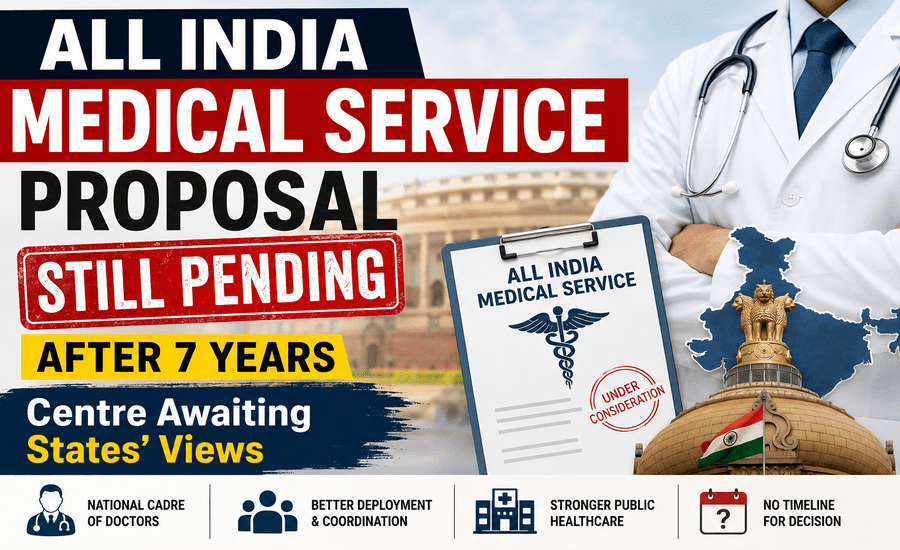
New Delhi: More than seven years after the Central Government first informed Parliament about consultations with states on the creation of an All India Medical Service (AIMS)—a proposed national cadre of doctors on the lines of the IAS and IPS—the plan remains under consideration, with the Union Health Ministry still awaiting responses from several states and Union Territories.
The update was confirmed in a response to an RTI application dated May 26, 2026, which stated that the proposal is still under examination and further inputs from states and UTs are being collected before the matter is moved to the Department of Personnel and Training (DoPT) for final consideration.
Proposal Aimed at Creating National Cadre of Doctors
The proposed All India Medical Service is designed to create a unified cadre of medical professionals who would serve both the Centre and state governments, similar to officers of the Indian Administrative Service (IAS) and Indian Police Service (IPS).
The objective of the proposal is to strengthen public healthcare administration, improve the availability of specialists in government hospitals and create a structured leadership pipeline in the medical sector.
RTI Reply Confirms Proposal Still Under Discussion
According to the Union Health Ministry’s RTI response, the proposal for creating the All India Medical Service is still “under consideration.”
The ministry stated that views from remaining states and Union Territories have been sought, and only after receiving complete responses will the matter be taken up with the DoPT for further action.
Despite being discussed for several years, the proposal has not yet moved to the final approval stage.
Background: First Proposed in Parliamentary Reply
The idea of an All India Medical Service has been under discussion for years.
In a Lok Sabha reply in December 2018, the Ministry of Health and Family Welfare stated that a committee reviewing the Central Health Service had examined the need for such a cadre. The committee recommended that states be consulted before any final decision is taken.
Since then, the proposal has remained in the consultation phase.
States Divided on Proposal
At the time of earlier consultations, responses from states and Union Territories showed mixed views.
Some regions, including Goa, Mizoram, Dadra and Nagar Haveli, and the Andaman and Nicobar Islands, supported the proposal.
However, states such as Kerala and Sikkim opposed the idea.
Andhra Pradesh had suggested a more comprehensive framework to address manpower shortages and broader healthcare staffing requirements.
Objective: Strengthening Public Health Administration
Supporters of the proposal argue that a national medical cadre could significantly improve the functioning of India’s public health system.
Key expected benefits include:
- Better deployment of doctors and specialists across states
- Improved coordination in public health administration
- Strengthening leadership in government healthcare institutions
- Addressing regional disparities in medical staffing
Proponents believe that a structured national cadre could help address long-standing gaps in healthcare delivery, particularly in underserved regions.
Concerns Over State Control and Autonomy
However, the proposal has also faced criticism from some states and stakeholders.
Opponents have raised concerns regarding:
- Reduced state control over health personnel
- Uncertainty over service conditions and postings
- Administrative challenges in federal coordination
Health being a state subject under the Constitution has also been cited as a key reason for resistance to the proposal in some regions.
No Final Timeline for Decision
Despite repeated discussions over the years, the RTI response indicates that consultations are still ongoing, and no final timeline has been set for a decision on the creation of the All India Medical Service.
With the proposal still at the consultation stage, it remains one of the long-pending administrative reforms in India’s public health governance framework.
Read Also: Nitin Gadkari Unveils India’s First Flex-Fuel Passenger Car, Supporting E20 to E100 Ethanol Blends