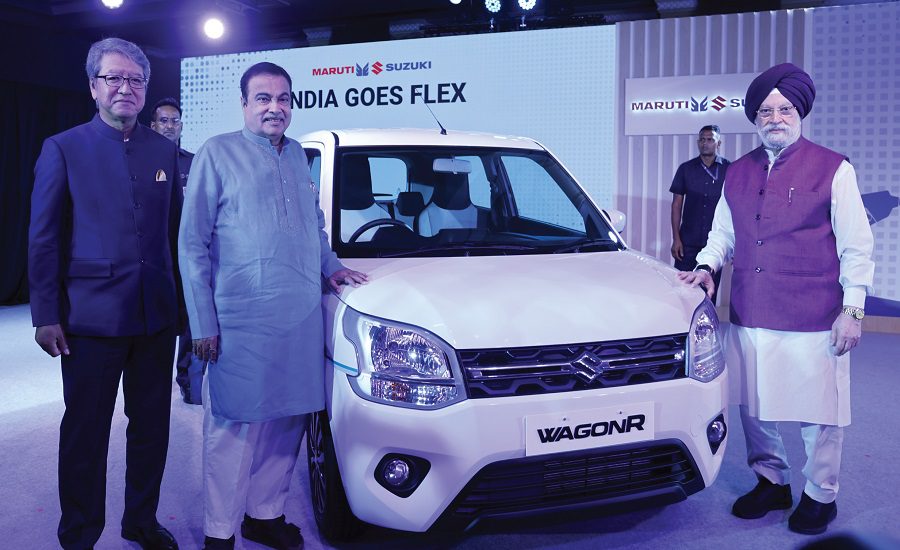
New Delhi: In a major milestone for India’s green mobility and energy transition efforts, Maruti Suzuki India Limited on Thursday launched the country’s first mass-market flex-fuel passenger vehicle, the WagonR Flex Fuel, capable of operating on ethanol-petrol blends ranging from E20 to E100.
The vehicle was officially launched in New Delhi by Union Minister for Road Transport and Highways Nitin Gadkari in the presence of Union Minister for Petroleum and Natural Gas Hardeep Singh Puri, senior government officials and industry representatives.
The launch marks a significant step in India’s push towards alternative fuels, reduced crude oil imports and lower carbon emissions.
India’s First Flex-Fuel Passenger Car
The WagonR Flex Fuel has been specifically engineered to operate on varying ethanol-petrol blends, providing consumers with the flexibility to use:
- E20 (20% ethanol blend)
- Intermediate ethanol blends
- E85 (85% ethanol blend)
- E100 (nearly 100% ethanol)
Unlike conventional petrol vehicles, the flex-fuel WagonR is equipped with advanced engine and fuel-management technologies that automatically adapt to different ethanol concentrations.
Maruti Suzuki stated that the vehicle represents the next phase of the company’s commitment to cleaner and more sustainable mobility solutions.
Advanced Technology Enables Multi-Fuel Compatibility
At the heart of the new WagonR Flex Fuel is an advanced Engine Control Unit (ECU) calibration system.
The technology continuously detects the ethanol content in the fuel and adjusts engine parameters accordingly to ensure optimal performance, fuel efficiency and emissions control.
This enables the vehicle to seamlessly run on any ethanol-petrol blend between E20 and E100 without requiring manual intervention by the driver.
The company said the technology has been specifically developed to support India’s long-term biofuel strategy and evolving fuel ecosystem.
Nitin Gadkari Highlights Energy Security Benefits
Addressing the launch event, Union Minister Nitin Gadkari emphasized the importance of ethanol-based fuels in reducing India’s dependence on imported crude oil.
India currently imports a significant portion of its petroleum requirements, making fuel imports a major contributor to the country’s foreign exchange expenditure.
Gadkari noted that widespread adoption of flex-fuel vehicles could substantially reduce this dependence while creating new economic opportunities for the agricultural sector.
According to the minister, large-scale use of ethanol could generate estimated foreign exchange savings of approximately ₹1.44 lakh crore.
He said the initiative aligns with the government’s broader vision of strengthening energy security, reducing emissions and boosting rural incomes.
Supporting Farmers and Rural Economy
The minister further stated that increased ethanol consumption would create sustainable demand for biofuel feedstocks produced by Indian farmers.
“Flex-fuel vehicles can create a strong and sustainable demand for ethanol, benefiting our farmers, industry and the environment together,” Gadkari said.
He also expressed confidence that the launch would encourage other automobile manufacturers to introduce similar vehicles and accelerate the development of ethanol distribution infrastructure across the country.
Hardeep Singh Puri: India’s Ethanol Journey Is Unstoppable
Union Petroleum and Natural Gas Minister Hardeep Singh Puri described the launch as another important step in India’s biofuel transformation.
He highlighted the success of the ethanol blending programme and its role in improving both farmer incomes and national energy security.
According to Puri, the country’s ethanol ecosystem has evolved significantly over the past few years.
“We have transformed our farmers from annadatas to urjadatas while strengthening India’s energy security,” the minister said.
He described flex-fuel vehicles as a “win-win” proposition that helps reduce crude oil imports, save foreign exchange, lower emissions and generate economic opportunities in rural India.
Maruti Suzuki Bets on Multi-Technology Future
Speaking at the launch, Maruti Suzuki India Limited Managing Director and CEO Hisashi Takeuchi reiterated the company’s commitment to offering multiple clean-mobility technologies.
According to Takeuchi, the company is pursuing a diversified strategy that includes:
- Battery Electric Vehicles (BEVs)
- Hybrid Vehicles
- CNG and CBG Vehicles
- Ethanol Flex-Fuel Vehicles
The approach aims to support India’s twin objectives of reducing oil imports and lowering carbon emissions.
He acknowledged that the ethanol fuel ecosystem in India is still at an early stage but expressed confidence about its future growth potential.
Why Flex-Fuel Vehicles Matter
Flex-fuel vehicles are widely regarded as an important transitional technology for countries seeking to reduce fossil fuel consumption without immediately shifting entirely to electric mobility.
Key Advantages of Flex-Fuel Vehicles
- Reduced dependence on imported crude oil
- Lower greenhouse gas emissions
- Increased use of renewable biofuels
- Enhanced energy security
- Additional income opportunities for farmers
- Support for domestic ethanol production industry
Since ethanol is produced from agricultural feedstocks such as sugarcane, maize and other biomass sources, increased consumption can also stimulate rural economic activity.
A Major Step Towards Sustainable Mobility
The launch of the WagonR Flex Fuel represents a significant development in India’s evolving automotive and energy landscape.
As the government continues to promote cleaner fuels and alternative energy sources, flex-fuel technology is expected to play an increasingly important role in bridging the gap between conventional internal combustion engines and fully electric mobility.
Industry observers believe the success of the WagonR Flex Fuel could encourage wider adoption of ethanol-compatible vehicles and accelerate investments in fuel infrastructure, helping India move closer to its goals of energy self-reliance, environmental sustainability and rural economic growth.