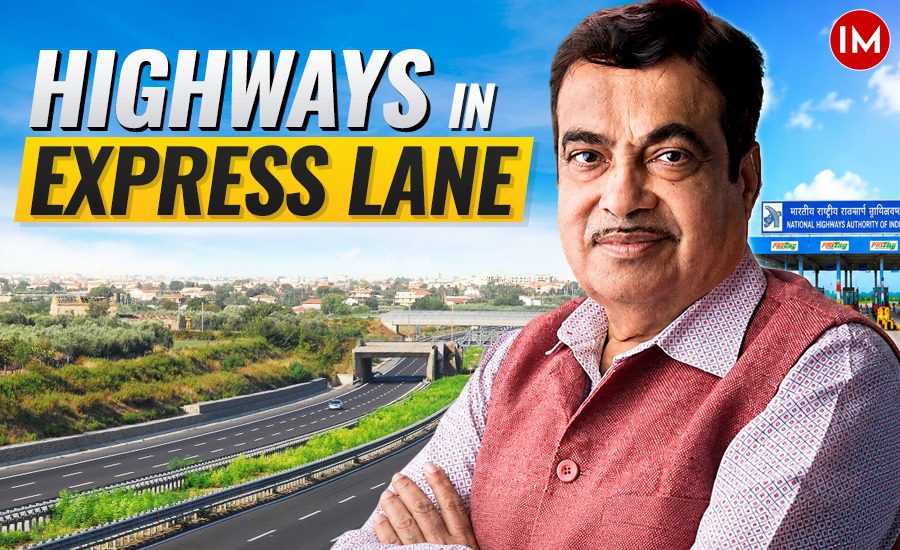
From stalled highway projects and mounting NPAs to world-class expressways transforming how India moves, Nitin Gadkari, Minister of Road Transport and Highways of India, has led one of the most ambitious infrastructure overhauls in the country’s history.
In this candid conversation with Indian Masterminds, the minister reflects on the vision, reforms, and relentless execution that are reshaping India’s roads, reducing logistics costs, promoting green fuels, and driving the nation toward faster, cleaner, and more connected growth.
The Delhi-Dehradun Expressway was recently inaugurated. What makes it a landmark project?
Uttarakhand is Devbhumi – a land of pilgrimage and natural beauty. But reaching it has always been a nightmare. Earlier, it took eight to nine hours from Delhi. Accidents were frequent, roads treacherous. With this new expressway, we have brought that journey down to just two hours and fifteen minutes. That is the scale of transformation.
But what truly sets this project apart is how we built it. We created a 12-kilometre elevated stretch through a dense forest — not cutting through it, but going over it — so animals can pass freely below. Special underpasses have been designed for elephants, tigers, and other wildlife. We have even given our forest commandos camouflage uniforms matching the jungle terrain. It is a small detail, but it reflects our thinking: infrastructure must respect ecology, not destroy it.
You have been at the helm of this ministry for twelve years. When you took charge, what did you inherit?
A complete mess. There were 406 stalled projects worth ₹3.85 lakh crore. Banks had classified them as NPAs. Contractors had abandoned sites. The entire sector was paralysed.
We moved decisively. Projects worth ₹40,000 crore that were beyond recovery were terminated. For the rest, we sat with banks, contractors, and officials and worked out solutions. In the first three years, we helped rescue Indian banks from NPAs worth ₹3,00,000 crore. That was perhaps the most significant — and least talked about — achievement of this ministry.
Once we stabilised the financial side, we dug into why projects stall in the first place. The core problem was poor planning—projects were awarded without land acquisition, environmental clearances, or utility shifting. We reversed that approach delays and disputes. Today, 90 percent of land acquisition is completed before we issue the appointment date. We solve problems before they reach the contractor. That has made all the difference.
You introduced major structural and cultural reforms within the ministry. How did you drive that change?
Time is the most valuable capital of the 21st century. A decision delayed is as damaging as a decision made wrong. I told my officials clearly: take ownership, make decisions, and make them quickly. If it is right, proceed. If not, stop — but don’t sit idle.
We distributed power across the organisation. Teamwork replaced hierarchy. I started holding direct review meetings for every state’s projects. When officials know that each project’s status lands on the minister’s table, accountability follows. The administration sharpened up. Performance audit, I always say, matters far more than financial audit. A person who draws a salary on the first of every month and never worries about delivery has got things completely backwards.
Highway construction has dipped — from around 12,000–13,000 km per year to roughly 9,000 km. Is something going wrong?
Nothing structural. We are in a transitional phase within the Bharatmala project cycle. Earlier, financial authorisation per project was ₹3,000 crore; it has now been tightened to ₹1,000 crore, at 18 percent interest. On top of that, every project must move through the Ministry, then the Finance Ministry committee, then the Cabinet. These processes take time. The dip is temporary, not a trend.
And let me be clear — we do not have a financial problem. Our monetisable project pipeline is worth ₹3,20,000 crore. We can raise up to ₹15,00,000 crore by monetising existing assets. When we issued InvIT bonds, they were oversubscribed 14 times. Fourteen times. That tells you everything about investor confidence in this sector.
The PPP model was completely broken when you arrived. How did you rebuild it?
Trust had collapsed — between government, developers, and banks. I started by experimenting with multiple financing models: BOT, Hybrid Annuity, EPC. Each model was tailored to the risk profile of different kinds of projects. There is no one-size-fits-all answer in infrastructure finance.
We also overhauled the toll system. The new mechanism uses ANPR cameras — your number plate is photographed at entry and exit, and you are charged only for the distance actually travelled. No more fixed toll plazas, no more long queues. For truck drivers, the impact is significant: for ₹3,000, a truck can now cross 200 toll points. That is a massive reduction in operational cost, which feeds directly into lower logistics prices for the entire economy.
You built the Mumbai-Pune Expressway as Maharashtra’s PWD Minister. Tell us about that – and how you rejected the lowest bidder.
The lowest tender that came in was ₹3,600 crore. I rejected it. Instead, I set up the MSRDC — Maharashtra State Road Development Corporation — and we executed the project in-house. It was completed in two years for ₹1,600 crore. We saved ₹2,000 crore, which in today’s value would be close to ₹20,000 crore.
The same philosophy carried forward: the Zojila Tunnel had an estimated cost of ₹12,000 crore; we built it for ₹5,500 crore. I built 55 flyovers in Mumbai and the Bandra-Worli Sealink the same way. When Dhirubhai Ambani told me the expressway could not be built, I took it as a challenge. He later told me, “You have won, I have lost.” I told him he was like a father to me. His blessing meant everything.
Read Also: Great Nicobar Island Project: India’s Grand Strategic Gamble in the Indo-Pacific
You are India’s loudest champion of ethanol, EVs, and alternative fuels. Why is this so central to your thinking?
Because India spends ₹22 lakh crore every year importing fossil fuels. That money leaves the country. And while it does, vehicular emissions cause 40 percent of our urban air pollution. These two crises — economic and environmental — have the same answer: alternative fuels.
Ethanol is the fastest, most practical solution right now. The farmer has transformed — from a food producer to an energy producer and an industrial producer. Two airlines have already adopted sustainable aviation fuel. Telecom towers that burn 450 crore litres of diesel annually are being switched to ethanol generators. Bio-bitumen patents have been sold. Domestic cooking could shift from imported gas to ethanol.
On green hydrogen, the infrastructure — transport and filling stations — is the current bottleneck. It will take time, but it will come. The direction is clear: reduce imports, reduce pollution, empower farmers, and make India self-sufficient in energy.
Logistics cost reduction seems to be your north star. Why does it matter so much?
Because it is the difference between India being competitive globally or not. Our logistics cost is 16 percent of GDP. Europe and America manage it at 12 percent. We should be targeting 8 percent or below.
Research from IIM Bangalore, IIT Chennai, and IIT Kanpur confirms that if the new highway network is completed on schedule, logistics costs can fall to single digits within three to four years. That one shift — logistics costs in single digits — will boost exports, grow industry, create employment, generate wealth, and increase GST collections. A good road is not just tarmac. It is an economic multiplier.
India is the world’s number one country for road accidents – 5 lakh accidents and nearly 1.8 lakh deaths every year. Why has progress been so elusive?
This is the one area where I will say, without hesitation, that we have not succeeded. And it is the area that keeps me up at night.
We have improved road engineering. We have tightened vehicle safety standards. We have launched driving training schools at the district level — 2,000 schools, in partnership with Tata, Leyland, and Maruti Suzuki. Getting a driving licence is now digital, rigorous, and harder to game. We have run national road safety campaigns with Shankar Mahadevan, Akshay Kumar, and Aamir Khan.
We have also introduced the ‘Labhvir’ scheme: any bystander who rushes an accident victim to a hospital receives ₹5,000. The hospital gets up to ₹1.5 lakh for treatment over seven days. This scheme alone can save 50,000 lives a year.
But the brutal truth is this: most accidents are caused by human behaviour. Jumping signals. Using mobile phones while driving. Not following lane discipline. Overspeeding. Until behaviour changes at scale, numbers will not fall decisively. We are campaigning hard. We will not stop.
A final word – have you set the milestones you set out to achieve?
That is not for me to say. Working is our responsibility. Auditing whether we have done it well — that is your job and the public’s job. What I can tell you is this: man is not finished when he is defeated. He is finished when he quits. We have never quit. We have kept moving — for the country, for the poor, for the people who wave at our cars on newly built roads and smile. That smile is milestone enough.
Blurbs
” Solving problems with positivity and moving forward – that is the real test of leadership.”
“In the first three years, we helped rescue Indian banks from NPAs worth ₹3,00,000 crore.”
“The brutal truth is this: most accidents are caused by human behaviour.”
“The direction is clear: reduce imports, reduce pollution, empower farmers, and make India self-sufficient in energy.”