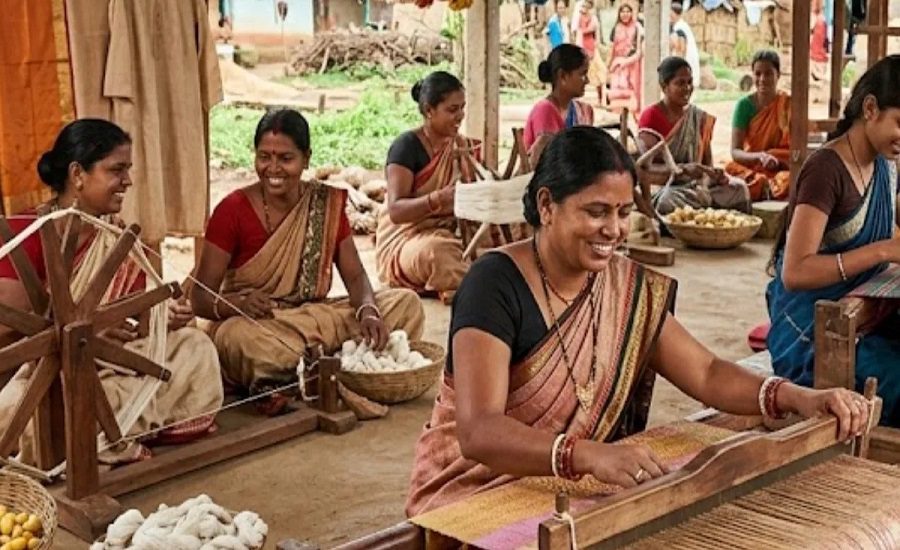
Gandhinagar: Gujarat’s Hastkala Setu Yojana (HSY) has emerged as a major initiative supporting traditional artisans across the state by improving income opportunities, skill development, and market access. Launched in 2020, the scheme is aligned with national initiatives such as Atmanirbhar Bharat, ‘Vikas Bhi, Virasat Bhi’, and ‘Vocal for Local’, aimed at promoting India’s cultural heritage while strengthening economic self-reliance.
Implemented across all 34 districts of Gujarat, the scheme is executed by the Industrial Extension-Cottage (Indext-C) under the Commissioner of Cottage and Rural Industries, with the Entrepreneurship Development Institute of India (EDII) acting as the knowledge partner.
Over 21,000 Artisans Registered, Majority Women Beneficiaries
So far, over 21,690 artisans have been registered under HSY, with 82% women participation, reflecting strong women-led empowerment in the handicraft sector.
The scheme also ensures social inclusion:
- 21% beneficiaries belong to Scheduled Castes
- 20% belong to Scheduled Tribes
- 34% belong to Other Backward Classes (OBCs)
This inclusive approach has helped extend benefits to marginalized communities engaged in traditional crafts.
Skill Development and Entrepreneurship Training Boost Self-Reliance
Beyond financial assistance, HSY focuses heavily on capacity building and skill enhancement. Under the programme:
- 15,586 artisans received entrepreneurship development training
- 9,292 artisans received specialized skill training
- Over 70 master trainers and 150 mentors provide continuous support
These efforts aim to transform artisans into self-reliant entrepreneurs capable of scaling their craft-based businesses.
Strong Market Linkages Through B2B and E-Commerce Platforms
One of the key achievements of the scheme has been improved market connectivity. Around 9,300 artisans have benefited from direct Business-to-Business (B2B) orders.
The government has also organized:
- 7 B2B meets
- 4 fashion shows connecting artisans with designers
In addition, more than 2,000 artisans have been trained in digital marketing and onboarded onto e-commerce platforms such as Amazon, Flipkart Samarth, Meesho, and Etsy, enabling them to reach national and international buyers.
Economic Impact: Rising Income and Employment Generation
The scheme has recorded significant economic outcomes:
- Total sales of ₹102.08 crore
- Creation of over 50,000 employment opportunities
- Assistance provided to more than 5,900 existing artisans
Income levels have also improved notably:
- Earlier, only 9% artisans earned above ₹15,000 monthly
- Now, this has increased to 50%
Additionally, the share of artisans relying primarily on handicrafts has risen from 20% to 45%, showing increased financial dependence on traditional crafts as a stable livelihood source.
Improved Market Access and Institutional Support
Around 73% of artisans have successfully accessed direct markets through exhibitions and fairs. The scheme has helped strengthen Gujarat’s handicraft ecosystem through consistent institutional support and market exposure.
Government Tackles Implementation Challenges with Modernization
Initial challenges included limited documentation, financial delays, reluctance toward technology adoption, and weak marketing systems. The Gujarat government has addressed these issues through:
- Technology upgrades
- Design innovation initiatives
- Market diversification strategies
- Public-Private Partnerships (PPP)
These reforms have improved efficiency and expanded the scheme’s reach.
From Local Craft to Global Recognition
The Hastkala Setu Yojana has evolved into more than just a welfare programme—it has become a transformative platform for artisans, helping preserve Gujarat’s cultural heritage while connecting it to global markets.
By promoting a “Local to Global” approach, the scheme strengthens the broader vision of building a self-reliant India and ensuring sustainable livelihoods for traditional artisan communities.