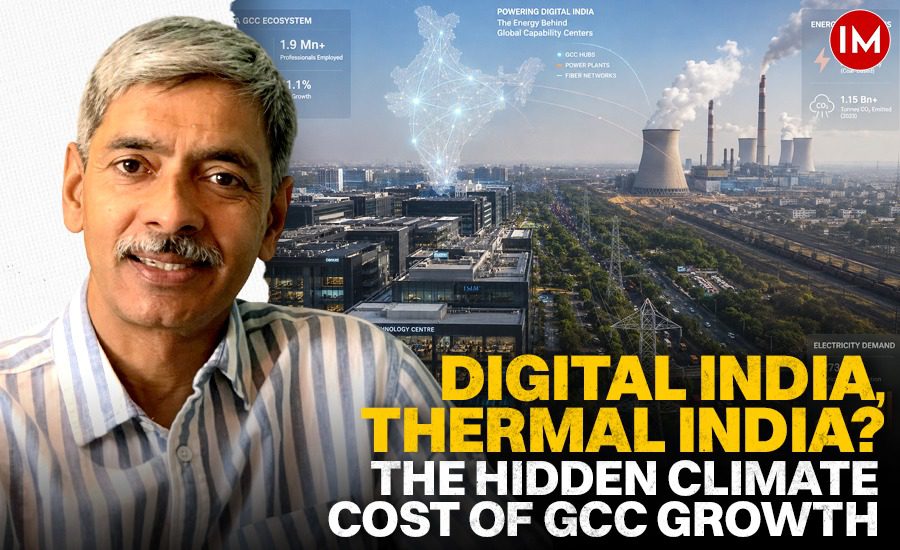
India’s Global Capability Centre (GCC) boom is among the country’s most significant economic success stories. What began as back-office support for multinational corporations has transformed into a strategic ecosystem driving engineering, AI, financial analytics, supply chains, semiconductor design and digital innovation.
Today, India hosts more than 1,700 GCCs, employing millions and contributing substantially to services exports and GDP. Bengaluru, Hyderabad, Pune and Chennai remain established hubs, while states such as Andhra Pradesh, Tamil Nadu and Maharashtra are aggressively competing for the next wave of investment. Andhra Pradesh’s ambitions around large-scale AI and hyperscale infrastructure, particularly around Visakhapatnam and Vizianagaram, signal the scale of what lies ahead.
At first glance, this looks like an unqualified national opportunity.
And it is.
But every strategic opportunity carries second-order consequences. The GCC boom is no longer merely about office parks and software talent. Increasingly, it is becoming a story of industrial-scale digital infrastructure.
That distinction matters.
Because a modern AI-enabled GCC ecosystem is not simply a campus with programmers and glass buildings. It is an energy-intensive operating system requiring uninterrupted electricity, high-performance computing, massive cooling systems and twenty-four-hour resilience.
And that brings us to a genuine ESG question few policymakers are asking:
Are we building economic engines or future climate liabilities?
India’s New Digital Factories
For decades, economic growth was associated with factories, highways and industrial corridors. Today, digital infrastructure is becoming the new industrial backbone.
A gigawatt-scale AI ecosystem is not lightweight infrastructure.
To put scale into perspective, a 1 GW AI-enabled ecosystem could consume electricity comparable to nearly one million homes, while housing hundreds of thousands of advanced computing chips operating continuously. Such facilities demand uninterrupted power, backup systems, cooling towers, water-intensive thermal management and redundant infrastructure operating round the clock.
This becomes an ESG issue because AI infrastructure generates heat at extraordinary levels.
Servers running advanced computation cannot operate without tightly controlled temperatures. Cooling is not optional, it is mission-critical.
That means high-capacity HVAC systems, chilled water loops, immersion cooling and large thermal management systems. Depending on architecture and geography, these facilities can consume substantial quantities of water annually.
Now connect this reality with India’s climate condition.
The country is already grappling with record heatwaves, groundwater depletion, urban heat island effects, rising electricity demand and climate-linked energy stress.
Yet many cities aggressively chasing GCC investments are themselves becoming heat-stressed urban ecosystems.
This contradiction is hard to ignore.
The Heat Problem Nobody Is Planning For
Recent climate studies underline the growing role of urban vegetation in reducing city temperatures.
Trees significantly reduce the urban heat island effect, where asphalt, concrete and dense infrastructure trap heat. Yet poorer and hotter cities where cooling matters most continue to receive the least natural heat relief.
This lesson should deeply concern India’s urban planners.
As states compete to attract GCCs and data centres, the focus remains on land, connectivity, incentives and electricity access. Far less attention is paid to climate carrying capacity.
How many cities are evaluating:
- thermal stress thresholds?
- long-term water sustainability?
- tree cover adequacy?
- cooling resilience?
- power reliability under rising temperatures?
The honest answer is: not enough.
India risks building smart cities without climate-resilient cities.
This could prove costly governance risk if ignored
.
The ESG Blind Spot: Scope 1, 2 and 3 Emissions
The climate footprint of GCC growth remains surprisingly absent from mainstream ESG discussions.
Viewed through an ESG perspective, the problem becomes starker.
Scope 1 emissions involve direct operational impacts- diesel backup generators, cooling refrigerants and on-site fuel use. If power instability rises, will diesel dependence quietly grow?
Scope 2 emissions are potentially the biggest challenge. AI infrastructure consumes enormous electricity. If the underlying energy mix remains coal-heavy, can digital expansion genuinely claim ESG leadership?
Renewable energy agreements help, but AI systems demand uninterrupted baseload power and twenty-four hours a day.
Then comes Scope 3 emissions, the most overlooked category.
These include semiconductor manufacturing, construction steel and cement, imported servers, logistics, hardware replacement cycles, water extraction and e-waste disposal.
In other words, the carbon footprint begins long before the first server is powered on.
What More Needs to Be Done?
India does not need slower digital growth.
It needs smarter digital growth.
First, governments must make climate carrying-capacity assessments mandatory before approving large GCC and AI infrastructure projects.
Second, cities hosting hyperscale facilities should adopt heat-resilience and cooling-efficiency benchmarks, especially in climate-stressed regions.
Third, approvals must include water-use accountability and urban cooling commitments, including tree cover and green infrastructure.
Fourth, ESG disclosures must transparently report Scope 1, 2 and 3 emissions, energy sourcing and lifecycle environmental costs.
Finally, state incentives should reward sustainable digital infrastructure, not merely capital inflows.
India’s Strategic Lesson
Military strategy offers an enduring lesson here that expansion without sustainment weakens capability.
Economies are no different.
India unquestionably needs GCCs. They strengthen exports, jobs, technological depth and global competitiveness. But growth without ecological foresight creates strategic vulnerability.
The next phase of India’s digital rise cannot be “growth at any environmental cost.”
It must become digital growth with climate intelligence.
Because the real test of ESG is not whether India can attract investment.
It is whether India can remain economically transformational without becoming environmentally extractive.
And perhaps the question policymakers should now confront is this:
Are we measuring digital GDP while quietly ignoring digital externalities?
(This is the second and concluding part on Climate Risk by the author and what needs to be done more for better governance being not only a business risk but a strategic risk and must form part of enterprise risk frameworks, assessment and performance benchmarking)