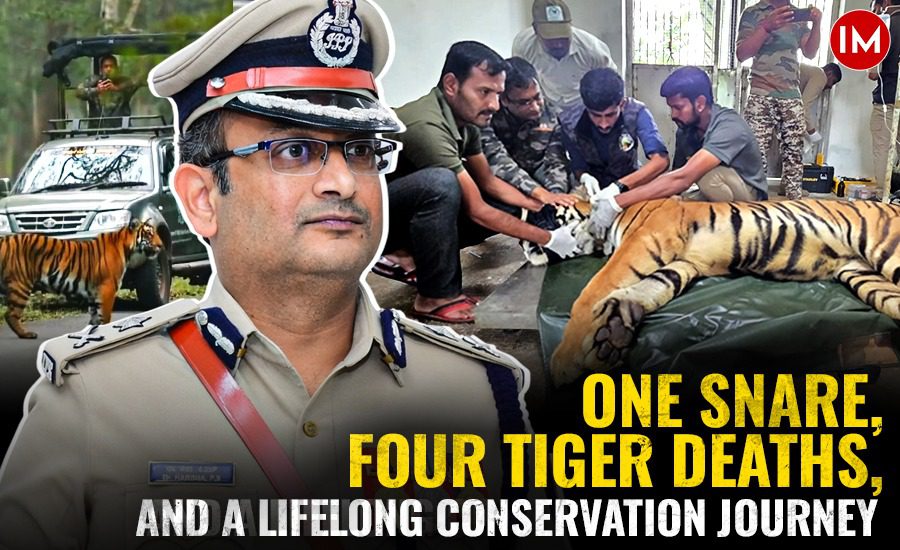
A tiger died in a snare. Then three cubs died because they could not survive without their mother.
For most people, it would have been a tragic wildlife incident. For Dr. P.S. Harsha, it became a life-changing moment.
Today, Dr. Harsha is known not only as a senior Indian Police Service officer but also as a respected tiger researcher whose work is helping shape the understanding of human-tiger conflict in India. A 2004-batch IPS officer of the Karnataka cadre, he currently serves as Inspector General of Police, Ballari Range. Alongside an accomplished policing career, he has built a remarkable second identity—as a wildlife conservationist, researcher, and tiger biologist.
Born in the historic fort city of Chitradurga, Karnataka, Dr. Harsha completed his medical education before choosing public service. Over the last two decades, he has served in several important positions, including Additional SP Gulbarga, SP Tumakuru, DCP Bengaluru City, Commissioner of Police Mangaluru City, and Commissioner of Information and Public Relations.
WHEN A PASSION BECAME A MISSION
Dr. Harsha’s fascination with tigers began during his student days. What started as curiosity gradually turned into a serious commitment to conservation.
The turning point came during his visits to Nagarahole Tiger Reserve, where he closely followed the life of a tigress that was well known to researchers and forest staff.
“It was one human-tiger conflict incident that wiped out four tigers in one shot,”Dr. Harsha told Indian Masterminds.
The death of the tigress and her three cubs deeply affected him. It pushed him to go beyond admiration and understand the real challenges facing tiger conservation. That decision eventually led him to pursue a Ph.D. in Wildlife Management and Tiger Biology from Kuvempu University.
Also Read – Rethinking Police Reform After Two Decades: Time for a Data-Driven Revisit
A POLICE OFFICER IN THE FOREST
Unlike many researchers, Dr. Harsha brought together scientific fieldwork and administrative experience.
His research covered Nagarahole, Bandipur and BRT Tiger Reserves within the Nilgiri Biosphere landscape. He studied tiger population stability, habitat use, livestock depredation, conservation pressures, and human-tiger conflict.
Using GIS mapping, remote sensing, and field observations, he analysed how and why conflicts occur and how they can be reduced.
His research has been published in reputed journals, including the Journal of Environmental Biology and the Asian Journal of Education and Social Studies.
THE DISCOVERY THAT CHANGED CONSERVATION THINKING
One of the most important findings from his research challenged a common assumption.
Many people believed that human-tiger conflict occurred evenly across tiger reserves. However, Dr. Harsha’s analysis revealed a very different picture.
Conflicts were concentrated in specific hotspots, while large portions of the reserves experienced little or no conflict.
“The conflicts were highly concentrated in specific pockets. Large sections of protected areas recorded almost no conflict at all,” he told Indian Masterminds.
The finding carries major implications for conservation. It suggests that authorities can focus resources, monitoring, and mitigation measures in identified hotspots rather than spreading efforts uniformly across an entire landscape.
WHY TIGERS COME INTO CONFLICT WITH HUMANS
According to Dr. Harsha, tigers are not natural man-eaters.
Their preferred prey includes chital, sambar, gaur, and wild boar. However, certain situations can push them towards conflict.
Older or injured tigers may find livestock easier to hunt. Young male tigers dispersing from their mother’s territory often move through plantations and settlements because forests have become fragmented. Tigresses raising cubs outside protected areas may also increasingly depend on livestock for food.
These factors, combined with shrinking habitats, increase encounters between humans and tigers.
HABITAT FRAGMENTATION: THE BIGGEST THREAT
Among all conservation challenges, Dr. Harsha considers habitat fragmentation the most serious.
As forests become divided by roads, settlements, and development projects, wildlife movement becomes difficult and dangerous. Tigers that once moved freely across connected forests now pass through human-dominated areas.
At the same time, he sees hope in wildlife-friendly infrastructure such as underpasses, overpasses, and elevated corridors that allow animals to move safely across landscapes.
PUTTING PEOPLE AT THE CENTRE OF CONSERVATION
One of the strongest messages from Dr. Harsha’s work is that conservation cannot succeed without local communities.
People living near forests often face livestock losses, crop damage, and sometimes even threats to their lives. Their concerns cannot be ignored.
“For them, conservation can sometimes appear as an elite idea that does not reflect their reality,” he told Indian Masterminds.
He believes that faster compensation systems, community engagement, and technology-driven early warning systems can help build trust between conservation authorities and local residents.
A CAREER OF SERVICE ON TWO FRONTS
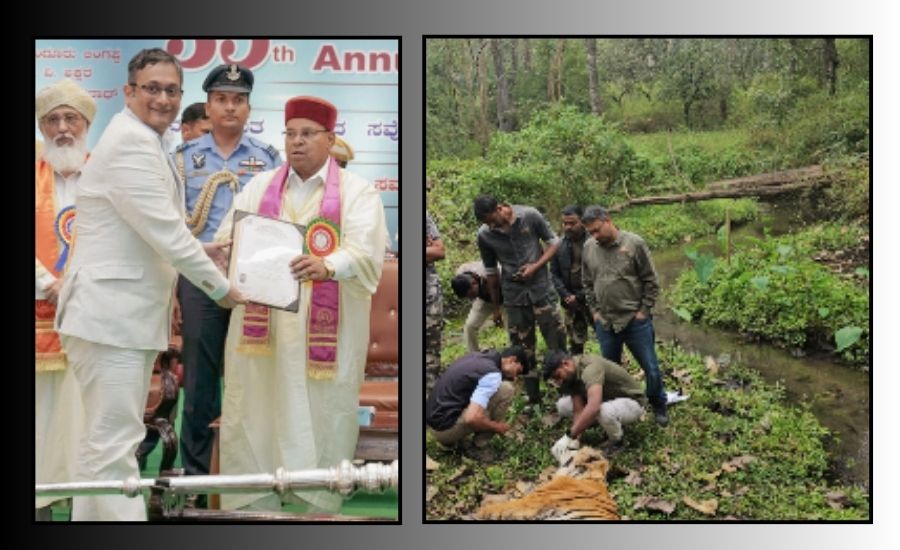
Dr. Harsha’s contributions have earned him the Chief Minister’s Award for Police Welfare and Innovation and the Chief Minister’s Medal for outstanding policing.
As Commissioner of Police, Mangaluru City, he introduced people-centric initiatives such as ‘My Beat My Pride’ and ‘Aashakirana’, which received wide appreciation.
Yet, beyond the police uniform, he continues to contribute to India’s conservation movement through research, science, and advocacy.
His journey shows that public service can take many forms. In Dr. P.S. Harsha’s case, it stretches from city streets to dense forests, from law enforcement to wildlife science, and from protecting people to helping protect one of India’s most iconic species—the tiger.
Also Read – In Tamil Nadu’s Remote Hills, IAS Officer Abhilasha Kour is Bridging the Last Mile