On India’s eastern coastline, where the Bay of Bengal meets a city known for its beaches, ports, and quiet efficiency, a bold transformation is underway. Visakhapatnam, already one of the country’s most livable urban centres, is now being positioned for something far bigger: a global data and technology powerhouse.
At the centre of this shift is a young administrator with a technocrat’s instinct and a field officer’s grounding. Since taking charge on April 1, 2026, Collector Muttimbaku Abhishikth Kishore has articulated a vision that is both ambitious and unusually comprehensive, to make Vizag the “Data Centre Capital of the World” while building a balanced, citizen-first growth model. According to him, Vizag is prepared to be the next big IT hub, not just for the country, but for the world.
In an exclusive conversation with Indian Masterminds, IAS officer Kishore talks about his vision, plans and governance style.
Geography that became destiny
“We have three international cables passing through our coast, linking us to the Americas, Europe and the East.”
For years, Vizag’s coastline was seen as a scenic advantage. Today, it is being understood as a strategic one. Beneath the waters of the Bay of Bengal lie the invisible highways of the digital world, submarine cables that carry the bulk of global internet traffic. Vizag sits at a rare intersection of these routes, connecting continents in ways that few Indian cities can claim. This is not just a technical detail; it is the foundation of the city’s new ambition.
Read Also: How Nagaland’s PIMS Became the Digital Backbone of Government Administration
Add to this the presence of a natural port, a relatively less congested urban space, and a cost structure that still remains attractive, and you begin to see why the administration believes Vizag can host the data infrastructure of the future. What was once geography has now become destiny.
Numbers that signal a shift
“Twenty-five percent of India’s private domestic investment is coming into Andhra Pradesh, and a majority of that is coming into this region.”
Big visions often sound abstract until numbers begin to back them. In Vizag’s case, the numbers are hard to ignore. Andhra Pradesh has emerged as the top destination for private domestic investment in the country, accounting for a staggering 25% in the current financial cycle. Even more striking is the fact that over 60% of this investment is flowing into the Visakhapatnam Economic Region.
This is not incremental growth, it is a decisive shift in where capital is choosing to go. The arrival of a U.S.D. 15 billion global data project, described as the largest FDI India has seen since Independence, further underlines this momentum. For a city that once sat quietly on the sidelines of India’s IT boom, this is a moment of arrival.
Building Beyond a City: The Economic Region Idea
“We are not planning for one district, we are planning for nine districts as one integrated economic region.”
What makes Vizag’s transformation different is its scale of thinking. This is not a city trying to grow within its existing limits; it is a region being designed to function as a unified economic engine. In collaboration with NITI Aayog, the administration is shaping the Visakhapatnam Economic Region, an expansive framework that covers the entire ‘Uttarandhra’ belt.
The effort goes beyond roads and buildings. It includes policy design, institutional capacity, and long-term planning that looks at how industries, people, and infrastructure will interact over decades. It is this layered approach that gives the vision its depth. The idea is simple but powerful: growth must be comprehensive, or it will not sustain.
Infrastructure that Keeps pace with ambition
“We are creating expressways, connecting the airport seamlessly, and opening up new growth pockets across the city.”
Walk through Vizag today, and the signs of change are hard to miss. A newly built expressway now cuts through what used to be congested stretches, linking emerging zones of activity. The Bhogapuram International Airport is no longer a distant promise, it is being woven into the city’s daily life through new roads and connectivity plans.
There is talk of a double-decker highway with a metro running through it, and a coastal corridor that will trace the city’s shoreline all the way to the airport. Yet, amid all this, there is a careful restraint. The administration is conscious of what makes Vizag special, that rare ability to move from home to beach, airport, or bus station within minutes. Development here is not meant to overwhelm; it is meant to fit in.
Governance model that chases investment
“Once a company announces a project, it becomes the government’s project, we ensure it gets grounded.”
Behind the scenes, much of Vizag’s momentum is being powered by a governance model that is both efficient and unusually hands-on. Andhra Pradesh’s ‘Single-Desk Portal’ has simplified the maze of approvals into a single interface, with a 21-day timeline and a near-perfect delivery record. But beyond systems, there is an attitude shift. Investors are not left to navigate bureaucracy on their own; they are actively supported, even pursued, by the administration to ensure their projects take off.
Institutions like the state’s Economic Development Board function as facilitators, bridging the gap between intent and execution. It is this approach that has quietly built confidence among investors, and turned announcements into realities.
Andhra’s Investor Playbook: Where projects become government missions
“Once a project is announced here, it becomes the government’s project, not the company’s.”
There is a certain clarity in the way Muttimbaku Abhishikth Kishore explains Andhra Pradesh’s investment story. The State’s consistent top ranking in ease of doing business, he says, is not accidental. It comes from a system where the burden of execution shifts from the investor to the government. Once an investor announces intent, officers begin tracking the project as their own responsibility: coordinating approvals, resolving bottlenecks, and even engaging with ministries in Delhi when needed.
This approach is backed by a dedicated business development ecosystem, including an Economic Development Board modelled on global institutions like Singapore’s. For large and mega projects, the support is end-to-end, right from paperwork to on-ground execution. The underlying message to investors is simple: you bring the idea, the State will help you build it.
Rewiring the city: Roads, corridors and a new urban spine
“We are opening up new pockets of the city and connecting them in a way that supports future growth.”
The transformation of Visakhapatnam is as much about physical movement as it is about economic momentum. A key piece in this puzzle is the newly completed expressway connecting Anakapalli to Anandapuram. By bypassing the congested national highway that cuts through the city, it has quietly redefined how people and goods move across emerging zones. But this is only one layer. The administration is working to seamlessly integrate the upcoming Bhogapuram International Airport with the city through a network of priority roads, ensuring that access is smooth and time-efficient.
Plans for a double-decker national highway paired with a metro line add another dimension to this evolving infrastructure. Along the coastline, a proposed coastal corridor, currently in the DPR stage, aims to link the city’s marina directly to the airport, blending mobility with scenic value. While the expressway is alreadyoperational, several of these connecting roads are under construction, gradually reshaping Vizag’s urban spine.
Betting on experiences: Vizag’s MICE ambition
“We are creating spaces where global events can happen, at a scale the country will notice.”
Beyond industry and data, Vizag is also positioning itself as a destination for experiences. The administration is pushing strongly into the MICE segment: meetings, incentives, conferences and exhibitions, recognising its potential to bring high-value tourism and global visibility. Around ten luxury properties, including five-star and seven-star facilities, are coming up across the city. These are not standalone hotels but integrated spaces with large convention and banquet capacities, designed to host international-scale events.
The plan has received a further push with the proposal for a second Bharat Mandapam in the country, following the one in Delhi. The announcement, made by the Union Commerce Minister during the Partnership Summit, has moved into the approval stage, with land already earmarked and discussions underway with the India Trade Promotion Organisation. When realised, this convention centre could anchor Vizag’s emergence as a national hub for large-scale events.
Holding on to what matters: Vizag way of life
“People here reach the beach in ten minutes, the airport in twenty, we want to keep it that way.”
Amid the scale of transformation, there is a conscious effort to preserve what residents value most. Vizag’s identity has always been tied to its ease of living, a city where distances are short, life is less hurried, and the coastline is part of everyday experience. The administration is keen that development does not come at the cost of this character.
Even as infrastructure expands and investments pour in, the goal is to maintain that delicate balance where growth enhances life rather than complicates it. The idea is not to turn Vizag into another crowded metro, but to evolve it into a city that combines opportunity with comfort. It is this sensitivity to local expectations that the administration believes will ensure public support for the changes underway.
Building people, not just projects
“We are creating a talent pool that industries can directly tap into.”
Growth, in Vizag’s model, is closely tied to people. Through initiatives like Swarna Gramam and Swarna Ward, often described as a fourth tier of governance, the district is focusing on identifying and preparing local talent. Graduates can walk into designated centres, take an online assessment, and generate a verified profile that reflects their skills. This database is then made accessible to companies setting up operations in the region.
The results are beginning to show. In a recent recruitment drive, Infosys hired around 500 candidates in Vizag using this very system. Alongside this, the State’s skill development ecosystem is working to continuously identify, train and align the workforce with industry needs. The intent is clear: investments should translate into local employment, and growth should feel tangible to the people who live here.
From tribal fields to policy tables
“One small intervention can create a very large impact, that is something I’ve seen closely.”
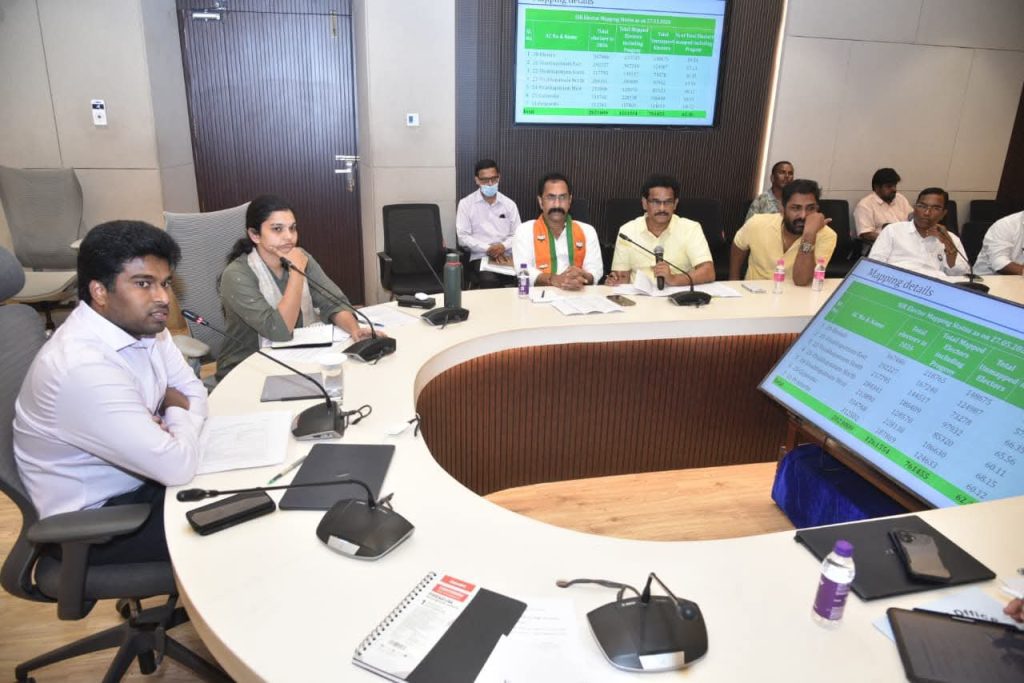
Long before he began speaking about global investments and infrastructure corridors, Abhishikth Kishore was working in some of the most remote corners of the State. As a young officer in Chinturu, then Naxal-affected tribal region at the intersection of multiple States, he was tasked with building governance systems from the ground up.
Among his most memorable interventions was in the promotion of Tussar silk. By introducing reeling practices and linking production to markets, incomes of nearly 3,000 tribal families tripled within a year. The fabric, once sold at premium outlets like Fabindia for around I.N.R. 20,000 was made available through a local brand at nearly I.N.R. 5,000, that too without compromising quality. The initiative not only created livelihoods but also established a sustainable identity for the region’s produce. For the officer, it remains a reminder that governance, at its best, is about impact that reaches the last mile.
Institutions that anchor a growing city
“We have a very strong institutional setup here, and that helps us deliver.”
Vizag’s present strength is also rooted in its past. As one of the older districts in the region, with administrative origins tracing back to 1803, it carries a deep institutional memory. The city consistently ranks among the top performers in national cleanliness surveys, highlighting the strength of its civic administration.
It is also home to a range of institutions that quietly support its growth: the Ratan Tata Innovation Hub, Marine Research Facilities under the Government of India, and the century-old Andhra University, which recently marked its 100th year. These institutions do more than coexist, they collaborate, creating a network where governance, research and community needs intersect.
City ready for its moment
“Vizag is in for great times, and the reason is its people.”
As plans unfold and projects take shape, there is a growing sense that Visakhapatnam stands at a defining moment. Infrastructure is expanding, investments are deepening, and governance systems are aligning toward a common goal. Yet, for the Collector, the real driver of this transformation lies in the city’s people. He describes them as open, capable and quietly ambitious, qualities that cannot be engineered but can certainly be nurtured.
In the end, the story of Vizag is not just about policies or projects. It is about a city finding confidence in its own potential, and a belief that its future will be shaped as much by its citizens as by its plans.