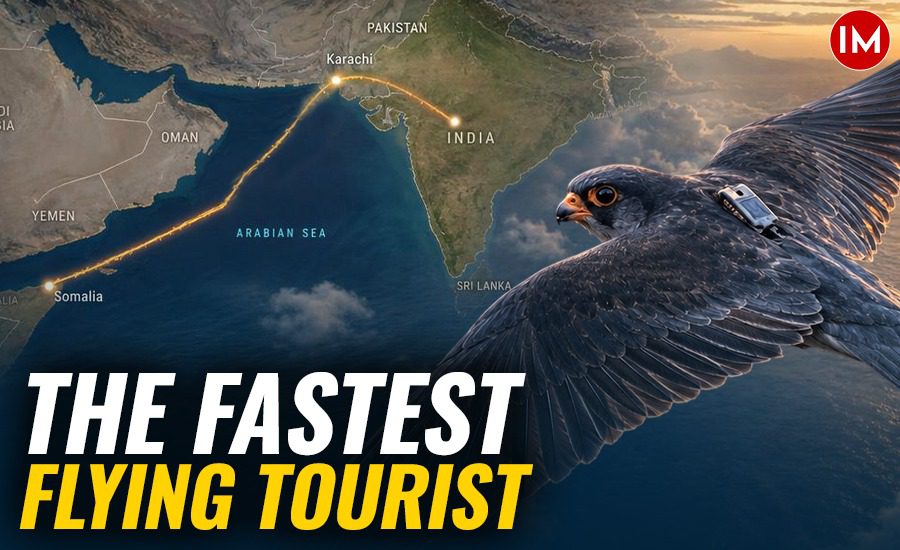
At 7:30 in the morning on May 14, a young bird named Alang lifted off from the Somalian coast and began one of nature’s most astonishing journeys — a nonstop flight across the Arabian Sea toward India. For more than two days, the young female Amur Falcon pushed northward over endless open ocean, battling winds, exhaustion, and uncertainty. By the time scientists tracked her latest location on May 16th, Karachi in Pakistan, she had already flown nearly 3,300 kilometres without stopping once.
Her destination: the western coast of India. Her story: one of the greatest migration tales on Earth. Scientists at the Wildlife Institute of India (WII) are tracking Alang in real time through satellite technology as part of a decade-long conservation programme in Northeast India. What they are witnessing is not just a bird crossing oceans — but the success of one of India’s most inspiring community-led wildlife conservation efforts.
Indian Masterminds spoke to Dr. R Suresh Kumar, Senior Scientist in the Department of Endangered Species Management, to understand the remarkable journey of the Amur Falcon, the science behind tracking it, and how local communities in Northeast India transformed from hunters into protectors.
The Tiny Raptor Making a Giant Journey
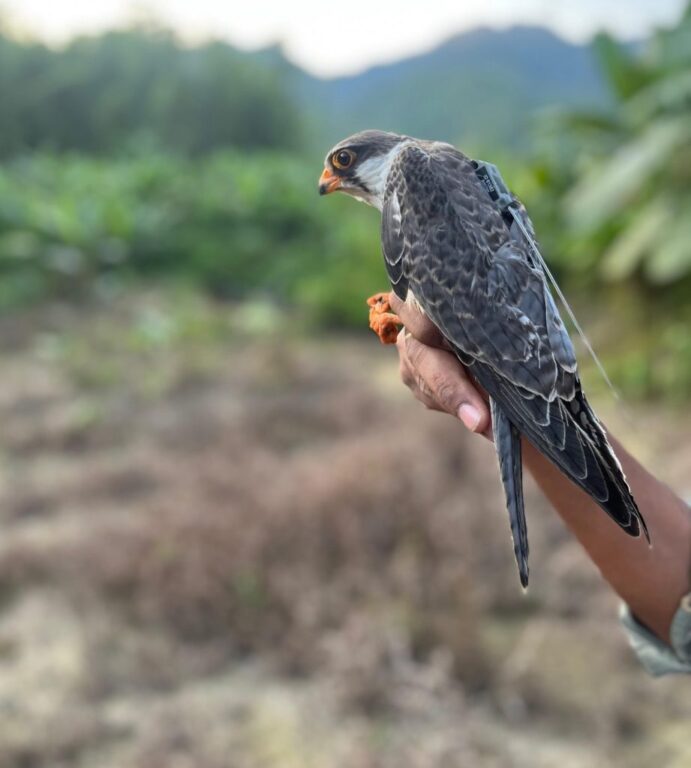
Alang is a young female Amur Falcon tagged in November 2025 in Chiuluan village of Manipur’s Tamenglong district. She is one of three birds — Apapang, Ahu, and Alang — fitted with satellite transmitters under the ongoing Amur Falcon conservation programme.
After spending nearly four months in Southern Africa, Alang began her return migration toward her breeding grounds in Far-East Asia. Her current journey is staggering even by migratory bird standards. After departing Somalia, Alang began crossing the Arabian Sea — a nonstop flight expected to last nearly three days. Scientists estimate that she would eventually fly around 3,300 kilometres continuously before touching land near the Indus delta or Gujarat’s Kachchh region.
Read Also: Once in the race to become India’s national bird, today is on the brink of extinction
Additional DG (Forest) Mr. Ramesh Pandey, a 1996 batch IFS officer, shared on social media that Alang had crossed nearly 3,300 kilometres over the Arabian Sea in almost 60 hours before landing east of Karachi in Pakistan. After a brief halt overnight, she resumed her journey and was expected to cross Rajasthan later in the day.
‘Alang’ the young female Amur falcon, tagged in Manipur in Nov 2025 is returning back to Far-East Asia after spending 4 months time in South Africa. It crossed Arabian Sea flying non-stop for 3300 km in 60 hrs and landed at east of Karachi in Pakistan. After spending a night… pic.twitter.com/Sy4gv12D00
— Ramesh Pandey (@rameshpandeyifs) May 17, 2026
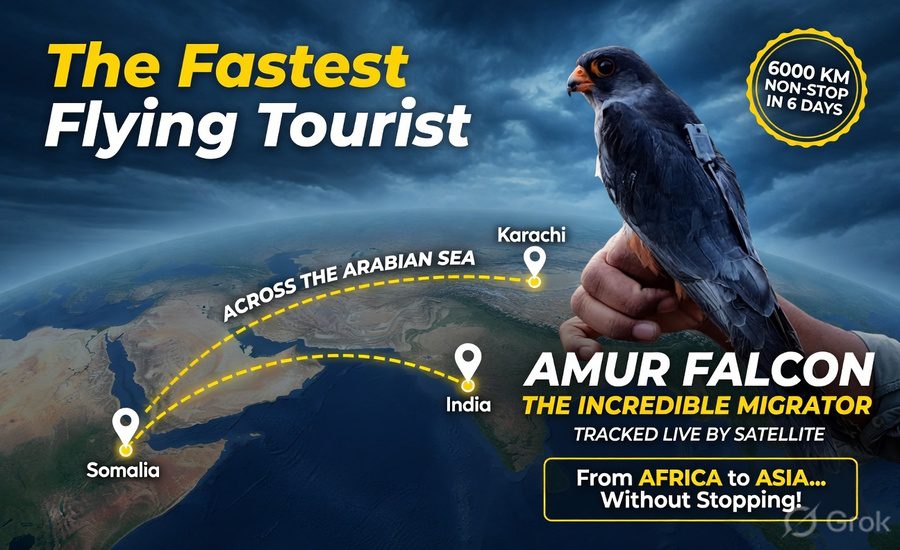
At the same time, another tagged male falcon, Apapang, completed an even larger journey — flying nearly 6,000 kilometres in six days from Somalia before taking a stopover in eastern Myanmar and continuing toward Beijing.
One of the Greatest Travellers on Earth
Birds are among the greatest travellers on the planet, but the Amur Falcon stands apart for the sheer scale and difficulty of its migration. Every year, these small raptors travel from their breeding grounds in the Amur region — located north of China near the Russia-Mongolia border — to Southern Africa and back again. The complete migratory cycle spans nearly 20,000 kilometres one way.
Despite weighing barely 170 to 180 grams, the bird crosses continents, forests, deserts, and oceans with astonishing precision. Speaking to Indian Masterminds, Dr. Suresh Kumar explained: “Starting from its nesting grounds and flying through India, Somalia, Kenya, Tanzania, Zimbabwe, and finally South Africa — that one-way route alone spans at least 20,000 kilometres.”
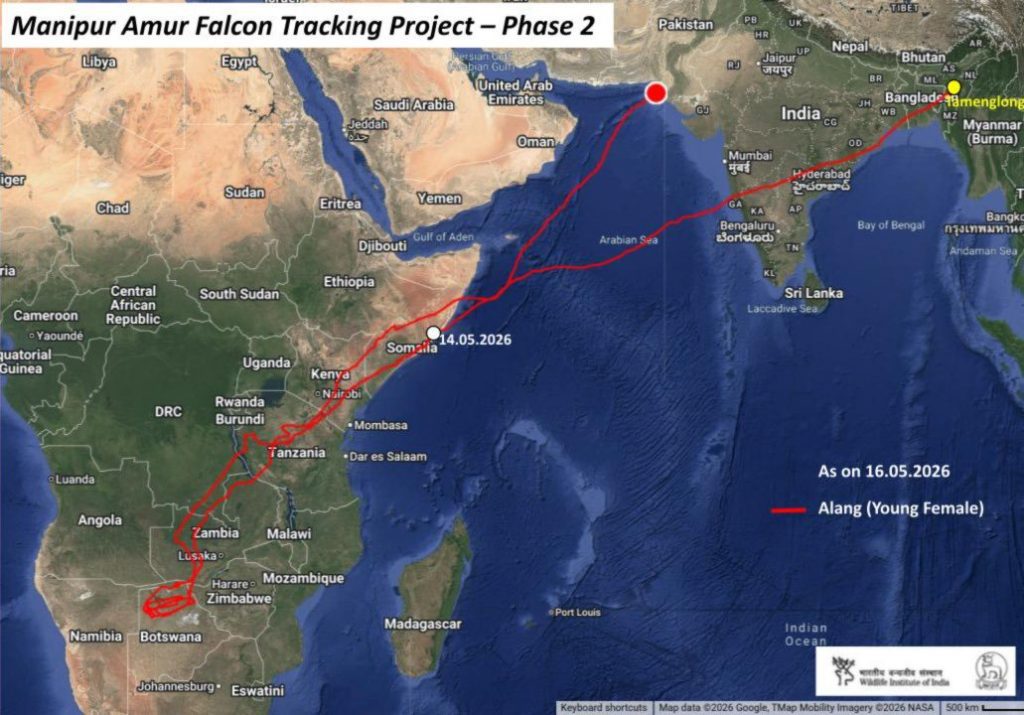
What makes the Amur Falcon truly extraordinary is its nonstop ocean crossing. “When these birds depart from Northeast India, they travel nearly 6,000 kilometres without stopping,” Dr. Kumar said adding, “They need enormous energy reserves to sustain such a long flight. Through our research, we discovered that the food they get in Northeast India helps them prepare for this demanding journey.”
Why Northeast India Matters to the Amur Falcon
The story of the Amur Falcon is deeply connected to the forests and hills of Northeast India. Every October and November, millions of Amur Falcons arrive in select pockets of Nagaland and Manipur, especially in hilly terrains such as Tamenglong district. They stay there for nearly a month before continuing toward Africa.
According to Dr. Kumar, nowhere else in the world do these birds gather in such massive numbers. “We found that these staggering congregations exist only in Northeast India,” he told Indian Masterminds. “You may spot a few birds elsewhere, but not in lakhs. This region becomes a critical stopover point for the species.”
Ironically, these massive gatherings once made the birds vulnerable. Years ago, large-scale hunting of Amur Falcons was common in parts of Northeast India. But over the past decade, local communities have transformed into frontline conservation partners. “Those same local communities who once hunted the birds are now protecting them,” Dr. Kumar said. “That is the real success story.”
India’s Decade-Long Conservation Mission
The conservation effort began in Nagaland around 2013–14 before expanding into Manipur. The current satellite tracking phase started in 2024, with three birds tagged in November 2025 in Tamenglong district. According to Dr. Kumar, the initiative was never just about tracking birds — it was about understanding them. “If you want to conserve a species, you first need to understand it,” he said, “We needed to know where these birds travel, why they stop in certain places, what threats they face, and how climate and habitat changes affect them.”
The project combines scientific research, satellite telemetry, community awareness, and local participation. Union Environment Minister Bhupender Yadav praised the programme, calling it “one of the successful community-led conservation efforts in India.” He noted that the project has generated valuable scientific insights into this “incredible small raptor” and is helping guide future conservation strategies.
In a continued effort over the last decade for conservation of Amur Falcons in Northeast India, three Amur Falcons were satellite-tagged in their stopover site (Chiuluan) in Tamenglong district of Manipur in November 2025.
— Bhupender Yadav (@byadavbjp) May 16, 2026
Having completed more than four months in their… pic.twitter.com/7XmkUxbND6
Tracking a Bird from Space
Tracking an Amur Falcon is no easy task. The bird is tiny — weighing less than 200 grams – yet scientists attach lightweight satellite transmitters to monitor its movement in real time. Dr. Kumar explained that traditional tracking methods simply cannot work for migratory birds. “Once a bird flies away, you cannot follow it physically,” he said.
“So we use satellite technology. Every moment, every day, we can know exactly where the bird is.” The data reveals migration routes, stopover sites, weather impacts, and even threats like hunting and habitat degradation.
The technology is also helping scientists understand climate change. “Climate is changing rapidly,” Dr. Kumar said. “We need baseline scientific data to understand how these changes are affecting birds and migration patterns.”
India’s Crucial Role in the Central Asian Flyway
India occupies a strategic position in the Central Asian Flyway (CAF), one of the world’s major migratory bird routes connecting Arctic and Central Asian breeding grounds with South Asia. Every year, India hosts more than 370 migratory bird species.
“Birds, the greatest travellers on Earth, undertake epic seasonal journeys spanning continents in search of breeding and non-breeding grounds. India, strategically positioned at the southern end of the Central Asian Flyway (CAF) – one of the world’s major migratory routes connecting Arctic and Central Asian breeding grounds to wintering areas in South Asia—hosts over 370 migratory bird species annually. Of these, a significant portion, including around 171-257 waterbird species linked to the CAF, use Indian wetlands as critical wintering (non-breeding) and stopover sites, with India supporting stopovers for over 90% of CAF species,” Mr Ramesh Pandey told Indian Masterminds.
He further said, “India’s location in the CAF plays a pivotal role in global bird conservation by providing essential habitats that sustain populations of threatened species across 30 range countries. As a core wintering and passage hub, it safeguards birds like Bar-headed Geese, cranes, and waders facing habitat loss and climate challenges. To strengthen this, India led the Initiative for the Central Asian Flyway (ICAF), unanimously adopted at CMS COP14 in 2024. This includes establishing a Coordinating Unit hosted by the Government of India to drive capacity building, knowledge sharing, research, and coordinated action for over 600 migratory species along the flyway.”
“Ramsar sites serve as vital anchors for bird conservation, offering protected wetlands that support breeding, feeding, and resting for migratory flocks while enhancing ecosystem services. India has dramatically expanded its network from 27 sites (around 2014) to 99 as of April 2026, now ranking among the global leaders and bolstering CAF protection,” he added.
Indian wetlands support over 90 percent of migratory species linked to the flyway and serve as vital stopover and wintering habitats for birds such as cranes, geese, waders, and raptors. To strengthen conservation efforts, India led the Initiative for the Central Asian Flyway (ICAF), which was adopted during CMS COP14 in 2024.
The initiative focuses on research, coordination, knowledge sharing, and habitat protection for more than 600 migratory species across 30 countries. India has also dramatically expanded its network of Ramsar wetlands — from 27 sites around 2014 to 99 sites by April 2026 — significantly strengthening habitat protection for migratory birds.
Tracking Other Migratory Species
The work of Dr. Suresh Kumar and his team extends far beyond Amur Falcons. The scientists are also tracking species such as Common Cranes, Greater Flamingos, Lesser Flamingos, and sea turtles across India. “We are tagging sea turtles along the Tamil Nadu, Odisha, Maharashtra, and Lakshadweep coasts as well,” Dr. Kumar said.
“Once they enter the ocean, nobody knows where they go. Satellite tracking helps us understand their movement.” Such studies are building critical ecological knowledge and helping shape future conservation policies.
The World Record
While the Amur Falcon’s migration is among the most remarkable in the world, Dr. Kumar pointed out that another bird visiting India holds an even more astonishing record.
The Bar-tailed Godwit is known to undertake a nonstop flight of nearly 13,000 kilometres over the ocean.
“It completes the journey in 10 to 11 days without stopping,” Dr. Kumar explained.
Still, the Amur Falcon remains one of the world’s most extraordinary long-distance travellers — particularly because of its small size and its massive transcontinental journey.
A Story of Science, Survival, and Hope
At its heart, the story of the Amur Falcon is not just about migration. It is about science guiding conservation. It is about communities changing old practices to protect wildlife.
It is about understanding how even the smallest creatures connect continents and ecosystems. And somewhere high above the Arabian Sea, a tiny falcon named Alang continues to fly — carrying with her not just the instinct of migration, but the success of a conservation movement that has transformed India’s Northeast into one of the world’s most important safe passages for migratory birds.
As Dr. Suresh Kumar summed it up: “This project shows why scientific research is essential for conservation. You cannot protect a species properly unless you truly understand it.”
Read Also: The Success Story of Amur Falcon Conservation in Manipur