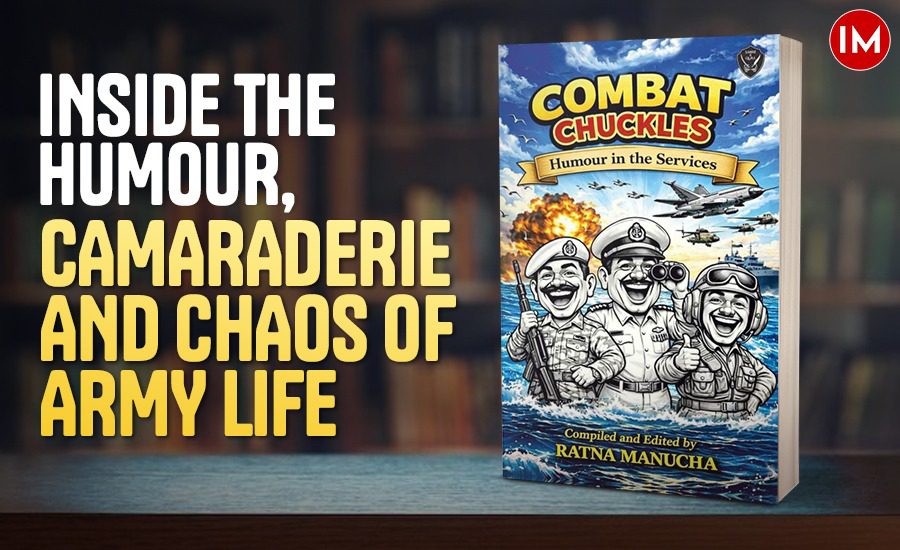
Brig Rajendra Singh, SM, FRGS and Col Ajay K Raina established Sabre& Quill seven years ago as the publishing arm of the Military History Research Foundation (MHRF) to provide a platform for writers connected with the defence services, life in cantonments and strategic scholarship in India. Their range of books is impressive – from battle victories to memoirs of veterans, translations of classics like Arthashastra to horror mysteries, books on China and the lesser-known heroes of 1857. To this vast repertoire, there is a new addition of ‘Combat Chuckles’ which deals with combat situations and incidents in cantonments, with the explicit aim of drawing chuckles as one goes through the fine selection of 21 short stories and three anecdotal poems. Compiled and edited by Dehradun-based author and educator Ratna Manucha, whose lifelong connection with the army, first as a daughter and then as a spouse, equips her with all the right credentials to share with readers the camaraderie and espirt de corps which makes life in uniform not just bearable, but absolutely delectable.
Although I never donned a uniform, (even though I cleared my SSB), I spent my formative years in the Jalandhar Cantonment. I also had the privilege of doing my army attachment with the 7 Sikh Light in Akhnur area, alongside later postings in the military stations of Kalimpong and Siliguri, besides the cities of Kolkata, New Delhi and Dehradun which each have army cantonments and golf courses. I have also had more than my share of ‘Fauji’ anecdotes from my father, uncles, cousins and friends – many of whom are army brats. And so, when RM asked me to write a blurb for her book, and also do a review, there was no question of not doing it.
Also Read – The Forest Mothers of India: Meet the Unsung Women Heroes Protecting Forests and the Environment
Let us now get to the book. We begin with the poems, for they are only three in number – two of which are from RM herself. The first is ‘Life in the Army’, a sanitized and publishable version of what we heard in our growing-up years. The lines I liked best in this are: ‘Life in the army/They say is one big joke, / But I have yet not started laughing /and the others too are long faced blokes!’
In ‘The Visit’ of the GOC to a military station, everyone and everything obviously has to be perfect: ‘You see, the General is paying a visit/(other lesser mortals just ‘pass through’/the barbers and tailors worked round the clock… everyone has to look fit/Doesn’t matter if they have to squeeze into their 6 Bs , and slowly turn blue!’
Now for some of the stories – since a review is only a sampler – starting from ‘Borderine Etiquette’ by Lt Col Manoj Asthana, in which two adjacent border posts across the LoC looked absolutely spick and span – for their respective GOCs who were visiting. Then we have Brig Suyash Sharma’s ‘Tipsy Pudding’ – an ode to the mouthwatering concoction for RIMC cadets. The pudding is a sponge cake immersed in fruit syrup as the base, topped with layers of fresh fruit, custard jelly, fresh cream and dry fruits – with each chef adding his/her own personal touch – crumbled Marie biscuits, or tinned cherries and jam. Mouth-watering descriptions indeed!
I now come to my favorite story ‘Military Jargon Goes Awry’ from Wing Commander Anupama Joshi, but before I narrate its themes, a few words about her. Anupama is among the first batch of women to have joined the armed forces in 1992, and she went on to win the legal battle for parity with gentlemen officers. The story is regarding a cryptic communication addressed to a ‘dog-shooting squad’ at an Air force station in the Western sector where all attempts to chase or castrate the strays had failed. A high-powered decision was taken to scare the four-legged intruders away from the fenced area with the use of rubber bullets, as they would often appear on the runway and thereby affect the normal operations of takeoffs and landings . However , due to a typographic error by the sergeant , the order read: ‘The following dogs are detailed to shoot the officers.’ After the choicest expletives had been hurled at the hapless sergeant, his quivering fingers typed out a fresh order which said ‘Read officers for dogs, and dogs for officers’.
This not only had me in splits, but also reminded me of one of my first lessons at the Times of India Training School four decades ago. We were told of how typos can ruin a story as well as a reputation. Thus, on account of a missing ‘r’ the obituary of a General read ‘The battle-scared veteran died peacefully in his sleep last night.’ But in the correction that was carried out the next day, the ‘a’ in ‘battle’ became an ‘o’, and so the corrigendum ran as follows: ‘The bottle-scarred veteran died peacefully in his sleep last night.’
In ‘Orders Received, Thinking Deferred’ by Brig Steve Ismail, we learn that for the NCO, the instructions of the Subedar Major are like the commandment of the Lord. Because they had been told to reach before the GoC, their Shaktiman truck refused to give way to the cavalcade of the General, even when the pilot was blaring the siren to indicate that the VVIP was in one of the Jongas (a legendary, rugged 4×4 vehicle manufactured in India specifically for the Indian Army from 1969 to 1999).
‘Turbaned Tales’ by Brigadier Preet Pal Singh narrates interesting anecdotes from his journeys across the continents on account of his turban being the most prominent part of his sartorial bearing. He writes: ‘My turban all through has been a conversation starter, a royal diadem and often a magic prop. From being mistaken for an Arab sheikh, a red Indian to being quizzed about my helmet, I have lived by Khushwant Singh’s diktat “A sardar abroad is never anonymous”’.
Then we have Col Avnish Sharma’s take on Military Language. ‘Clear as Camouflage’ starts with him contesting the number of languages Indians speak – for in addition to the 22 official languages, he has added the 23rd quasi official language of military lingo. This is spoken by over two million people serving in the Indian army as well as the veterans. Some examples are wilco, roger, tiger, clot, bajri etal. ‘You walk like a pregnant duck, pull up your socks, tighten your belt, get on the ball, move, you lazy bum, get lost’ — these are part and parcel of every cadet’s life, and they haunt him/her even after s/he has left the services and is heading towards the grave!
Last, but not least, is the poem ‘If (Revisited)’ by Col Shivaji Tanjan Ghosh, which offers a deep philosophical insight: ‘If you can speak/and not feel depressed if others disagree;/If you can meet with those who became generals/and those who missed the boat/and treat both equally;’ then and only then can it be said that you have lived your life like a true soldier: for you have taken the twist with the turn, the dusk with the morn, and the agony with the ecstasy.
Also Read – Why India’s Plantation Drives Fail to Cool a Burning Nation