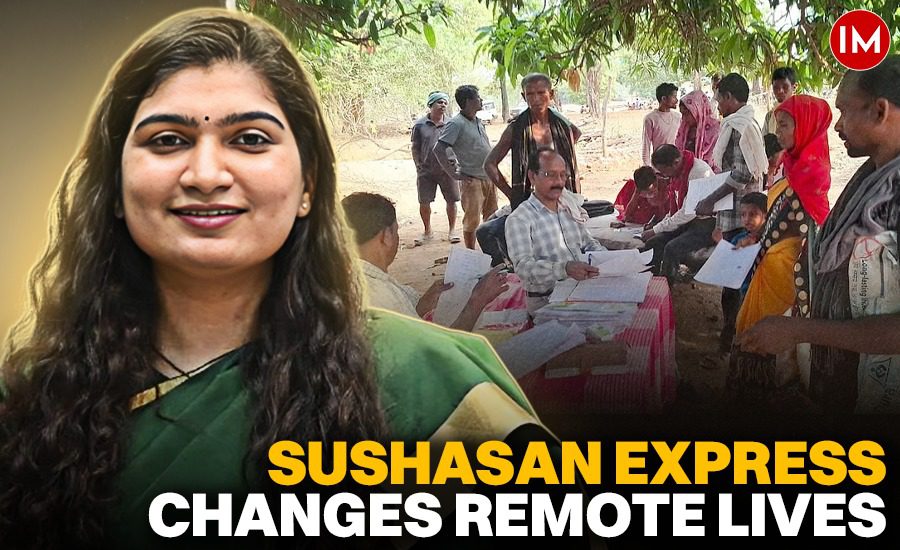
In the dense interiors of Chhattisgarh’s Narayanpur, there were villages where accessing basic government services often meant undertaking exhausting journeys through difficult terrain. For thousands of families living in these remote settlements, official documents were not just delayed; they often remained entirely out of reach.
Distance was only one part of the challenge.
Poor road connectivity, scattered habitations and long-standing security concerns in Maoist-affected pockets had created an invisible barrier between people and public services. For years, identity registration, welfare enrolment and grievance redressal remained difficult for many residents.
It was a reality that demanded a different approach.
And under the leadership of IAS officer Namrata Jain, a 2019-batch Chhattisgarh cadre officer and the current Collector of Narayanpur, the district administration decided to take governance to the people instead of waiting for people to come to governance.
That decision gave birth to Sushasan Express, about which she exclusively shared details with Indian Masterminds.
THE MOVING OFFICE BRINGING GOVERNMENT TO EVERY DOORSTEP
Launched in January 2026, the initiative was designed as a mobile governance model functioning under the direct supervision of Collector Namrata Jain.
Read Also: The Day a Village Heard the National Anthem for the First Time
The idea was simple but powerful: a travelling service centre that moves into some of Narayanpur’s most difficult-to-reach habitations, sets up temporary camps, and delivers essential government services on the spot.
Explaining the vision behind the initiative, Collector Namrata Jain said,
“For years, tough geography, scattered habitations and security concerns kept many villages beyond the routine reach of administration. Basic services such as identity registration, welfare enrolment and grievance redressal often required long travel or remained inaccessible altogether. The Sushasan Express changes that equation.”
The administration introduced a structured daily monitoring system to ensure every application received is tracked, processed and delivered without delay.
As Namrata Jain put it,
“Our focus is to ensure that every resident of interior areas is covered under essential schemes. Every application received, processed and pending is monitored daily to maintain transparency and timely delivery.”
72 PANCHAYATS, 20,000 DOORSTEPS, ONE ADMINISTRATIVE PUSH
In just four months, the impact has been substantial.
Between January and May, the Sushasan Express has already visited 72 of Narayanpur’s 112 panchayats, reaching more than 20,000 households across the district’s interior settlements.
Each visit has carried the state’s services directly to communities that had remained distant from routine administrative access.
For Collector Namrata Jain, the initiative is about restoring confidence in public systems.
“Governance must not stop where the road ends. Our effort is to ensure that distance never becomes a reason for exclusion,” she said.
THE NUMBERS THAT REFLECT CHANGE ON GROUND
The scale of service delivery through Sushasan Express tells its own story.
The initiative has facilitated:
- 2,126 Aadhaar cards issued
- 4,022 Ayushman cards issued
- 306 labour cards generated
- 713 birth and death certificates
- 562 ration cards issued
- 180 caste certificates
- 104 income certificates
- 63 residence certificates
- 233 PM Samman Nidhi-related services
The outreach has also extended to:
- Pension-related services
- MGNREGA job card facilitation
- Election Form-6 registrations
- Health and disability surveys in remote areas
One of the programme’s most impactful interventions has been Aadhaar service delivery.
A total of 10,682 Aadhaar updates, including Mandatory Biometric Updates, have been completed, bridging a critical gap, since Aadhaar remains central to accessing most welfare schemes.
REDEFINING LAST-MILE GOVERNANCE
What makes Sushasan Express significant is not just the number of certificates issued or applications processed.
Its larger contribution lies in changing the relationship between administration and communities that had long remained on the margins.
Under IAS Namrata Jain’s leadership, Narayanpur is showing how governance can move beyond office buildings and fixed service centres.
By entering difficult terrain, crossing administrative barriers and physically reaching citizens, Sushasan Express is turning last-mile delivery into first-contact governance.
And in Narayanpur’s remote villages, that movement is changing lives, one doorstep at a time.
Read Also: From the Heart of Naxal Belt Arises an IAS Officer