The forest guard standing deep inside the forests of Valmiki Tiger Reserve was confidently identifying species, explaining animal behaviour, and discussing conservation facts with unusual precision. Beside him stood senior Indian Forest Service officer Arvinder Singh, quietly listening.
Then came the unexpected moment.
The guard was referring repeatedly to a field guide tucked under his arm — a book he had relied upon during training and field duty for years. Watching him, Mr. Singh’s wife smiled and finally revealed the truth.
“The person who wrote that book is standing right beside you.”
For a brief moment, the guard was stunned.
That scene captured the extraordinary journey of a man who spent nearly a decade creating practical wildlife books not for fame or literary recognition, but for the people standing on the frontlines of conservation — forest guards, foresters, zookeepers, enforcement teams, and wildlife staff who protect India’s forests every day.
Today, Mr. Singh, a 1995-batch Indian Forest Service officer of the Bihar cadre, serves as PCCF (HoFF) and Chief Wildlife Warden of Bihar. But long before occupying the state’s top wildlife post, he was struggling with a problem that very few people noticed.
India’s wildlife protectors often lacked the tools to identify the wildlife they were expected to save.
A QUESTION THAT CHANGED EVERYTHING
The idea took root in 1999 during Mr. Singh’s training at the Wildlife Institute of India.
At the institute, he realised that even formal wildlife education relied heavily on rough sketches and limited visual references. Species identification was often difficult even for trained officers.
That worried him deeply.
“If I, as a trained wildlife officer, found identification difficult, how would my guards and foresters manage?” he told Indian Masterminds.
The question stayed with him long after the training ended.
At the time, frontline forest staff across India had very limited access to practical field manuals. Scientific literature existed, but it was often too technical, inaccessible, or unsuitable for field use. Many guards posted in forests had little visual reference material to identify endangered animals, birds, reptiles, or plants.
Mr. Singh believed conservation could not succeed unless the people protecting wildlife were first empowered with knowledge.
And so began an ambitious mission.
BUILDING A BOOK WITHOUT RESOURCES
Today, creating an illustrated field guide may seem straightforward. But in the late 1990s and early 2000s, the process was painfully difficult.
There was no easy internet access. Digital photography was expensive. Wildlife photographs were hard to obtain. Design software was unfamiliar. And copyright restrictions made using existing images nearly impossible.
But Mr. Singh refused to abandon the project.
“I didn’t even have a computer then. I took a loan to buy one,” he recalled while speaking to Indian Masterminds.
He taught himself computer software from scratch. Since photographs were unavailable for many species, he hired painters to create detailed illustrations manually. He arranged scanning systems and slowly assembled the book page by page.
Wildlife photography itself was another challenge. Capturing rare species in forests during that era required enormous patience, technical skill, and money.
Still, he kept finding solutions.
“It was solution after solution,” he said.
What began as an idea gradually transformed into a massive documentation effort covering endangered wildlife species found across India.
The project ultimately took nearly six years of relentless work before the first book was completed around 2005–06.
A FIELD GUIDE FOR THE PEOPLE ON THE GROUND
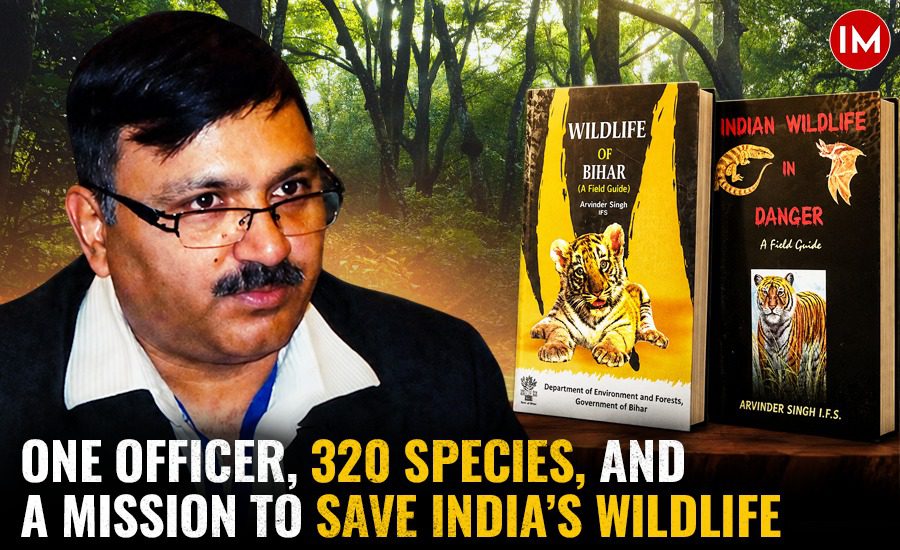
The result was Indian Wildlife in Danger — a practical field guide featuring 320 endangered species found in India.
But the book was never meant to be a decorative wildlife encyclopedia.
It was designed as an operational manual for frontline conservation workers.
Each species was presented in a highly accessible single-page format containing coloured illustrations, distribution maps, scientific classification, identifying features, food habits, breeding information, threats, illegal trade details, and legal protection status.
The goal was simple: make wildlife knowledge practical and usable.
“They don’t need complicated scientific literature. They need practical information,” Mr. Singh explained to Indian Masterminds.
The book also addressed an often-overlooked reality — wildlife crime. Forest staff needed to identify not just live species, but also poached body parts, illegal wildlife products, and trafficking patterns.
For young forest guards entering service, the guide became both a training tool and a confidence builder.
DOCUMENTING BIHAR’S WILDLIFE HERITAGE
Years later, Mr. Singh wrote a second major work — The Wildlife of Bihar: A Field Guide.
Unlike the first book, which focused broadly on endangered Indian wildlife, this work documented Bihar’s wildlife landscapes, sanctuaries, biodiversity zones, and protected areas in detail.
The Bihar government itself encouraged the publication because of its growing usefulness for training and field operations.
Today, copies of the book are distributed to forest officials and staff during training programmes across the state.
The impact, however, is visible not inside offices, but inside forests.
In places like Valmiki Tiger Reserve, forest personnel continue using the guides while patrolling difficult terrain and identifying species on the ground.
That, perhaps, remains the book’s greatest success.
Not awards. Not recognition.
But the fact that somewhere in a forest, a guard protecting wildlife still carries it in his hands.