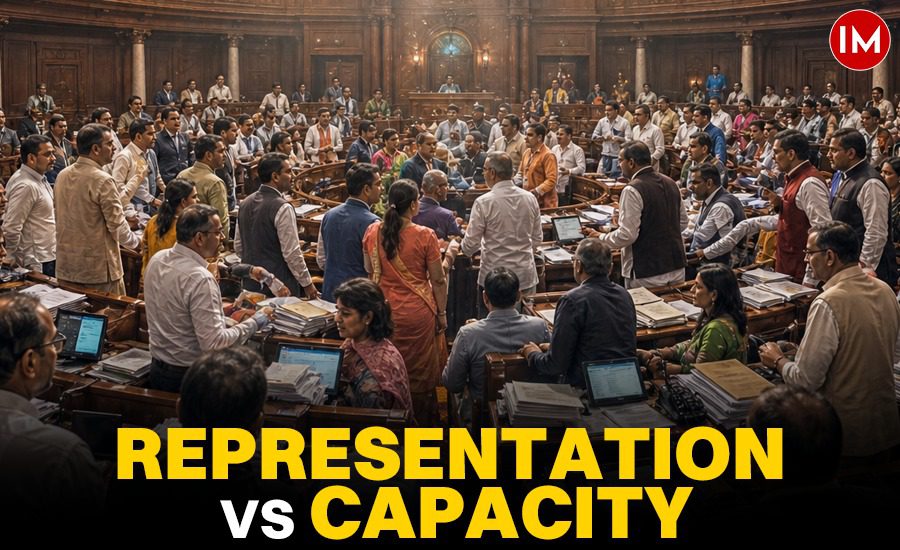
The proposal to expand the Lok Sabha to nearly 850 seats is widely justified as a corrective to India’s skewed representation ratios. With each Member of Parliament (MP) representing an exceptionally large population, the argument for smaller constituencies appears democratically sound. Yet, this logic captures only one dimension of the problem. Legislators operates within an administrative ecosystem, and without a corresponding expansion in State capacity, increasing constituencies risks deepening an already visible imbalance between political demand and administrative supply.
Multiplication of Political Demand
Consider a large district in a politically active state such as Uttar Pradesh. A typical district is simultaneously accountable to multiple elected representatives- several MLAs, one or more MPs and local body leaders. The District Magistrate (DM) acts as the nodal point for all administrative coordination.
Under the current structure, district officials receive parallel requests from different representatives for the same limited pool of resources- road construction, police deployment, or beneficiary selection under welfare schemes. For instance, demands for inclusion in housing schemes like Pradhan Mantri Awas Yojana often arrive through multiple political channels, each backed by local expectations and electoral considerations.
When the number of constituencies increases, this dynamic intensifies. A district that earlier interacted with one MP may now deal with two or even three MPs, each representing a smaller, more politically sensitive constituency. The administrative machinery, however, remains unchanged.
The consequence is not simply an increase in workload but a qualitative shift in governance. Decision-making slows because prioritisation becomes contested, and administrative choices are more likely to be influenced by political urgency rather than objective criteria.
Also Read – How Financial Crackdowns Are Helping Jhalawar Outsmart Narcotics Cartels
Constituency Management
Smaller the constituency, fiercer is the battle, says an old adage about electoral contests. A shift in the functional role of MPs is another structural outcome of smaller constituencies. MPs are drawn deeper into constituency-level engagement, responding to granular demands related to infrastructure, welfare delivery, and individual grievances.
For example, under MPLADS, MPs recommend small-scale works- roads, community halls, school buildings within their constituencies. Over time, especially in politically competitive regions such as Karnataka or Tamil Nadu, this mechanism has evolved from a supplementary development tool into a central instrument of constituency-level politics. MPs are expected to personally track project approvals, intervene with district authorities for execution, and ensure visible delivery before the next electoral cycle.
When constituencies become smaller, this dynamic intensifies. The political payoff from resolving highly localised issues, fixing a rural road, securing a ration card, or expediting a pension becomes more immediate and electorally rewarding. As a result, MPs increasingly invest time in grievance redressal meetings, site visits, and coordination with district officials, often functioning as de facto local executives rather than national legislators.
This has observable spillover effects. Parliamentary data over the years has shown concerns about declining time devoted to detailed legislative scrutiny and committee work, even as constituency engagement has grown. The opportunity cost is significant: time spent navigating district-level implementation reduces the bandwidth available for examining bills, questioning the executive, or contributing to national policy debates.
Coordination Stress in a Multi-Level System
Expanding the number of MPs introduces a larger and more diverse set of actors into the system, each with distinct priorities and political compulsions. For example, highway projects under Bharatmala are designed and funded at the Union level, often executed through central agencies, but their success depends heavily on coordination with state governments and district administrations for land acquisition, clearances, and local facilitation. Even under the current system, such projects frequently face delays due to misalignment between national priorities and local political concerns.
If the number of constituencies increases, this dynamic becomes more complex. A single highway stretch may pass through multiple smaller constituencies, each represented by a different MP with distinct electoral compulsions. One MP may demand a rerouting to include a town in their constituency, another may push for additional exits, while the state government may resist changes that escalate costs or disrupt planning.
Illusion of Better Governance Through Smaller Constituencies
The assumption that smaller constituencies inherently produce better governance rests on a conflation of access with effectiveness. While reduced constituency size may improve the visibility of representatives and ease citizen access, it does not automatically enhance the quality of governance.
Governance outcomes across states have been uneven. States such as Kerala and Karnataka, which combined decentralisation with real fiscal devolution and administrative empowerment, have shown relatively stronger outcomes in local service delivery, planning, and social sector indicators. Kerala, for instance, devolves close to 25-30% of its plan expenditure to local bodies, enabling them to function as genuine governance units rather than symbolic institutions.
In contrast, in states like Uttar Pradesh and Bihar, despite having the same dense network of elected representatives, local bodies often lack financial autonomy, technical staff, and administrative control. As a result, elected representatives exist, but governance outcomes, especially in sectors like sanitation, primary health, and local infrastructure, remain inconsistent.
Larger Legislature, Stretched State
A larger Lok Sabha will increase the density of political interaction with the state, intensify pressures on an already constrained bureaucracy, and complicate coordination across levels of government. It may deepen democratic participation, but it also risks stretching administrative capacity to its limits.
Ultimately, the effectiveness of this reform will depend not on the number of representatives it creates, but on whether the administrative state evolves alongside it. Without that parallel transformation, India may achieve greater representation in form, but face diminished effectiveness in governance.
Also Read – From Screens to Stories: How Rajasthan’s First Park Library Is Helping a District Rediscover Reading