Ahmedabad: AI In Law was at the center of discussion during the Gujarat High Court Arbitration Week 2026, where Supreme Court Judge Justice KV Viswanathan highlighted both the benefits and risks of Artificial Intelligence in the legal profession.
Referring to a translation error where the legal phrase “leave granted” became “chutti swikriti,” he explained why AI can be useful for lawyers and judges but cannot replace human reasoning, judgment, and decision-making. The remarks came during a wider discussion on the future of arbitration, technology, and justice delivery in India.
Gujarat Arbitration Week 2026: Justice KV Viswanathan Shares AI Translation Anecdote
Justice KV Viswanathan recalled an incident involving the translation of one of his judgments into Hindi using AI tools. The judgment began with the commonly used Supreme Court phrase “leave granted.” However, the translated version reportedly rendered it as “chutti swikriti,” which literally means “leave sanctioned” in the everyday sense of taking time off from work.
Read also: Supreme Court Mandates Panic Buttons & GPS in All Public Transport Vehicles
The judge humorously remarked that the translation effectively informed the litigant that their leave application had been approved. The anecdote was used to demonstrate how AI systems can sometimes misunderstand legal terminology and context.
What Does “Leave Granted” Mean In Supreme Court Proceedings
In Supreme Court practice, “leave granted” does not refer to vacation or absence from work. The phrase means that a Special Leave Petition (SLP) has been admitted by the Court and converted into a regular appeal for detailed hearing and adjudication.
Justice Viswanathan explained that legal expressions often carry specialized meanings that may not be understood correctly by automated translation systems.
Gujarat Arbitration Week 2026: AI Can Help But Cannot Replace Human Judgment
Speaking at the Gujarat High Court Arbitration Week 2026, Justice Viswanathan acknowledged that AI can significantly improve efficiency in the legal sector.
According to him, AI tools can assist in document review, translation, legal research, and organizing large volumes of records. These capabilities can help save time and improve productivity for legal professionals. He suggested that courts and arbitral tribunals may even explore AI-assisted preparation of factual summaries in document-heavy disputes, subject to human verification.
Risks Associated With AI
Despite its advantages, Justice Viswanathan warned that AI can generate inaccurate information and fabricate legal authorities or propositions. He emphasized that blind reliance on technology can create serious risks for lawyers, litigants, and the justice system. His observations align with broader concerns among legal experts regarding AI hallucinations and overconfident errors in legal research and drafting.
Responsibility Must Remain With Humans
Justice Viswanathan stressed that AI may assist judges, arbitrators, and lawyers, but responsibility for reasoning and judgment must remain with human decision-makers. He stated that the final award, decision, or judicial reasoning cannot be delegated to a machine.
The judge underlined the importance of human oversight and verification whenever AI-generated content is used in legal proceedings.
Gujarat Arbitration Week 2026 Focuses On Future Of Dispute Resolution
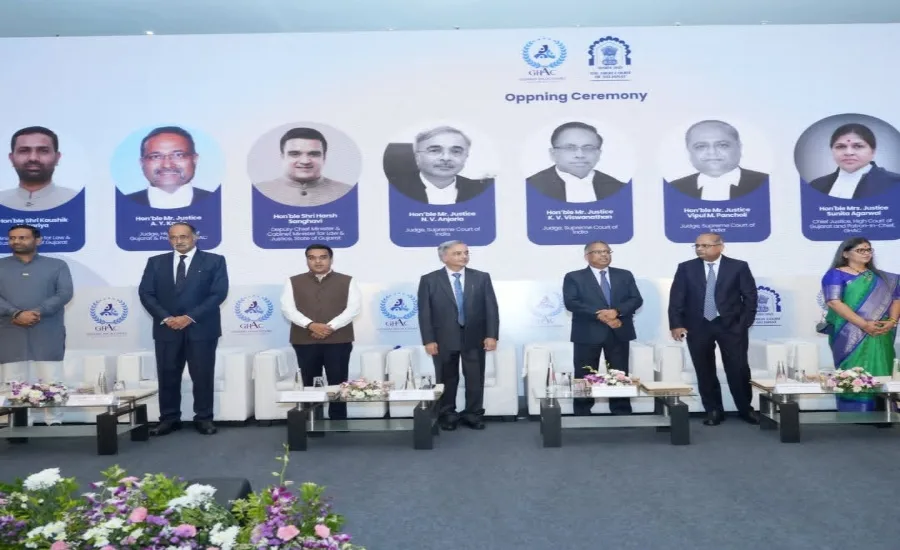
The remarks were delivered during the inaugural session of Gujarat High Court Arbitration Week 2026. The event brought together judges, lawyers, businesses, government representatives, arbitration institutions, and international practitioners to discuss the future of dispute resolution and institutional arbitration in India.
Several senior judicial figures also spoke about making arbitration more efficient, affordable, and accessible while strengthening institutional mechanisms across the country.
Why The Discussion Matters
As courts and legal institutions increasingly adopt digital tools, questions about the responsible use of AI have become more important. Justice Viswanathan’s remarks highlight a balanced approach: embracing technology for efficiency while ensuring that legal reasoning, accountability, and justice remain human responsibilities.
Read also: Attorney General Must Be Involved In Key BCI Decisions, Supreme Court Rules
FAQs
Justice Viswanathan cited an AI translation error where the legal phrase “leave granted” was translated as “chutti swikriti,” illustrating the limitations of AI in understanding legal terminology and context.
He said AI can assist judges, arbitrators, and lawyers with tasks such as research and document review, but reasoning, judgment, and final decisions must remain with humans.
The key risks include incorrect translations, fabricated legal citations, inaccurate legal analysis, and overreliance on machine-generated outputs without human verification.