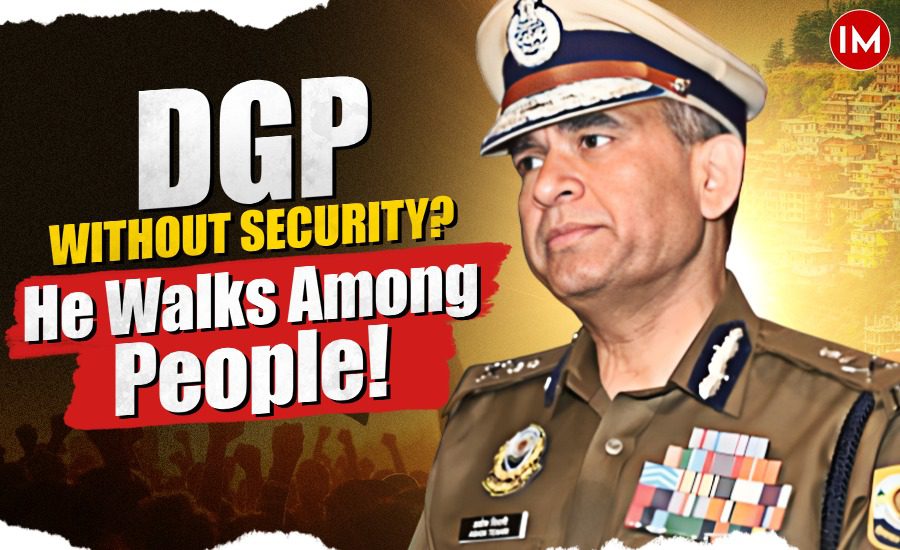
In the quiet hills of Himachal Pradesh, where simplicity shapes life and governance is closely watched by its people, a new chapter in policing is unfolding. At the centre of it stands Ashok Tewari, a 1993-batch IPS officer who has taken charge as the Director General of Police (DGP). His approach is not loud. It is steady, grounded, and deeply human.
At a time when the state faces challenges like drug abuse and changing crime patterns, Tewari is clear about one thing—policing must be firm, but it must also be humane.
ROOTS IN A SIMPLE FAMILY
Ashok Tewari’s story begins far from the corridors of power. He comes from a middle-class family in Uttar Pradesh. Life was simple. Resources were limited. But there was a clear focus—education.
He grew up in a household where studying was not just encouraged but expected. His father worked in the judiciary. Discipline and integrity were part of everyday life. With four brothers and one sister, the family shared a close bond. There was little luxury, but there was strong support.
Read Also: The Nine-Day DGP: Why Shyam Bhagat Negi’s Brief Tenure Is More Than Just a Formality
Like many children from such families, his path was shaped early. Study hard. Build a future. Stand on your own feet.
EDUCATION THAT SHAPED A MIND
Tewari’s academic journey reflects both talent and discipline. He studied at the prestigious Indian Institute of Technology Kanpur, where he completed both B.Tech and M.Tech in Computer Science.
This was not a small achievement. IIT Kanpur is known for its rigorous standards. It sharpens analytical thinking and builds problem-solving skills. These qualities would later define his approach as a police officer.
Before joining public service, he also worked in the international financial sector. It was a stable and promising career path. But something else was calling him—the desire to serve.
CHOOSING THE UNIFORM
The decision to join the Indian Police Service was not sudden. It grew over time. Like many in northern India, the idea of civil services was always present in society.
Family, mentors, and environment played a role. But ultimately, it was his own choice.
He cleared the UPSC and joined the Indian Police Service in 1993, becoming part of the Himachal Pradesh cadre.
The uniform, as he sees it, is not just authority. It is responsibility.
A CAREER BUILT ON DIVERSITY
Over the years, Tewari has held several key positions. Each role added a new dimension to his experience.
He has served in the police force at various levels, understanding both field realities and administrative challenges. He also worked as Managing Director of the Himachal Roadways Transport Corporation, where he handled a completely different system—public transport.
His career also includes exposure to central forces like the Indo-Tibetan Border Police (ITBP). Such roles broaden perspective. They help officers see governance beyond one department.
Before becoming DGP, he served in vigilance and anti-corruption roles. This experience strengthened his understanding of accountability and clean governance.
TAKING CHARGE AS DGP
In 2025, Ashok Tewari took over as the DGP of Himachal Pradesh after the retirement of his predecessor. The responsibility was immense.
His first message was clear—align the police force with the vision of the state government.
But beyond policy alignment, he focused on something deeper—changing how people see the police.
A HUMANE APPROACH TO POLICING
Tewari often speaks about a simple but powerful idea: police and public are not separate.
According to him, the only difference is the uniform.
He believes fear of police begins early. Children are often told, “Police will come if you misbehave.” This creates distance. Over time, this fear becomes mistrust.
He wants to change that.
He has instructed officers to be polite, respectful, and approachable. A courteous tone can do what force often cannot—build trust.
He has even kept his office open. Anyone can walk in. No barriers. No hesitation.
This is not symbolic. It is a message.
THE FIGHT AGAINST DRUGS
One of the biggest challenges before him is the rising drug problem, especially the spread of synthetic drugs like “chitta.”
Tewari is clear that this cannot be solved by police action alone.
Arrests and legal action are necessary. But they address only the supply side.
The real battle, he says, is reducing demand.
This is where society must step in. Families, schools, youth groups, and communities must work together.
He supports the vision of the state leadership to turn this fight into a mass movement. Awareness campaigns, rehabilitation, and youth participation are key parts of the strategy.
He believes that unless young people lead the change, the problem cannot be fully solved.
BUILDING TRUST, NOT FEAR
For Tewari, the future of policing lies in partnership.
He rejects the idea that police and public are on opposite sides. Instead, he sees them as partners with a shared goal—keeping society safe.
He often says that not all police personnel are the same, just as not all citizens are the same. Judging an entire system based on a few cases is unfair.
Trust must be built step by step.
Small actions matter. Listening patiently. Speaking respectfully. Acting fairly.
These are simple things. But they create lasting impact.
WALKING THE TALK
What sets Ashok Tewari apart is not just what he says, but how he works.
He prefers walking through the streets of Shimla instead of always using official vehicles. This helps him connect with people. It gives him a ground-level view of reality.
It also sends a message—leadership is not distant.
In a state like Himachal Pradesh, where people value simplicity, this approach resonates deeply.
A VISION FOR THE FUTURE
Ashok Tewari’s vision is not about dramatic change overnight. It is about steady progress.
A disciplined police force. A respectful approach. Strong action against crime. And deep cooperation with society.
He wants a Himachal where people feel safe, not scared. Where police are seen as helpers, not enforcers.
His journey—from a middle-class home to IIT, from corporate life to IPS, and now to leading the state police—reflects determination and purpose.
But more importantly, it reflects a belief.
That governance works best when it is human.
And in the hills of Himachal, that belief is quietly shaping the future of policing.
Read Also: Three Decades, One Milestone: The Journey of Anu Garg, Odisha’s First Woman Chief Secretary