In Arunachal Pradesh, where mountains, forests and difficult terrain often make communication challenging, a new storytelling initiative is trying to connect remote villages with the rest of India.
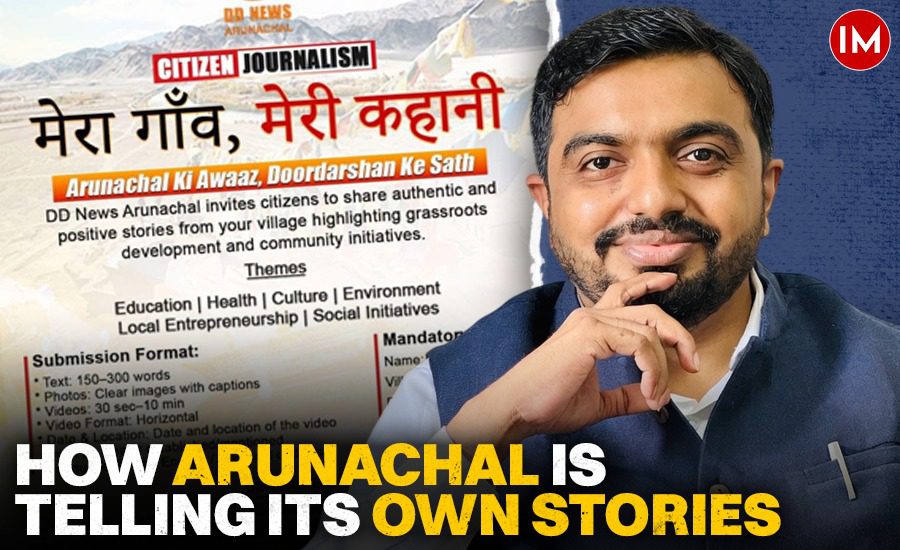
“Mera Gaon Meri Kahani” is an initiative launched under the Ministry of Information and Broadcasting by IIS officer Utsav Parmar (2015 batch), who currently serves as Joint Director and Regional News Unit Head of Doordarshan and Akashvani Arunachal Pradesh. He also oversees the Central Bureau of Communication and Press Information Bureau in Itanagar.
The project encourages people from villages across Arunachal Pradesh to record and share stories from their communities using mobile phones. These stories range from local festivals and traditional knowledge to acts of kindness and community-led initiatives that rarely find space in mainstream media.
Mr Parmar says the idea emerged after he realised how isolated many parts of Arunachal remain from national media networks.
“When I came here, I realised that because Arunachal is very remote and far from mainland areas, there is hardly any network from big channels or reporters. So we thought, “Why not start something ourselves?” Mr Parmar shared in an exclusive interview with Indian Masterminds.
The initiative began in a district in Arunachal with a simple approach. Villagers, students and local youth were encouraged to capture stories, cultural events and everyday experiences on their phones and send them to the team at Doordarshan and Akashvani. The content is then verified, edited and broadcast through official platforms.
BRIDGING MISCONCEPTION ABOUT THE NORTHEAST
According to Mr Parmar, the larger goal is not just content creation but correcting the limited understanding many Indians have about the Northeast.
“People in big cities know very little about the Northeast, especially Arunachal. There are so many misconceptions. This initiative is an attempt to bridge that communication gap and show the real Arunachal to the rest of the country,” he explains.
A major focus of “Mera Gaon Meri Kahani” is involving students. Many young people from villages move to towns like Itanagar for education and later return home during vacations or after completing their studies. Mr Parmar believes they can become important storytellers for their communities.
“We are encouraging students to document and share stories from their villages. Our team also goes to villages to collect stories. That is the basic philosophy,” he says.
STORIES EMERGING FROM ARUNACHAL’S VILLAGES
Although the initiative was launched recently, a variety of stories have already started emerging.
Several submissions revolve around local festivals, customs and community traditions. One of the stories highlighted a group of young people who created their own community radio station with support from the Indian Army. The station now runs round-the-clock programming for the local population.
Another story came from near the Tawang border region, where a woman prepared homemade food for soldiers stationed in difficult terrain.
“She said, ‘These jawans work so hard for us. I brought food from home for them.’ These are very touching stories that you won’t usually find in Delhi, Mumbai or Bangalore,” Mr Parmar recalls.
For him, these stories reveal a side of Arunachal Pradesh that mainstream conversations often miss.
PRESERVING LANGUAGE AND INDIGENOUS KNOWLEDGE
One of the most important aspects of the initiative is language preservation.
Arunachal Pradesh has one of the richest linguistic landscapes in India. Despite a population of roughly 1 to 1.5 million people, the state is home to 26 major tribes and hundreds of sub-tribes, each with distinct dialects and oral traditions.
Akashvani currently broadcasts news in 11 local dialects in addition to Hindi and English.
“These are very unique languages, many of which are spoken near the Indo-China border. These communities hold tremendous traditional knowledge,” Mr Parmar says.
He points out that several tribal communities possess generations of knowledge related to survival, climate adaptation and sustainable living.
Before road connectivity improved in many areas during the 1990s, access to basic commodities such as salt was extremely limited. Communities developed methods to extract salt from certain tree leaves. Traditional housing patterns were also designed to reduce damage during earthquakes and heavy rainfall.
Communities living in border areas have long understood how to survive in dense forests, manage heavy rainfall, cope with earthquakes and make use of natural resources with minimal infrastructure.
DOCUMENTING KNOWLEDGE BEFORE IT DISAPPEARS
Mr Parmar says these forms of indigenous knowledge deserve documentation before they disappear with rapid urbanisation and migration.
“Our job through Doordarshan and Akashvani is to bring these stories forward before the elders who hold this knowledge pass away and before the youth migrate due to globalisation,” he says.
The team is now exploring the use of artificial intelligence and machine learning tools to help preserve endangered dialects and oral traditions. Though still at an early stage, the idea reflects the broader ambition of the project — using modern technology to preserve traditional knowledge.
Mr Parmar, who is originally from Gujarat, says his experience in Arunachal Pradesh changed his understanding of the Northeast.
He believes the region contains practical knowledge systems that are often overlooked in mainstream conversations, especially in discussions around sustainability and climate adaptation.
SOCIAL MEDIA CREATORS GIVING THE NORTHEAST A NEW VOICE
At the same time, Mr Parmar is optimistic about the growing number of digital creators emerging from the Northeast.
Social media has allowed young creators from Arunachal and neighbouring states to showcase local humour, traditions, food, music and languages to wider audiences.
“Their content is very original because they are less influenced by mainstream city trends. Their storytelling style and language nuances are unique. We want to preserve this originality and cultural essence through this initiative,” Mr Parmar says.
As “Mera Gaon Meri Kahani” expands, the initiative is slowly building a people-driven archive of Arunachal Pradesh – one village story at a time.