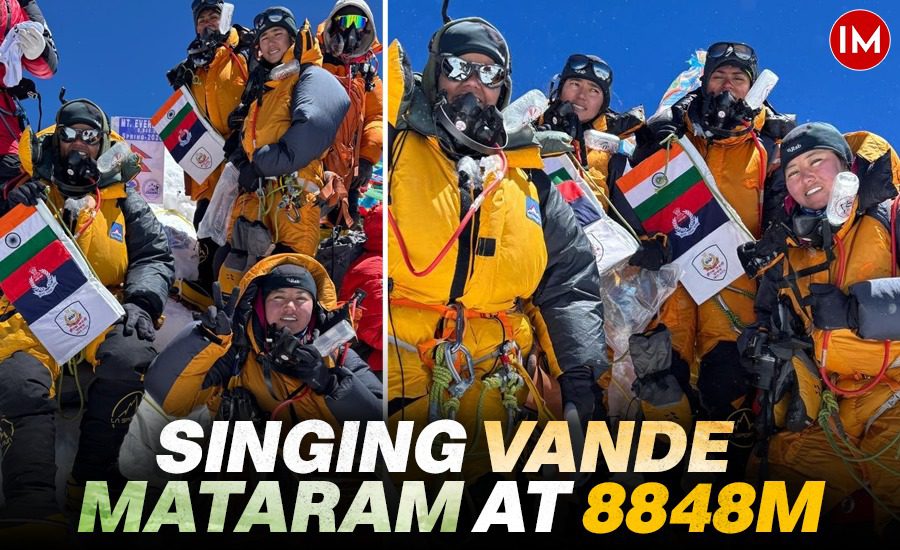
At 8 am on May 21, somewhere above the clouds, where oxygen thins out and even standing still demands effort, four women in BSF uniforms removed their oxygen masks and began to sing.
“Vande Mataram.”
The wind was violent. The temperature had plunged below minus 30 degrees. Every breath felt earned. Yet Constables Kouser Fatima, Munmun Ghosh, Rabeka Singh, and Tsering Chorol stood on the summit of Mount Everest and completed something far bigger than a climb.
They had just become the first all-women team from the Border Security Force to scale the world’s highest mountain under “Mission Vande Mataram”, an expedition launched during the BSF’s Diamond Jubilee year and the 150th anniversary of the national song.
But the story of this summit did not begin on Everest.
It began years earlier, inside training grounds, mountain institutes, planning rooms, and in the mind of an IPS officer who believed women in uniform could push the limits of adventure sports in ways never attempted before.
Also read: A BSF IG’s Spiritual Commitment to Ayodhya
THE IDEA THAT STARTED WITH A QUESTION: “WHY NOT WOMEN?”
For 1994 batch IPS officer Raja Babu Singh, the idea was never merely about mountaineering.
It was about visibility.
It was about proving that women constables — not senior officers, not specially designated elite climbers — could stand at the highest point on Earth carrying the tricolour and the spirit of the nation.
During his tenure in the BSF, Singh had already conceptualised ambitious adventure programmes. One of them was an all-women rafting expedition from Gangotri to Ganga Sagar. Another was a large-scale coastal cycling mission. But Everest remained the biggest dream.
“We selected enthusiastic women soldiers and started grooming them for mountaineering. I designed the programme, supported them, and sent them for specialised training,” Singh shared in an exclusive conversation with Indian Masterminds.
The preparation was not symbolic. It was systematic.
The women were first trained in Manali, then at the BSF’s adventure training facilities in Dehradun. They were sent on smaller Himalayan expeditions near the Nanda Devi region to build endurance, acclimatisation, and technical climbing skills.
To shape the team, Singh entrusted the training responsibility to celebrated mountaineer and Padma Shri awardee Love Raj Singh Dharmshaktu, a veteran Everest climber known for his experience in high-altitude expeditions.
The process stretched across years.
And slowly, the climbers began turning into mountaineers.
FOUR WOMEN. FOUR DIFFERENT INDIAS. ONE SUMMIT.
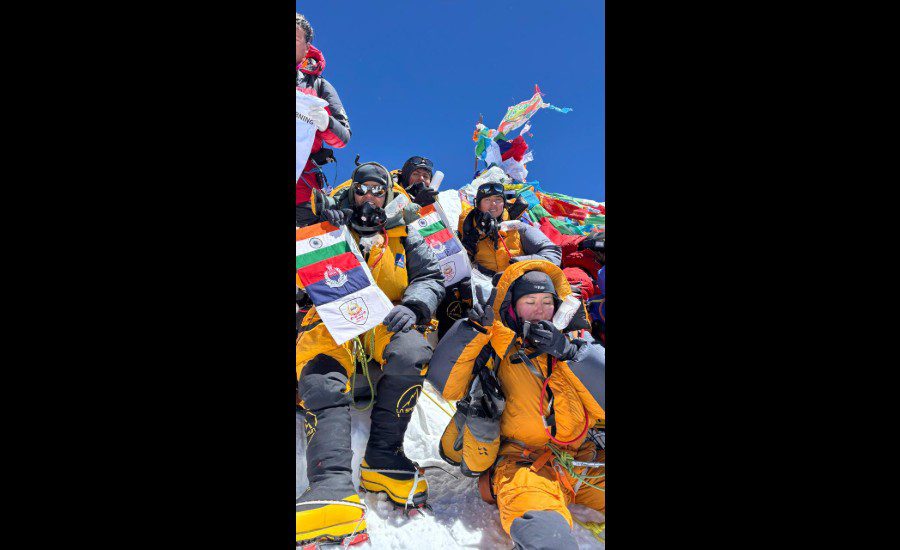
What made Mission Vande Mataram striking was the diversity of the women who formed its final summit team.
Kouser Fatima came from Ladakh’s high-altitude terrain.
Tsering Chorol hailed from Kargil.
Rabeka Singh represented Uttarakhand’s mountain belt.
Munmun Ghosh came from the plains of West Bengal.
Different languages. Different climates. Different journeys. Yet all four carried the same rank: constable.
In institutions where high-altitude missions have traditionally been dominated by senior personnel, their presence itself marked a shift.
According to BSF Commandant (Sports) of the 33rd Battalion, Parminder Kumar, the selection was based entirely on training performance, physical preparation, and past expedition experience.
“They were given basic and advanced mountaineering courses. Then came orientation training in Manali. After that, the final team was chosen for the Everest mission,” he told Indian Masterminds.
The expedition was officially flagged off from New Delhi on April 6, 2026, by BSF Director General Praveen Kumar.
From there, the team moved toward Nepal, toward base camp, and toward months of preparation that the public would never fully see.
INSIDE THE CLIMB WHERE EVERY STEP HURT
Everest does not allow shortcuts.
Before any summit attempt, climbers spend days acclimatising at base camp and higher camps so the body can slowly adjust to brutal altitude conditions.
Camp One. Camp Two. Camp Three. Camp Four.
Each stage strips away energy.
Parminder Kumar monitored the mission remotely while the team moved upward through dangerous sections of the climb. Communication was limited. Batteries drained quickly in extreme cold. GPS trackers became critical.
“At minus 32 degrees, even carrying radio batteries becomes difficult,” he said. “Sometimes contact would happen only briefly. We kept tracking their position through GPS.”
Then came the summit push.
The women reached Camp Four, often called the summit camp, in the afternoon. They were instructed to rest briefly because once the climb began, there would be no stopping point left.
At 6 pm, they started their final ascent into darkness.
There were no tents ahead. No recovery camps. No safe pause.
Only snow, ice, exhaustion, and altitude.
For nearly fourteen hours, they climbed through the night.
“At one point, moving just forty metres took almost an hour,” Kumar recalled. “We could understand how difficult it was simply by tracking them.”
And then, at 8 am on May 21, they stood on the summit.
THE MOMENT “VANDE MATARAM” ROSE ABOVE THE CLOUDS
There are moments in national memory that become larger than the event itself.
This became one of them.
After reaching the summit, the climbers removed their oxygen masks and sang “Vande Mataram” from the top of the world, believed to be the first rendition of the national song from Mount Everest.
The decision had been part of the mission vision from the beginning.
“We wanted the message of women empowerment to reach every girl,” Parminder Kumar said. “And we wanted them to sing Vande Mataram from the summit despite the extreme conditions. That itself was a major challenge.”
At that altitude, even speaking requires effort. Singing becomes extraordinary.
For the BSF officers tracking the climb from below, the moment became deeply emotional.
“It was a national objective,” Kumar said. “We had put in years of effort to prepare them for this.”
A NEW CHAPTER IN BSF’S ADVENTURE HISTORY
The BSF has a long mountaineering legacy. The force has scaled more than 50 peaks over the years, including Everest expeditions in 2006 and 2018.
But Mission Vande Mataram created a different milestone.
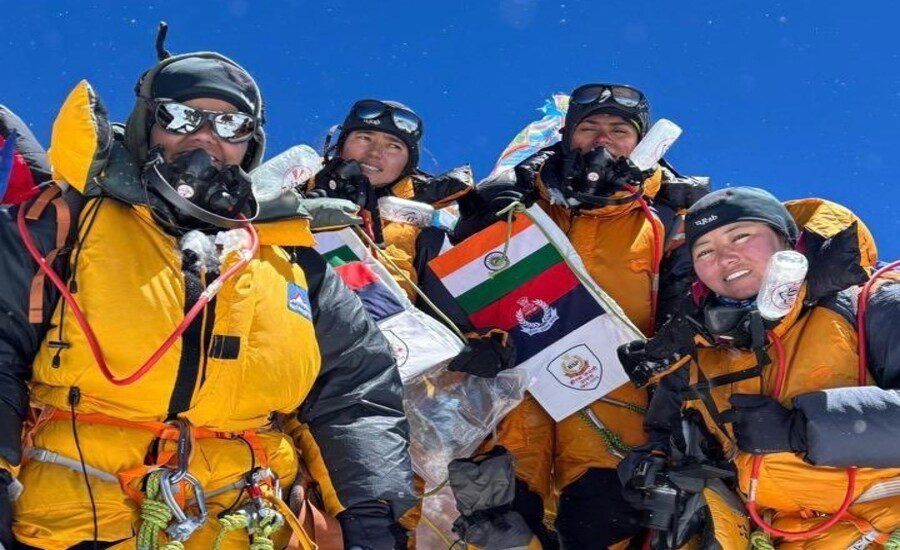
For the first time, an all-women BSF team had climbed Everest. And for the first time, “Vande Mataram” had been sung from the world’s highest peak.
Behind the images that circulated online lay years of planning, training, failures, weather battles, physical conditioning, and institutional belief.
For Raja Babu Singh, the mission represented the continuation of a larger vision: one where adventure sports become a platform for women in uniform to discover what they are capable of.
“When I came to the BSF, I thought, let’s do this through women soldiers,” he said.
That thought eventually travelled from training grounds in India to the summit ridge of Everest.
BEYOND EVEREST, A MESSAGE TO EVERY YOUNG GIRL
The impact of Mission Vande Mataram extends beyond mountaineering.
Inside the BSF, it has already become part of a broader push toward women-led adventure and sports initiatives, from river rafting expeditions to future coastal cycling missions.
But outside the force, the message may travel even farther.
A girl watching from a small town in Bengal.
A teenager in Ladakh.
A cadet dreaming of uniformed service.
A young athlete wondering whether she belongs in extreme sports.
The image of four BSF women standing on Everest answers that question without speaking.
“You can do anything,” Parminder Kumar said. “You just need the courage to accept the challenge.”
And on a freezing Himalayan morning above 8,848 metres, four women proved exactly that.
Also read: Ganga’s Daughters: BSF’s All-Women Rafting Expedition Sets Sail for Clean River and Empowerment