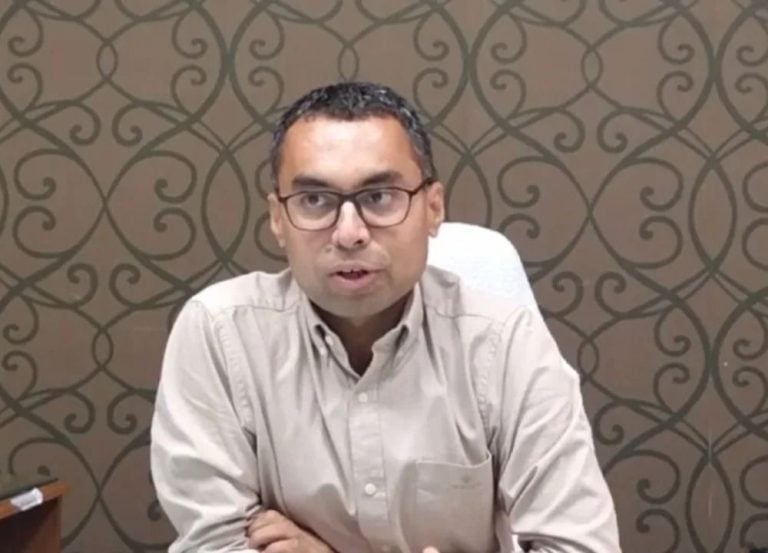
When Mohammad Aaquib took charge as Deputy Commissioner of Champhai, Mizoram, in February 2025, one of the first things he noticed was the contrast between the district’s potential and its developmental gaps.
Located along the India-Myanmar border, Champhai holds strategic importance for Mizoram. The district is known for its scenic landscape, agricultural activity, and growing tourism appeal. But during field visits and interactions with schools, teachers, and students, Mr Aaquib realised that education required focused attention.
“Though it is a very beautiful district with strong tourism potential, I realised that both the health and education sectors needed substantial support,” Mr Aaquib shared in a conversation with Indian Masterminds.
Coming from a humble background himself, the 2021-batch AGMUT cadre officer says he could relate to the struggles many students face in accessing quality education. What stood out most during his interactions was not a lack of willingness to learn, but the gap between classroom teaching and conceptual understanding.
That observation eventually led to the launch of Project LEAD, one of Champhai district’s flagship education initiatives under Mizoram’s District Transformation Programme.
WHY CHAMPHAI STARTED PROJECT LEAD
The District Transformation initiative introduced by the Mizoram government allows district administrations to propose innovative projects based on local needs. Champhai submitted nearly 45 projects under the programme, with education reform becoming one of its major focus areas.
The administration found that learning outcomes in several schools were lower than expected, especially in foundational literacy and numeracy, along with science and mathematics at the middle and secondary school levels.
Assessments and school-level observations showed that many students struggled with age-appropriate learning. Concepts were often memorised but not fully understood or applied.
“A Class 9 or 10 student may know what a quadratic equation is, but solving it confidently or applying the concept becomes difficult,” Mr Aaquib explains.
The district administration decided that instead of introducing another routine academic programme, the focus should be on improving teaching methods inside classrooms.
That became the basis for Project LEAD.
BUILDING A TEACHER-CENTRED REFORM MODEL
Rather than treating the initiative as a short-term campaign, the administration designed it as a long-term teacher-support programme.
Initially planned for six months, the project timeline was later extended to nearly a year after discussions with the Azim Premji Foundation, which partnered with the district for the initiative.
The first step involved creating a District Resource Group consisting of education department officials, DIET representatives, and selected teachers from subjects such as mathematics, science, and foundational learning.
Around 32 members became part of this group.
A two-day workshop was later organised with resource persons from the foundation who travelled from Bengaluru and Guwahati to Champhai. The discussions focused on identifying classroom gaps, understanding local challenges, and mapping areas where schools were already performing well.
“The idea was first to identify where we are lacking and also understand where we are already doing well,” says IAS Mohammad Aaquib.
The administration believes that sustainable reform cannot happen without teacher participation. Instead of top-down instructions, the programme aims to gradually encourage teachers to experiment with newer classroom approaches.
“There are challenges in keeping teachers continuously motivated because ultimately the success of the project depends on how receptive teachers are to these ideas,” he says.
MOVING BEYOND ROTE LEARNING
One of the biggest concerns identified during discussions was the disconnect between textbook learning and practical application.
Students often understood definitions and formulas theoretically but found it difficult to apply concepts to real-life situations or analytical questions.
The district now wants classrooms to become more activity-based and interactive.
“If we explain acids, bases, and salts only in a dry theoretical manner, students may not fully understand. But if teachers use demonstrations, litmus paper, and visual methods, the learning becomes more relatable,” Mr Aaquib says.
To support this, teaching-learning material from the Azim Premji Foundation is being adapted for Champhai’s requirements. The material includes both online and offline tools that simplify concepts through visual demonstrations, examples, and step-by-step explanations.
Around 160 schools — including primary, middle, and high schools — are expected to be covered in the first phase of the programme.
The district administration is also trying to ensure that the programme remains practical for teachers working in remote locations with varying levels of infrastructure.
ADDRESSING STUDENT HESITATION INSIDE CLASSROOMS
Apart from conceptual gaps, another issue repeatedly observed by the administration was student hesitation during classroom participation.
Mr Aaquib says many students in Mizoram are academically capable but often shy while interacting with outsiders or external trainers.
“So it becomes important that teachers from the local community themselves become empowered because students are naturally more receptive to them,” he explains.
The administration also discussed language accessibility while developing teaching resources. Although there were conversations about translating more material into Mizo, practical limitations meant that most content currently remains in English.
At the same time, the district believes students increasingly recognise the importance of multilingual learning for future opportunities beyond the state.
Earlier, Champhai district had also experimented with an English-learning initiative that reached around 4,500 students. The current effort aims to scale similar interventions in a more structured manner.
FOCUSING ON SUSTAINABLE IMPROVEMENT INSTEAD OF QUICK RESULTS
For the district administration, the goal is not immediate transformation but gradual and measurable improvement in classroom learning.
Training sessions for teachers are expected to continue in phases, followed by implementation across schools.
“We want this to become sustainable in the long term,” Mr Aaquib says. “If teachers learn how to communicate concepts better today, they can continue doing the same for future batches of students as well.”
He is also realistic about the pace of change.
“Even if we see a 10-15 per cent meaningful improvement, I would consider that a success,” he says.
In a geographically challenging border district like Champhai, where access and infrastructure remain ongoing concerns, the administration’s education initiative is attempting to focus on something fundamental — making classrooms more engaging, learning more practical, and teachers more confident in how they teach.