Near the centuries-old Bhrigu Ashram in Ballia, stalls selling Sattu still line the roads. Some serve chilled sattu ka sharbat to visitors escaping the eastern Uttar Pradesh heat. Others pair roasted gram flour with roti, litti, or puri – food traditions that have survived generations.
For years, however, this heritage remained confined to memory and local consumption. The product existed, but the economy around it had faded. Farmers had moved away from gram cultivation, industries were absent, and Ballia, once known for chana production, was importing raw material from other states to make the very product it was historically associated with.
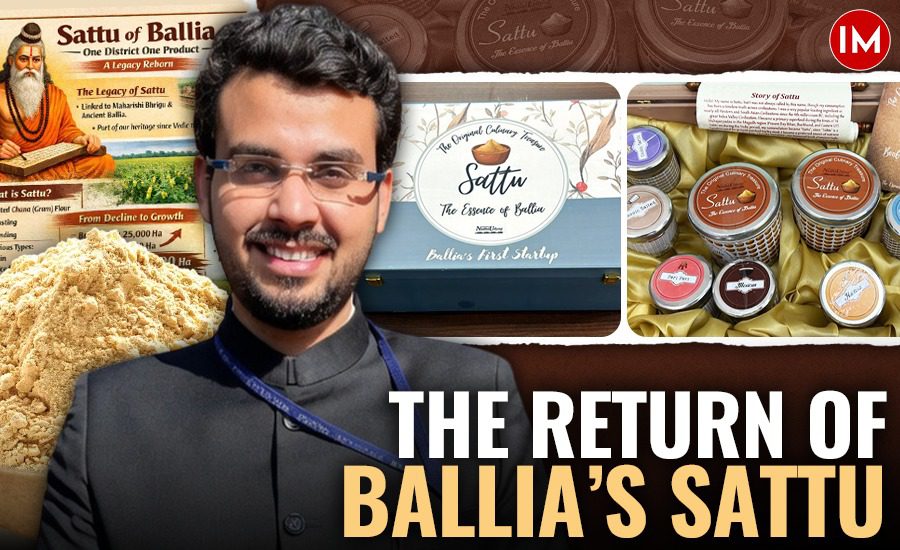
When 2020 batch IAS officer Aojasvi Raj joined Ballia as chief development officer (Uttar Pradesh cadre), he saw something larger than a traditional food item. He saw an economic opportunity hidden inside a cultural legacy.
“What struck me very early was that Ballia is overwhelmingly dependent on agriculture,” Aojasvi Raj shared in an exclusive interview with Indian Masterminds.
“The soil is fertile, but there was a need to identify a product that could create higher value for local farmers and generate employment within the district itself.”
That search eventually led him to Sattu.
REDISCOVERING BALLIA’S FORGOTTEN AGRICULTURAL IDENTITY
While going through district records and British-era gazetteers, Aojasvi came across historical references showing that Ballia was once a major centre for chana cultivation and processing. Nearly 25,000 hectares of land in the district were earlier dedicated to gram cultivation.
Over decades, that number collapsed.
By 2023, the area under chana cultivation had shrunk to nearly 2,500 hectares. Farmers had gradually shifted away due to poor returns and lack of organised market support.
At the same time, Sattu, one of eastern India’s most recognisable traditional foods, had lost its commercial identity in Ballia despite remaining deeply rooted in local culture.
IAS officer Aojasvi began speaking to local residents, historians, and people associated with Bhrigu Ashram. Again and again, the same stories surfaced.
“There is a very old connection between Ballia, Maharishi Bhrigu, and Sattu,” he says.
“People told us that Maharishi Bhrigu and his disciples consumed Sattu regularly, and even the tradition of Sattu ka Sharbat traces back to those practices.”
The cultural significance of the product immediately stood out. But Aojasvi also noticed something else — its modern economic relevance.
“At a time when awareness about protein consumption is rising rapidly, Sattu already had all the qualities needed for a modern health product,” he says. “It is natural, affordable, vegan, and nutritionally very strong.”
Lab testing showed that Sattu contained nearly 22 grams of protein per 100 grams, making it one of the most accessible vegetarian protein sources available in rural India.
That combination of heritage and nutrition became the foundation of Ballia’s revival strategy.
BUILDING AN ENTIRE ECONOMY AROUND ONE TRADITIONAL PRODUCT
The administration’s approach was not limited to increasing cultivation. The larger goal was to create a complete rural supply chain around Sattu.
Village-level meetings were organised with farmers to encourage larger gram cultivation during the Rabi season. Awareness campaigns explained how value addition through Sattu processing could generate significantly higher returns than selling raw produce.
Simultaneously, women self-help groups were brought into the centre of the project.
In small processing units across Ballia, women began roasting chana, removing husk, grinding the roasted gram into fine flour, and preparing different Sattu variants for packaging.
“Women SHGs became the backbone of the processing ecosystem,” the officer shared with Indian Masterminds.
“Farmers focus on cultivation, but the roasting, processing, and preparation work is largely being handled by women-led groups.”
The administration also focused aggressively on branding — an area often neglected in rural products.
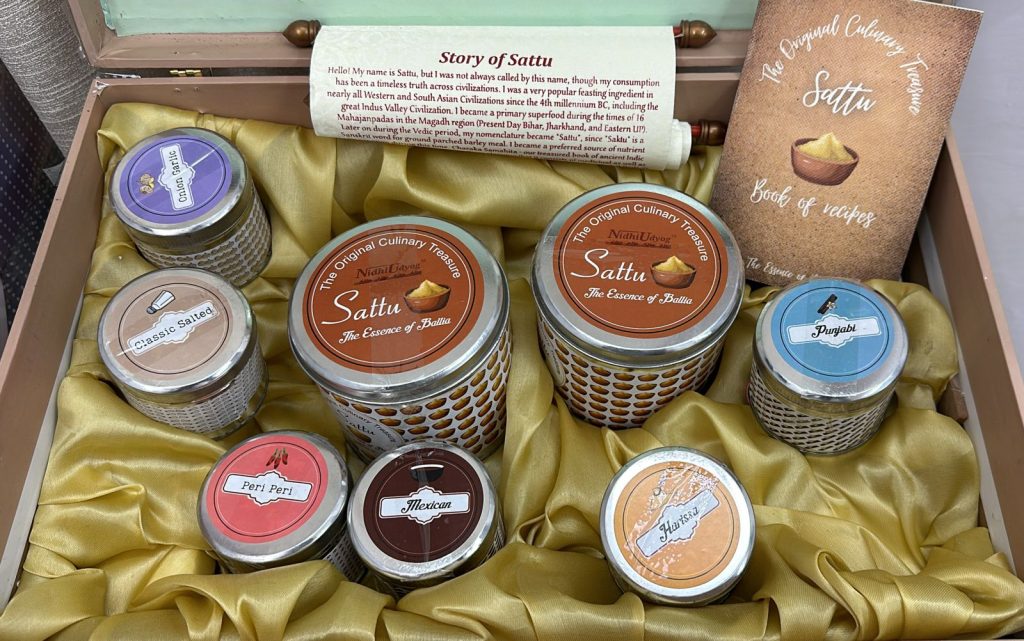
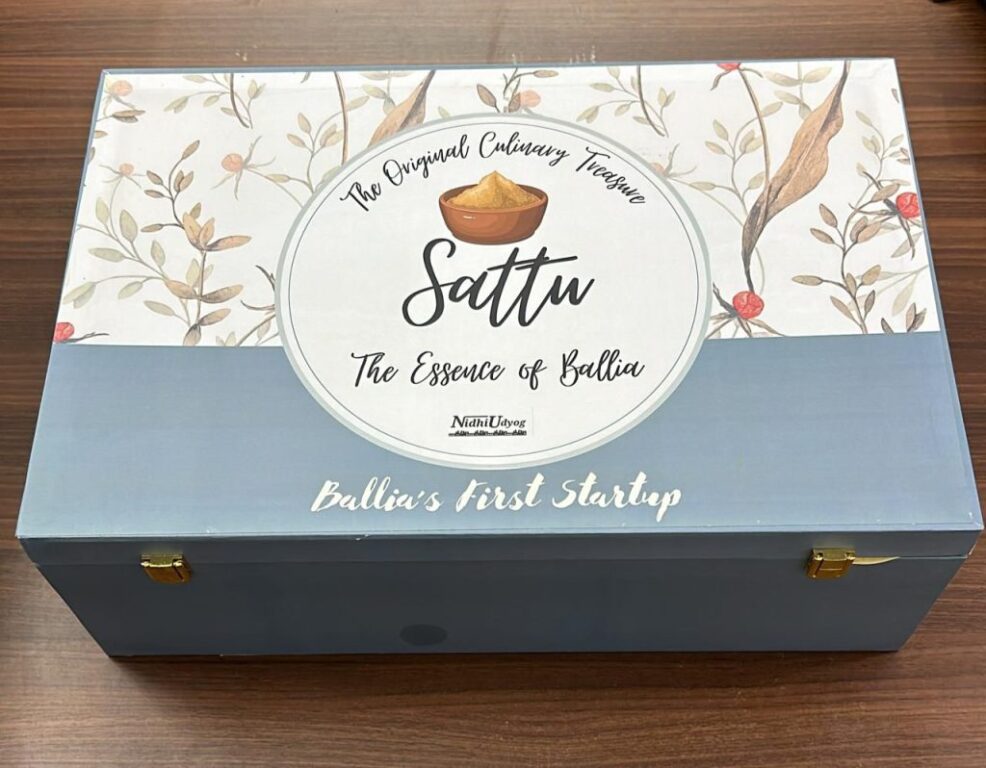
Traditional brown packets were replaced with carefully designed gift boxes carrying assorted Sattu flavours, nutritional information, recipe booklets, and Ballia’s cultural story. The packaging aimed to make Sattu appealing not only to rural consumers but also to urban and younger buyers.
Soon, Ballia’s Sattu was no longer being positioned merely as a traditional food item. It was being marketed as a modern vegan protein product with deep cultural roots.
THE ODOP PUSH THAT CHANGED EVERYTHING
Despite its long association with Ballia, Sattu was never officially recognised under Uttar Pradesh’s One District One Product (ODOP) programme.
Aojasvi found that surprising.
“When I joined, I could not understand why a product so deeply linked with Ballia was not part of ODOP,” he says.
“There were products under the scheme which had limited production bases, but Sattu already had social acceptance, historical relevance, and economic potential.”
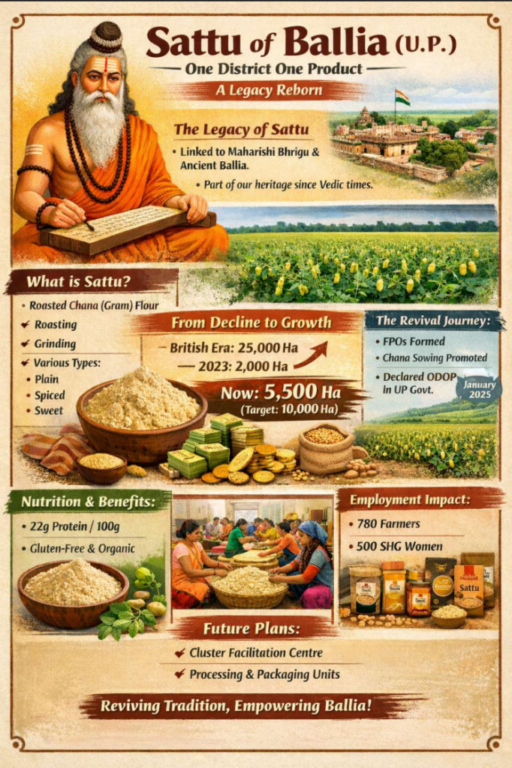
The district administration prepared a detailed concept note explaining the economics of Sattu, its cultural history, employment potential, and possibilities for value addition. The proposal was sent to the Uttar Pradesh government seeking recognition of Sattu as Ballia’s second ODOP product.
The process involved multiple rounds of surveys and approvals before the proposal was finally cleared in 2025.
The declaration proved transformational.
“Once Sattu got the ODOP tag, the confidence level changed completely,” Aojasvi says.
“Entrepreneurs started entering the sector, banks became more supportive, and people began seeing this as a serious economic opportunity.”
The ODOP recognition opened access to government-backed toolkits, credit linkages, facilitation support, and marketing opportunities. It also gave Ballia’s Sattu a much larger identity beyond district boundaries.
FROM ELECTION DUTY TO E-COMMERCE PLATFORMS
The administration understood early that production alone would not sustain the revival unless markets expanded simultaneously.
So the branding campaign moved aggressively outward.
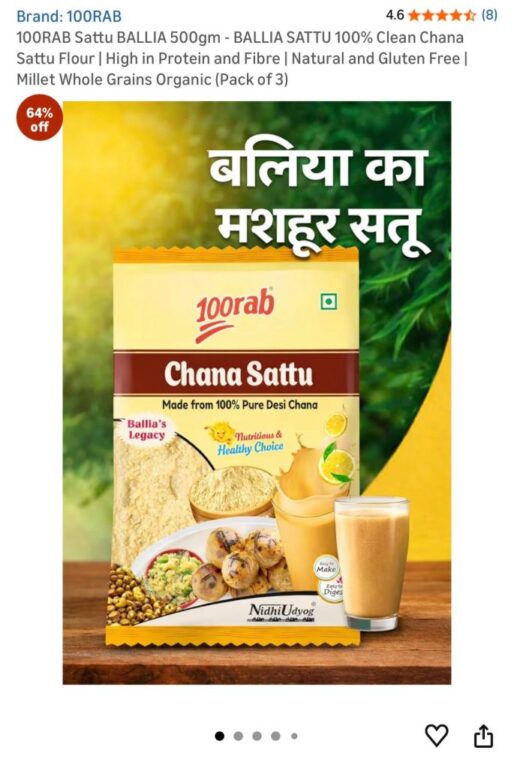
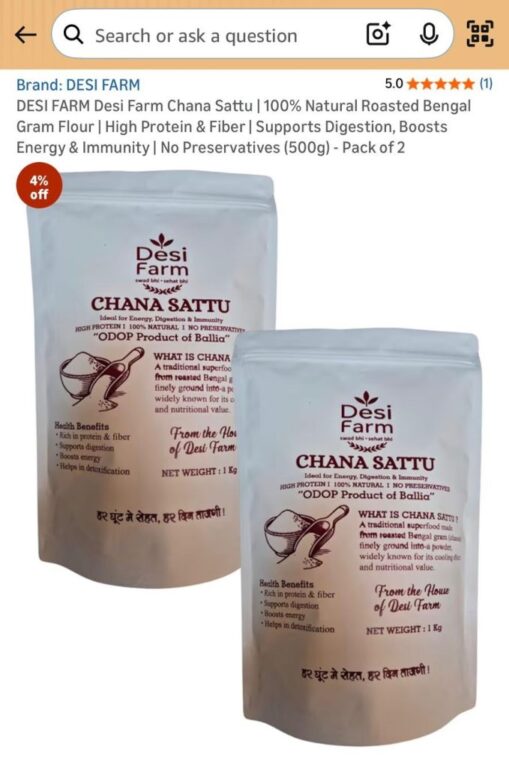
Ballia’s Sattu products were listed on e-commerce platforms like Amazon and Blinkit. Residential welfare associations in Uttar Pradesh and southern India were approached for local product placements. Ministers and dignitaries visiting the district received Sattu gift boxes instead of conventional mementos.
The response on e-commerce platforms surprised even local producers. With rising awareness around healthy eating and vegan protein, Sattu emerged as a high-demand product category online, helping Ballia-based entrepreneurs access consumers far beyond eastern Uttar Pradesh.
At district events, Sattu became a symbol of local pride.
One of the initiative’s most innovative moments came during the 2024 Lok Sabha elections. Nearly 60,000 Sattu packets were distributed among polling and police personnel deployed in peak summer conditions.
The move was designed both as a nutritional intervention and as a branding exercise. Sattu’s cooling properties and high protein content made it ideal for personnel working long hours in intense heat.
The initiative reportedly drew appreciation from election authorities and generated wider public attention for the product.
THE ECONOMIC SHIFT ON THE GROUND
Within two years, the numbers began reflecting the scale of change.
The area under gram cultivation in Ballia increased from nearly 2,500 hectares to around 5,500 hectares—more than doubling within a short period.
Around 500 women associated with self-help groups became part of the processing chain. Local entrepreneurs established roasting units, grinding facilities, packaging operations, and distribution networks, while six Farmer Producer Organisations (FPOs) began actively working on the expansion of the Sattu ecosystem.
The transformation became especially visible after Sattu received ODOP recognition. According to district estimates, revenues linked to the product ecosystem increased nearly 10 to 12 times following the declaration, as branding, institutional support, and market access improved significantly.
Five entrepreneurs connected to forward and backward linkage industries are now reportedly earning more than ₹1 crore annually. Before the ODOP push, many of them were operating at a much smaller scale with annual revenues of only ₹15–20 lakh.
One entrepreneur associated with the initiative reportedly expanded annual turnover from nearly ₹10 lakh in 2023 to around ₹80 lakh by 2025.
The economics of Sattu also made the shift attractive for farmers.
District estimates suggest that a farmer investing nearly ₹40,000–45,000 per hectare in gram cultivation can potentially generate returns ranging between ₹3 lakh and ₹5 lakh after processing and value addition through Sattu production.
In a district with limited industrial presence, that kind of agricultural value chain can significantly alter rural income patterns.
THE NEXT PHASE: PROTEIN BARS AND PROCESSING CLUSTERS
The administration is now preparing for the next stage of expansion.
New products such as Sattu protein bars and Sattu protein powder are being planned to target health-conscious consumers and younger markets. Work is also underway toward creating a cluster facilitation centre to support processing industries and strengthen forward linkages.
The long-term goal is to increase gram cultivation in Ballia to nearly 10,000 hectares over the next few years.
“This is not only about reviving one traditional product,” Aojasvi says.
“The larger objective is to build sustainable rural livelihoods, strengthen local enterprise, and ensure better income for farmers through value addition.”
MORE THAN A FOOD PRODUCT
Ballia’s Sattu revival stands out because it combines governance with cultural memory and market strategy.
Instead of importing an economic model from outside, the district rebuilt around something its people already understood, consumed, and identified with. Farmers returned to gram cultivation because demand was created. Women entered processing networks because local supply chains were developed. Entrepreneurs invested because branding and institutional support reduced uncertainty.
What was once seen as an old rural staple is now emerging as a modern nutritional product linked to heritage, employment, and local enterprise.
And in Ballia, the story of Sattu is no longer limited to kitchens and village stalls. It is becoming part of the district’s economic identity once again.