For most of human history, our medical systems were designed around a fundamental flaw: they were almost entirely reactive. We waited until a body-system failure became undeniably obvious – until the pain was too great or the tumor large enough to feel – before deploying immense resources to repair the damage. What we call “healthcare” is, in reality, a system designed for “sick-care”. The entire architecture – from hospitals to insurance – is built around disease, not health.
A combination of technologies like biotech and AI are now changing this. By 2040, healthcare will not merely improve—it will be fundamentally reimagined. And the shift will be so deep that future generations may find it difficult to understand why we ever waited to fall sick before taking action.
From Episodic Treatment to Continuous Health
The first signs of transformation are already around us. Healthcare is slowly moving away from occasional visits to doctors toward a continuous, almost invisible layer of monitoring and guidance. Devices we casually wear today are beginning to track vital signals—heart rhythms, sleep patterns, metabolic changes—while intelligent systems quietly interpret what these signals mean.
Read Also: AI Will Teach Everything—But Who Will Teach Us to Be Human?
Consider a simple but powerful possibility. A person feels perfectly healthy, going about daily life without concern. Yet, in the background, subtle shifts in biological markers begin to emerge—patterns too faint for human perception. An intelligent system picks this up and gently nudges the individual to make small adjustments in diet, activity, or routine. No alarm, no panic, no hospital visit—just timely awareness and correction.
This is the emergence of what may be called “Stage Zero” medicine, where disease is intercepted before it becomes visible, before it becomes dangerous, and often before it truly begins. For the first time in history, healthcare starts shifting from reacting to illness toward assuring health itself.
The Silent Intelligence Layer of AI
At the heart of this transformation lies artificial intelligence—not as a dramatic replacement for doctors, but as an invisible layer of intelligence surrounding every aspect of care. AI has the ability to process vast amounts of medical data in seconds, identify patterns across millions of cases, and continuously refine its understanding. This enables earlier detection, more precise diagnosis, and highly personalised treatment pathways.
What makes this truly transformative is not just capability, but integration. A patient’s medical history, diagnostic reports, genetic profile, and lifestyle patterns can now come together into a single, coherent picture. Doctors no longer need to spend valuable time gathering fragmented information; instead, they receive clear, structured insights that allow them to focus on what matters most—judgment, empathy, and care.
At the same time, a new concept is quietly taking shape: that of personal AI agents. These are not just tools, but intelligent assistants acting on behalf of individuals. A patient’s AI agent may monitor health continuously, flag early risks, coordinate tests, and even suggest interventions. A doctor’s AI agent may assist in diagnosis, keep track of emerging research, and ensure no critical detail is overlooked. China has already established the “Agent Hospital”, world’s first AI-powered virtual hospital. Healthcare once fragmented and reactive, is beginning to function as a coordinated, intelligent ecosystem.
From Managing Disease to Repairing Life
Yet, even this transformation is only the beginning. The deeper shift lies in our growing ability to intervene not just at the level of symptoms, but at the level of biology itself. Advances in technologies such as CRISPR-Cas9 are enabling precise modifications to genetic code. Conditions that once required lifelong management may, in time, be corrected at their source. A child born with a genetic predisposition may have that risk reduced or eliminated before it ever manifests.
At the same time, regenerative medicine is opening new possibilities. Scientists are exploring ways to repair damaged tissues, restore organ function, and even grow replacement organs. The idea that the body is fixed and finite is gradually giving way to a new understanding—that it can be repaired, renewed, and in some cases, re-engineered. Medicine, in this emerging paradigm, is no longer about managing decline. It is about restoring and sustaining vitality.
Rethinking Ageing and the Edges of Mortality
As these capabilities deepen, an even more fundamental question begins to surface—one that challenges our most basic assumptions about life. What if ageing itself is not inevitable?
Researchers like David Sinclair and Aubrey de Grey have argued that ageing is, at least in part, a biological process that can be influenced, slowed, or potentially reversed. Work being undertaken by organisations such as Altos Labs is exploring how cells might be rejuvenated to a younger state. The concept of longevity is no longer limited to living slightly longer. It is evolving toward the idea of extending healthy life significantly, possibly even reaching a point where medical progress outpaces the natural process of ageing.
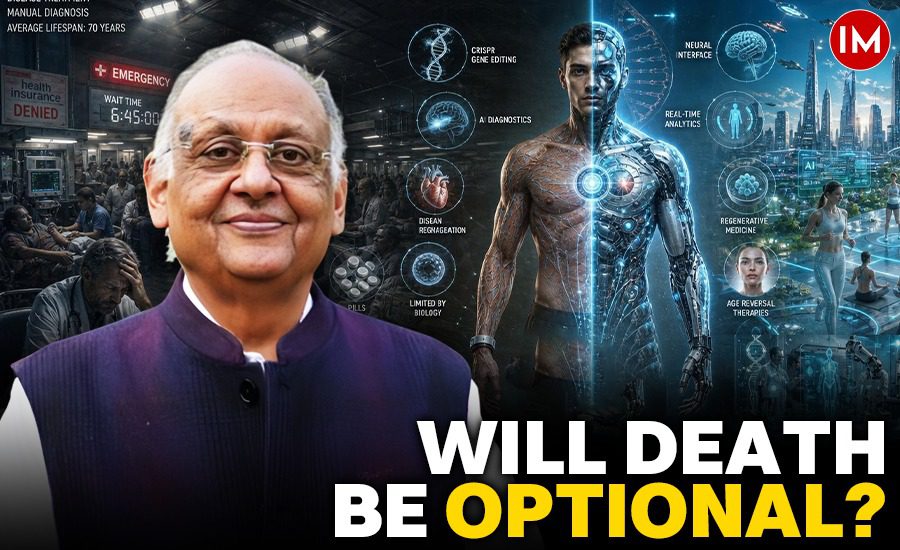
This does not necessarily mean that death disappears, though in their book “The Death of Death”, Cordeiro and Wood say that death may be optional by 2045. But it does signal a profound shift in how we understand the human lifespan. What was once accepted as fixed, may become flexible. What was once inevitable, may become negotiable.
Read Also: Ghost In The Code : When Intelligence Outruns Justice
The Emergence of the Transhuman
As we move from repairing biology to redesigning it, a new possibility begins to emerge—the transformation of the human being itself. Technologies such as Neuralink, led by Elon Musk, are exploring direct connections between the human brain and digital systems. While still evolving, such developments point toward a future where cognitive capabilities may be enhanced, where interaction with machines becomes seamless, and where the boundaries of human ability begin to expand.
The human being, long seen as biologically limited, may increasingly become biologically and technologically augmented. This is not merely a medical evolution. It is the early stage of a deeper transition toward what is often described as the Transhuman—a human whose capabilities are extended far beyond natural limits.
The Mind as the New Frontier
Parallel to changes in the body, an equally significant transformation is unfolding in the domain of the mind. Mental health, cognition, and emotional well-being are becoming central to healthcare. Intelligent systems are already being used to detect early signs of psychological distress, provide therapeutic support, and personalise interventions.
Looking ahead, the possibilities extend further. We may begin to understand memory, learning, and emotional patterns at a far deeper level. Interventions may help individuals process trauma more effectively, enhance cognitive abilities, and achieve greater mental balance. Healthcare, in this expanded sense, moves beyond the physical to encompass the entire spectrum of human experience.
The Ethical Crossroads
With such transformative power comes a set of questions that cannot be ignored.
If we can edit genes, should we restrict ourselves to curing disease, or should we allow enhancement? If life can be extended significantly, who will have access to these capabilities? If intelligent systems make critical medical decisions, how do we assign responsibility when something goes wrong?
There is also the risk of a new form of inequality—one that goes beyond wealth or opportunity and enters the realm of biology itself. A future where some individuals are healthier, enhanced, and longer-living than others could create divisions far deeper than those we see today.
These challenges are not theoretical. They are emerging alongside the technologies themselves. The future of healthcare will therefore depend not only on scientific progress, but on the wisdom with which that progress is guided.
The Subtle Shift: From System to Self
Perhaps the most profound transformation is also the most subtle. Healthcare will gradually cease to be something external—a system we visit when needed—and instead become an integral part of our everyday existence. It will embed itself quietly into our lives, operating in the background, continuously observing, learning, and guiding.
The journey that began in hospitals will extend into homes, then into the devices we carry, and eventually into the very fabric of our biological and cognitive systems. Care will no longer be episodic or reactive; it will be continuous, personalised, and deeply integrated into who we are. In such a world, the distinction between healthcare and life itself begins to dissolve. We do not “seek” healthcare anymore. We live within it. And in doing so, we cross an invisible but historic threshold—from a world where medicine responds to life, to a world where it actively shapes it.
For the first time in history, humanity stands at the threshold of not just healing itself, but redesigning itself—where the question is no longer how long we live, but how consciously, equitably, and wisely we choose to evolve as a species.
Read Also: The Age of AI: Awareness, Awakening, Being