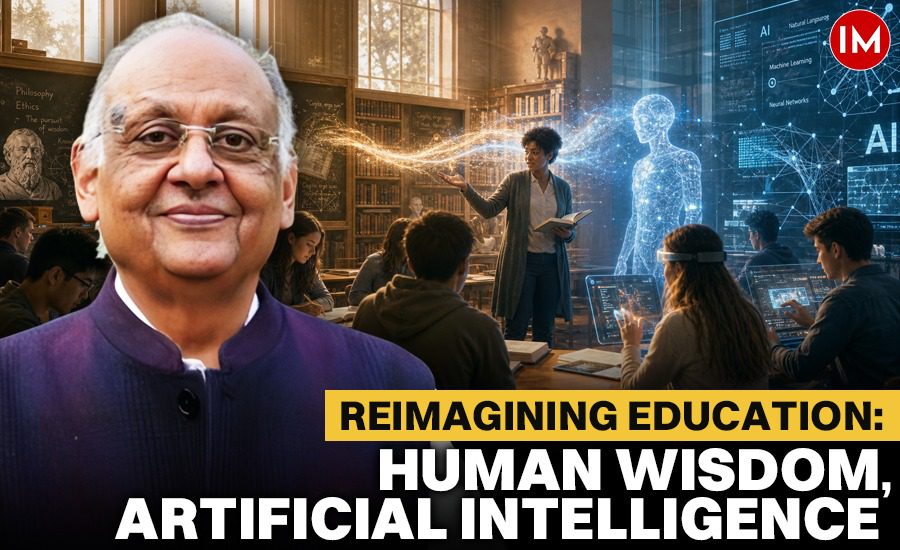
Artificial Intelligence is increasingly making our current education system, designed for a world of stability, predictability, and linear careers, obsolete. The future will be defined by uncertainty, constant change, and intelligent machines outperforming humans in knowledge and skills. If machines can know more, compute faster, and even create better, then what is the purpose of human education? The answer lies in shifting the focus from what we know to who we become. It is time to Reimagine, Redesign, and Recreate education—not as a system for information transfer, but as a system for human transformation—education that helps individuals become not just more capable, but more responsible and self-directed human beings.
The AI enthusiast’s vision of hyper-personalized AI tutors and virtual reality headsets rendering brick-and-mortar classrooms obsolete, isolating students in perfectly optimized, digital learning bubbles, is not the solution. It ignores the need for a strong guiding role for humans, and deeper focus on making integrity, self-discipline, responsibility, and character the key building blocks of students’ DNA. At the core lies inculcating Viveka—discernment; the ability to distinguish between what is real and lasting, and what is temporary and misleading—in simple terms, the ability to see clearly what truly matters versus what merely distracts or tempts us. Without Viveka, decisions become reactive and externally driven. The ancient Indian Gurukul system offers a powerful guiding light—one that can now be reimagined in an AI-enabled form. It was not just about subjects, but about shaping how a person thinks, behaves, and takes responsibility in life. By 2040, we would have not abandoned the school—we would have fundamentally re-engineered its purpose.
Also Read – The Hormuz Chokepoint: Why the U.S.–Iran Deadlock Is a Battle for Control, Not Compromise
From Rote Learning to Augmented Mentorship
The most significant shift would be the decoupling of “information delivery” from “teaching”. Basic literacy, mathematics, and technical coding are now seamlessly handled by AI-driven personalized learning agents. These digital companions adapt to the unique cognitive pace of every child, ensuring no student is left behind simply because they process information differently, ensuring that learning differences do not become life disadvantages.
Because the AI would handle the heavy lifting of rote memorization and standardized testing, the human teacher would be elevated, not replaced. Educators would transition into high-touch mentors and HECI Guardians, directing their energy entirely on Humanity, Ethics, Creativity, and Imagination (HECI)—focusing not just on what students know, but how they think, act, and respond under pressure. The classroom is no longer a place to silently ingest facts; it is a collaborative laboratory for debate, emotional intelligence, and complex problem-solving.
Bridging the Rural-Urban Divide via Digital Public Infrastructure
The true miracle of 2040 would not just be the technology itself, but its equitable distribution. We have to realize that deploying AI exclusively to top-tier urban schools would only build a faster machine for inequality. Instead, we should leverage our robust Digital Public Infrastructure (DPI) to democratize mastery.
Through localized satellite internet and the expansion of village-level digital hubs, the most advanced AI tutors would be accessible to a student in rural Bihar just as easily as they are to a student in South Mumbai. However, the physical village school would remain crucial as a safe social anchor, a place for nutritional support, and a center for community building. The infrastructure will evolve, not evaporate.
Linguistic Sovereignty and Cultural Continuity
Historically, accessing a “world-class” education often means abandoning one’s mother tongue and assimilating into an English-centric, Westernized paradigm. By 2040, exponential AI translation models would have shattered this barrier. World-class curriculum—from quantum mechanics to strategic foresight—would be dynamically translated and culturally contextualized into every major Indian dialect in real-time. Students would be able to reach the highest echelons of global academia, while remaining deeply rooted in their linguistic identity. Education would no longer be a tool for cultural homogenization; it would be an engine for diverse intellectual empowerment.
The Selective Rise of Unbundled Higher Education
While primary and secondary education would retain their physical social anchors, higher education would experience a more aggressive transformation. Traditional, four-year university degrees would have largely been unbundled. In an economy where technical skills become obsolete every few years, the static degree would be replaced by continuous, AI-curated micro-credentialing. Virtual Universities and “Schools of Disruption” would allow adults to reskill seamlessly while participating in the workforce. Yet, human connection would continue to be important. The most successful higher education models are likely to be hybrid—combining digital mastery with intensive, short-term physical residencies where cohorts gather to debate the ethical implications of their work.
A Grounded Transformation: Implementing and Democratizing Mastery
The future of education would not be a story of machines replacing teachers. It would be a story of technology finally absorbing the logistical friction of the industrial-era classroom, allowing human beings to return to the ancient, sacred work of guiding the next generation’s character. Technology would provide the scale, and humanity the wisdom. At its core is the ability of individuals to manage themselves—their thoughts, emotions, and actions. We often know what is right, yet fail to act on it—this gap is what education must consciously address.
Reimagining the Role of the State
This future requires governments to act as architects of a new educational ecosystem. The focus must shift from incremental reform to systemic transformation. Investments in digital infrastructure should be matched by equally strong commitments to equity, inclusion, and ethical governance. The integration of future literacy, systems thinking, and transdisciplinary approaches into curricula has to be deliberate and sustained. Equally important would be the creation of mechanisms for continuous monitoring and course correction, ensuring the system remains responsive.
Redesigning Institutions from Within
Educational institutions need to undergo a deeper transformation that goes beyond adopting new technologies; they should redefine their purpose. Schools and universities must evolve from being centers of content delivery to ecosystems of learning, where curiosity, collaboration, and critical thinking are nurtured. This requires a shift in institutional culture, leadership, and priorities. The challenge is not technological adoption, but the transformation of institutional DNA.
Recreating the Teacher
The teacher would remain the most critical pillar of this transformation, with a fundamentally redefined role. Teachers have to transition from instructors to mentors capable of guiding learners through complexity, ambiguity, and ethical dilemmas. This requires comprehensive retraining, restoring dignity and purpose to the teaching profession as central to nation-building.
Parents as Partners, Inclusive Technology
Education can no longer be seen as the sole responsibility of institutions. Parents have to become active partners in the learning journey, nurturing curiosity, reinforcing values, and providing emotional support. The home and the school must function as a cohesive continuum for the learner’s development.
The role of technology developers is equally critical, as the systems they design will shape future generations. These systems must be built with a strong emphasis on inclusivity, transparency, and cultural sensitivity. Safeguards have to be embedded, to ensure technology empowers, not exclude.
Games, Gadgets and Fun
The real transformation will depend not only on what we teach, but how we deliver it. The future of learning must be built around engagement, immersion, and joy—not passive consumption. Learning should increasingly happen through games, gadgets, and fun. Complex concepts can be experienced through simulations, role-playing, and interactive challenges rather than textbooks. AI-powered tools, AR/VR environments, and gamified platforms can turn learning into exploration, where students learn by doing, failing, and improving. A history lesson becomes a strategic game, science becomes experimentation, and ethics becomes lived dilemmas. When learning feels like play, curiosity becomes natural and discipline becomes self-driven. This is not dilution—it is deeper learning.
Shifting the Societal Mindset
Ultimately, the success of this transformation depends on a broader societal shift. The emphasis has to move away from degrees and credentials toward capabilities and character. Competition gives way to collaboration, and the pursuit of information complemented by the pursuit of wisdom. Society as a whole has to value character, innate morality and spirit of harmonious living, more than material achievements—valuing not just success, but the way success is achieved. Without this shift, even the most advanced systems will fail to achieve their true potential.
The Choice at Cross-Roads
We stand at a defining moment: choice between continuing to refine an outdated system, or embracing a bold reimagination that aligns education with the future. If we build intelligence without responsibility, we risk creating a highly capable but unstable society. The Hybrid Gurukul offers a pathway combining technological power with human depth. When technology gives us the power to learn anything anytime, what would matter is to ensure that we learn what truly matters—becoming thoughtful, ethical human beings in partnership with intelligent machines.
The machines will keep getting smarter. The real challenge is ensuring that humans become wiser and resilient, for living harmoniously in the exponential world. That is the true purpose of education—and the promise of the Hybrid Gurukul.
(Mr. Anurag Goel is a Career Civil Servant (IAS 1972) turned Futurist & Governance Architect)
Also Read- How Financial Crackdowns Are Helping Jhalawar Outsmart Narcotics Cartels