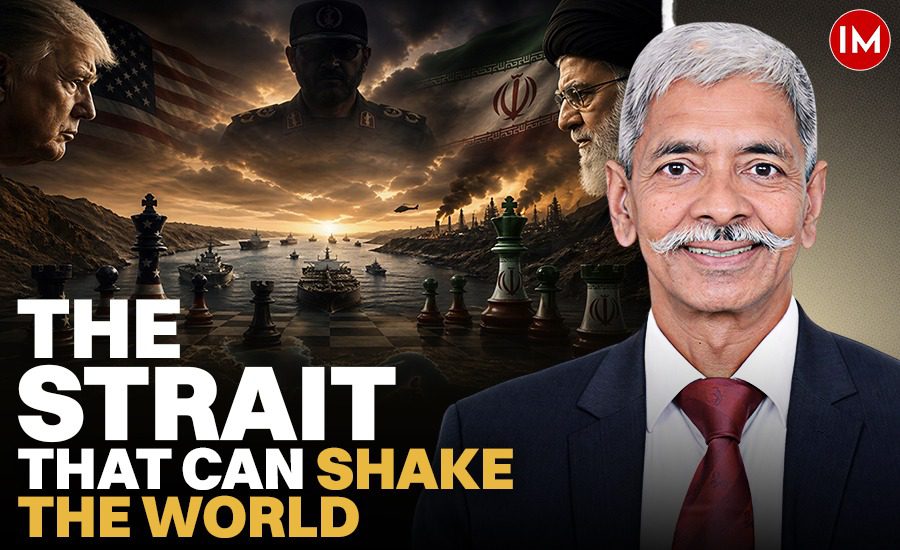
When energy pipelines remain shut, geopolitics stops being immaterial. It becomes immediate. At the petrol pumps, factories and industrial output and beyond there is a strategic anxiety. The current US– Iran deadlock sits no longer as a distant confrontation, but a systemic choke point with global consequences, one that has entered your home and kitchens.
Negotiations are not failing by accident; in fact, it is being structurally resisted.
A Conflict Without Closure
The latest round of U.S.–Iran engagements collapsed after prolonged talks, despite mediation attempts and temporary ceasefire arrangements. The U.S. position has hardened seeking a complete rollback of Iran’s nuclear capability. Iran’s response? A predictably firm “No.” capitulation, especially under pressure.
Is there no middle ground?
Possibly not as this is no longer a conventional diplomatic standoff. Instead, it is a contest between state policy and deep-state control structures inside Iran.
Also Read – Truth Behind India’s LPG Supply Strain Amid Rising Demand and Global Uncertainty
Why Israel Is Not at the Table but Still in the Room
Israel’s absence is deliberate, not incidental.
Tel Aviv is not a negotiating actor but a strategic variable. Its objective is singular: prevent a nuclear Iran at all costs being an existential threat. That often translates into preference for sustained pressure, covert operations, and calibrated escalation rather than negotiated compromise.
Will Israel accept a diluted deal? Unlikely.
Will Washington override Israeli security concerns- that is the real friction point.
Donald Trump is balancing two competing imperatives:
- Avoiding a wider regional war.
- Preventing nuclear proliferation.
Israel prioritizes the second. The U.S. must manage both.
And that divergence explains the visible absence but underlying influence of Israel in this equation.
Tehran–Moscow: Signals Beyond Optics
Iran’s Foreign Minister recent engagement with Vladimir Putin is not symbolic diplomacy. It is strategic signalling.
Three messages emerge loud and clear:
First, Iran is not isolated. It has alternative power alignments.
Second, Russia gains leverage any prolonged West Asia crisis diverts Western focus from Ukraine and also provides it economic mileage as an exporter of oil.
Third, negotiation dynamics shift. Iran negotiates from a position of external backing, not desperation.
.
Will Russia a reliable long-term balancer or just a tactical partner?
History suggests the latter. Moscow aligns when interests converge, disengages when they do not.
For now, Iran gains tactical depth but not strategic security.
The Real Power Centre: IRGC’s Battlefield Control
Not Tehran’s diplomats, not even its elected leadership, the only decisive actor is the Islamic Revolutionary Guard Corps (IRGC).
It as a parallel state; military, economic, ideological.
It remains the core and controls:
- Strategic assets.
- Proxy networks across West Asia.
- Significant segments of Iran’s economy.
- Negotiation red lines.
Sanctions, ironically, have strengthened it. By pushing economic activity underground, the IRGC has expanded its control through shadow networks, smuggling routes, and informal finance systems.
Can any deal survive without IRGC being won over. The answer is straightforward NO.
The IRGC thrives in confrontation, not reconciliation. Escalation legitimizes its dominance internally. So even if civilian policymakers agree to terms, enforcement becomes questionable and this is where the complication lies.
Hormuz: The Silent Battlefield
The Strait of Hormuz is not just geographical waypoint, it is leverage.
Nearly 30% of global energy trade flows through this narrow corridor. Disruptions here cause ripple instantly across global markets.
Nations, world over are already witnessing:
- Volatile oil prices.
- Supply chain stress.
- Insurance costs for shipping surging.
And the Global South is bearing disproportionate impact. So does India.
So, how does India shape up to this West Asia crisis. Let us analyse.
India’s Strategic Dilemma and Opportunity
India today is possibly the only nation which is uniquely positioned not because of the overwhelming expectations from the BRIC nations to EU and South Asian and African countries but because not only it is uniquely exposed but also wields much leverage.
Exposure first:
- Heavy dependence on imported energy from Gulf nations.
- Critical reliance on Gulf sea- lanes.
- Economic sensitivity to oil shocks.
Now the leverage:
- Trusted interlocutor across blocs.
- Strategic autonomy in foreign policy.
- Deep relationships with both U.S. and Israel.
- Historical ties with Iran.
- Strong political will.
India therefore is not choosing sides but preserving its options.
How long can India afford to remain a “silent stabiliser.”
Probably not anymore as energy disruption is immediate and also the clear and present risk. Industrial output, inflation, currency pressure, trade and commerce are all tied to this risk.
Should India Step In?
India may not like don the mantle of a mediator in the traditional sense. But must come forward to act a structured convenor as the leader of Global South.
Its role-play will be significant and will test its leadership skills when it undertakes
- Quiet back-channel diplomacy involving U.S., Gulf partners, and Iran.
- Leveraging platforms like G20 or Global South forums.
- Linking economic incentives (trade, infrastructure, connectivity) with de-escalation commitments.
- Reviving confidence-building frameworks around energy security
India’s credibility lies in one fact. It is not perceived as coercive.
That is a rare currency in today’s fractured geopolitical environment.
Possible End State-What Will the Deal Look Like?
A grand bargain is unlikely and we have to be realistic about it as much water has flown under the bridge.
More probable outcome is a managed compromise, built on:
- Limited Nuclear Freeze
Iran caps enrichment levels under international verification—but retains civilian capability. - Phased Sanctions Relief
Conditional, reversible, tied to compliance benchmarks. - Maritime Security Guarantees
Implicit or explicit commitments to keep Hormuz operational. - Proxy De-escalation (Partial, Not Total)
Reduction in regional hostilities but not elimination. - Back-channel Monitoring Mechanisms
Because trust deficit remains high.
This is not peace. It is controlled tension of a war zone.
Can the U.S. Prevail Over Israel?
Prevail is the wrong word.
The U.S. will attempt to align Israeli concerns within a broader framework, not override them.
That may involve:
- Security assurances.
- Intelligence-sharing guarantees.
- Strategic deterrence posture.
But if Israel perceives existential risk, it retains the option to act unilaterally.
The real equation is not control but coordination under strain.
Will the IRGC Comply?
This is the most critical uncertainty.
Reluctantly, conditionally, and reversibly.
The IRGC will evaluate:
- Economic benefits of sanctions relief
- Preservation of its internal dominance
- Strategic space to retain proxy influence
If a deal threatens its power base, compliance will be superficial.
If it strengthens regime stability, it may cooperate selectively.
Emerging Lessons for India
For India there are clear takeaways and what we must do to navigate and manage the risks that have risen due to the West Asia conflict which has been raging over the last sixty days.
Three aspects stand out distinctly,
Energy security is no longer an economic issue but a strategic doctrine.
Supply chains are not commercial they are geopolitical assets.
And influence is not declared it is exercised quietly, consistently.
India must therefore:
- Accelerate diversification of energy sources.
- Build strategic reserves with urgency.
- Expand naval presence in critical sea lanes.
- Institutionalise crisis diplomacy frameworks.
Because the next disruption may not give us enough warning time.
The Bottom Line
Wars today are not always conventional.
They may be fought through choke points, sanctions, and supply lines.
The Hormuz crisis is a confirmation that exercise of military power is no longer about dominance and preponderance alone, it can also be about control of systems and choke points.
And nations need that understand this shape outcomes and mitigate fallout risks better instead of waiting for the next war to happen.
(Colonel MV Shashidhar is an Indian Army veteran with 36+ years of leadership across combat operations, logistics, administration, and strategic planning.)
Also Read- Iran Is Weakest Now, Needs a Face-Saver