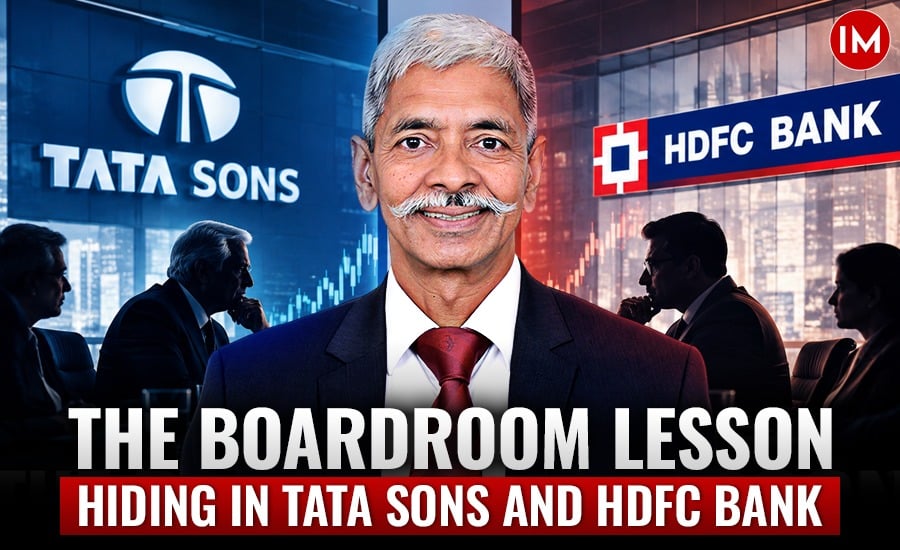
Two Chairmen. Two of India’s most trusted corporate names. Two exits, four months apart, for entirely different reasons. Put side by side, they point to the same underlying question Mint’s readers should be asking of every large promoter or trust-controlled entity in India: when a board’s decision rights are genuinely tested, who actually exercises them, and what happens when the answer turns out to be nobody?
A Chairman Removes Himself from The Race
On August 12, days ahead of a contentious annual general meeting, N Chandrasekaran resigned as chairman of Tata Sons. His term technically runs to February 2027. He chose to walk out of it early, and asked the board to begin a succession process without him in the running. The backstory matters more than the announcement. Tata Trusts-— the entity that collectively holds roughly two-thirds of Tata Sons and, per the Supreme Court’s 2021 ruling, carries protective rights over major decisions — had unanimously recommended extending his tenure for five more years as far back as September 2025. When that recommendation reached the Tata Sons board as a formal resolution on February 24, 2026, it still failed. One director withheld support. Six months of deadlock followed, with no resolution reached, until Chandrasekaran ended the uncertainty himself.
Also Read – The Mecca Pact Should Worry New Delhi, Just Not for The Reason Most Analysts Are Giving
Ten Years On, Still No Answer
This is not Tata Sons’ first brush with a Chairmanship crisis. A decade ago, Cyrus Mistry’s ouster exposed the same fault line, a promoter-trust structure with no transparent, pre-agreed mechanism for choosing or renewing its chairman, leaving the outcome to depend on trustee alignment that cannot be guaranteed in advance. Ten years and one more unresolved succession later, the group still has no publicly visible bench, no named runway, and no answer to the question that should matter most to Mint’s institutional-investor readership: who leads next, and by what process was that decided, when the entity holding the deciding vote cannot itself agree internally?
When The Exit Is About Ethics, Not Numbers
Contrast that with HDFC Bank in March. Part-time Chairman Atanu Chakraborty resigned with immediate effect, citing practices within the bank that did not align with his personal values and ethics. He offered no specifics in writing, though he later, in a television interview, pointed to how the bank had handled a regulatory lapse the Dubai Financial Services Authority had flagged the DFSA barred HDFC Bank’s DIFC branch from onboarding new clients in September 2025 over the mis-selling of Credit Suisse AT1 bonds to NRI clients, a lapse the bank’s own compliance functions had reportedly been aware of for years before it escalated. The RBI called the bank financially sound. The board said it had received no evidence of wrongdoing. None of that stopped the market: HDFC Bank’s ADRs fell 8 per cent, and the bank shed more than ₹61,000 crore in market value within the week, a striking illustration of how a governance disclosure gap, not a solvency concern, is what markets punish fastest.
One Discipline, Tested from Two Sides
In the Army, we called it a change of command — and it went further than a handover parade. Every reservation an outgoing officer held about readiness or conduct was formally logged and briefed to the successor, on record, before he walked away. Silence was never mistaken for the absence of a problem. Tata Sons shows what happens when the entity holding decision rights cannot agree on continuity. HDFC Bank shows what happens when a director’s dissent has nowhere structured to go until it becomes a resignation letter the market is left to interpret alone. Both are ownership-accountability failures in substance, one at the level of a divided trust bloc, the other at the level of a missing internal channel even though only one wore the label of a succession crisis.
The Comparison India’s Other Conglomerates Should Sit With
It is worth remembering that trust and promoter-controlled structures are not unique to Tata Sons – a meaningful share of India’s largest business houses run on some variant of the same architecture, where a family trust, holding company or promoter bloc retains decision rights over listed operating companies without itself being subject to the same disclosure discipline. Global governance codes increasingly ask a sharper question of exactly this structure: not merely whether a controlling entity exists, but whether that entity has demonstrated, through disclosed process, that it can reach internal consensus on the decisions that matter most. Tata Sons’ six-month deadlock is the clearest evidence yet that assuming such consensus, rather than testing for it, is itself a governance gap.
The Doctrine India Inc Still Owes Its Boards
Two changes deserve priority, and both are ownership-structure questions before they are board-process questions. First, entities that hold protective or controlling rights over a company’s leadership — trusts, promoter blocs, controlling shareholders should be required to demonstrate, in disclosed governance filings, that they have an internal mechanism for reaching consensus on succession before a resolution is tabled, not after it fails. Second, boards need a genuine escalation channel — a lead independent director or equivalent through which a dissenting voice can be heard and resolved internally, long before it becomes a market-moving letter. Tata Sons and HDFC Bank are not outliers. They are two of India’s most closely watched companies, and in both cases, the entity that actually held the decision rights — a trust bloc, a board without a listening mechanism was the one that failed to exercise them cleanly. Every other large Indian conglomerate structured around a similar promoter or trust bloc should read this as a warning about its own decision architecture, not merely as news about two Chairmen.
About The Author – Colonel M V Shashidhar (Retd) is a Defence & Strategic Affairs Expert, Certified Independent Director (IICA), ESG Advocate and Governance Thought Leader
Disclaimer—(The views and opinions expressed in this article are solely those of the author and do not necessarily reflect the views of Indian Masterminds. For feedback or queries, please write to [email protected].)
Also Read – Atmanirbharta 2.0: India’s Real Defence Test Begins After the Factory Gate