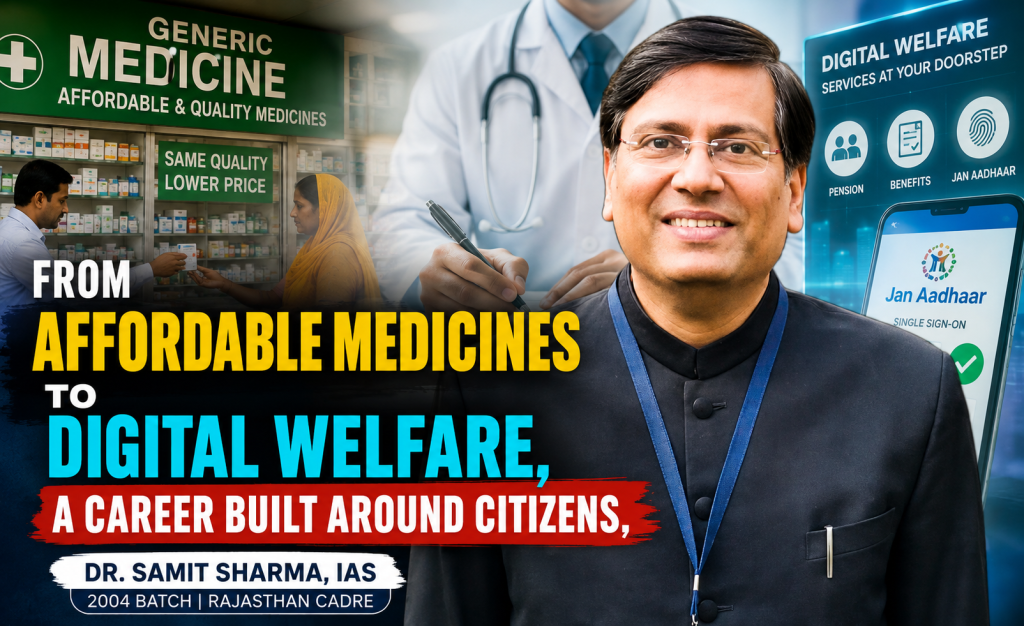
A doctor listens before diagnosing. An administrator, too, must listen before prescribing a solution.
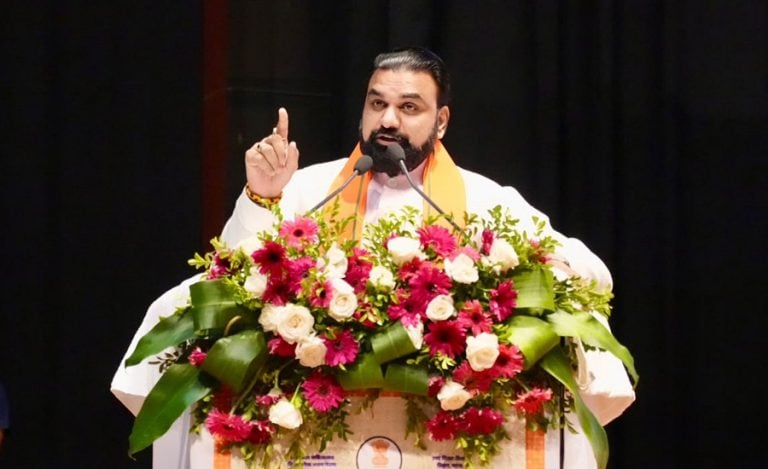
For Dr. Samit Sharma, this connection between medicine and governance has shaped a career built around one simple principle: understand the problem first, then design the solution.
A paediatrician by training, Dr. Sharma moved from treating individual patients to working on systems that affect millions of citizens. A 2004 batch Indian Administrative Service officer of the Rajasthan cadre, he is currently serving as Secretary to the Government and Registrar of the Cooperative Department, Rajasthan.
In an interaction with Indian Masterminds, Dr. Sharma spoke about his journey from medicine to administration, his experience with low-cost generic medicines, digital welfare delivery and the lessons he learnt from citizens during his field postings.
Also Read – How IFS Suraj Singh Digitised Timber Governance at Andaman’s Government Sawmill
DIAGNOSE BEFORE YOU PRESCRIBE
Dr. Sharma says his medical background continues to influence the way he approaches governance. “Medicine teaches you one thing above everything else — diagnose before you prescribe.”
As a paediatrician, he could not treat a child based on assumptions. He had to examine, test and confirm before deciding on treatment. A wrong prescription could have consequences for a real person. He carried the same discipline into administration.
When examining a welfare system, he says he does not begin by asking what solution should be introduced. Instead, he first looks at what is happening on the ground.
“Why is the medicine not reaching the patient? Why is the pension not reaching the widow on time?” he asks. For him, governance and medicine have a common purpose: reducing human suffering. Both require empathy, but empathy alone is not enough. It has to be combined with evidence.
“The stethoscope taught me to listen to the person in front of me before I designed a policy for the thousands behind them,” Dr. Sharma told Indian Masterminds.
REMOVING THE MIDDLEMAN
One of Dr. Sharma’s notable reform experiences came in 2008, when he worked on improving access to affordable generic medicines. Years later, his work in the social sector involved digital transformation and welfare delivery. On the surface, the two reforms appear very different. But Dr. Sharma sees a common philosophy behind both.
“Both reforms are built on the same idea: remove the middleman between the citizen and their entitlement and improve access to services.”
In the case of medicines, he saw an inflated, brand-driven pharmaceutical market creating a barrier between poor patients and affordable treatment. In welfare delivery, the barriers were different. Paperwork, discretion and delays could keep citizens away from pensions and other benefits.
His answer in both cases was to simplify the system. Whether it was a generic medicine shop inside a government hospital or an auto-approved pension through Jan Aadhaar verification, the objective was direct access.
“The philosophy is: make the system better for the citizen and ensure ease of living,” he said.
WHEN REFORM MEETS RESISTANCE
But reforms rarely move smoothly. Dr. Sharma learnt this while introducing low-cost generic medicine shops in Chittorgarh. The resistance, he says, came from an unexpected quarter.
“The resistance did not come from where I expected — it came from the system, based on exploitation of patients, from an ecosystem which used to reap huge financial benefits from the medicine supply chain.”
The initial rollout was slow. Adoption was limited. There was also scepticism about whether generic medicines were of sufficient quality. Some believed that poor-quality medicines were being pushed towards poor patients. The experience taught Dr. Sharma that an administrative order alone cannot make a reform successful.
“A reform cannot survive on the strength of an order alone — it survives on trust,” he said. The administration therefore worked to demonstrate quality, involve doctors and show measurable results. Patient footfall and the savings generated for citizens gradually helped build confidence.
That experience changed how he viewed resistance. “I have never treated resistance as an obstacle to route around; I treat it as a signal telling me where the trust deficit lies, and I address that first.”
LISTENING TO THE CITIZEN
Dr. Sharma’s philosophy was also shaped by his field experience as Collector and District Magistrate in Nagaur. He made himself personally accessible to citizens. Instead of allowing grievances to pass through multiple layers of the system, he preferred to hear people directly.
That accessibility earned him recognition from the print media as “Janata ka Collector.” But the title mattered less to him than what he learnt from those interactions. Again and again, citizens came to him with problems that were not extraordinary. They were asking for things that were already legally theirs.
The problem was that the system had made access unnecessarily difficult. That observation became one of the strongest lessons of his administrative career.
“The biggest failure of governance is not the absence of good schemes, it is the distance between a good scheme on paper and actual public service delivery to the citizens,” Dr. Sharma told Indian Masterminds.
FROM SCHEMES TO ACTUAL DELIVERY
For Dr. Sharma, good governance therefore cannot be measured simply by the number of schemes announced or orders issued. The real test is what happens after a scheme reaches the citizen.
Does the pension arrive on time? Can a poor patient afford the medicine? Can a beneficiary access an entitlement without repeatedly proving their eligibility? Can a citizen approach the administration without navigating unnecessary layers? These questions connect his experience as a doctor with his work as an administrator.
His career reflects a gradual shift from treating individual problems to improving systems. Medicine taught him to observe carefully, listen closely and avoid assumptions. Public administration gave him the opportunity to apply those lessons at scale.
Today, as Secretary to the Government and Registrar of the Cooperative Department, Rajasthan, Dr. Sharma continues to carry that citizen-first philosophy into governance.
His journey offers a simple lesson: policies may be designed in offices, but their success is ultimately decided in the lives of ordinary people.
And sometimes, the best way to understand governance is to approach it like medicine — listen first, diagnose carefully and then prescribe.